


Before the Valley Widens
By Sidonie Morel
Day 1 — Leaving Leh by Public Bus
The old bus stand and the weight of the roof
Leh’s old bus stand is not built for farewells. It has no clear edge, no threshold that marks the moment of departure. Instead, it operates as a holding space where people, goods, and intentions wait in loose proximity. Buses sit with engines off, their sides streaked with dust from earlier routes. Men move between piles of grain sacks, metal trunks scarred by travel, and bundles wrapped in blue plastic, tightening ropes with a practiced rhythm. What cannot fit inside is negotiated upward, onto the roof, where weight is distributed carefully, as if the balance of the vehicle depends on social agreement as much as physics.
Passengers claim seats without ceremony. A body leaning against a window is enough. The fare is paid in cash, noted in a small book, the transaction already receding into routine. There is no sense of anticipation in the air, no murmured excitement about what lies ahead. This bus does not carry tourists toward a promise. It carries continuity—supplies for villages, workers returning after short contracts, families moving between seasonal obligations.
When the driver finally sits, nothing else happens. No call, no signal. A few small adjustments resolve themselves: a bag nudged into place, someone stepping down from the footboard. The bus eases forward, and Leh loosens its hold without comment. The road narrows almost immediately. Outside the windows, the valley opens in measured increments, as if unwilling to reveal itself all at once. The bus does not hurry. Stops occur where they are required, not where they are scheduled. Time begins to follow need rather than design.
Checkposts and quiet approval

Several hours into the journey, the bus slows at a checkpoint. Papers are passed forward. Names are compared, a stamp pressed onto a page. The exchange is efficient and unremarkable. No one looks up for long. Movement here is not assumed; it is acknowledged and allowed. Once the documents are returned, the bus rolls on, the interruption absorbed into the rhythm of travel.
Beyond the checkpoint, the road traces the river closely, pressed between rock and water. The landscape grows less descriptive. Color drains away, leaving variations of pale stone and dust. Zanskar is still distant, but its conditions are already present: patience, adjustment, and the acceptance that passage is always provisional.
Day 2 —Akshu and the Road That Refuses Ease
Drang-Drung Glacier from a distance

The Drang-Drung Glacier comes into view without announcement. It sits beyond the road, distant and immobile, its mass difficult to judge against the surrounding rock. There is no designated stopping point, no sign directing attention. The bus slows only because the road demands it, negotiating a series of tight switchbacks that descend toward a small, uneven lake.
Below the road, the remains of a vehicle lie at an angle, partially covered by debris. There is no marker, no explanation. The wreck has become part of the landscape, absorbed into the slope. Its presence is not dramatic, only instructive. Infrastructure here is a fragile agreement, renewed daily by use and circumstance.
The glacier remains in view for several minutes, then slips behind a ridge. No one remarks on its disappearance. The bus continues, the moment passing without ceremony.
Morning mist and barren slopes
Akshu appears in the morning under a dense layer of fog. The village does not resolve itself fully. Stone walls emerge first, then the suggestion of roofs, then doorways that lead into opacity. The bus pauses briefly. There is no market activity, no visible exchange. Life here continues inward, shielded from display.

Once past the village, the terrain becomes increasingly austere. Slopes are stripped down to their mineral surfaces, fractured into loose plates of rock. Vegetation is sparse and low, offering no interruption to the monotony of pale ground. The road cuts across this surface without confidence. In places, it narrows to a single lane, its edges softened by erosion. This is not a road meant to reassure. It exists as long as conditions allow.
The bus moves steadily, its progress shaped by caution rather than speed. Each bend reveals another stretch of exposed hillside. The sense of isolation deepens not through distance, but through repetition. There is little to distract the eye. Attention turns inward, following the rhythm of movement.
Day 3 — Zongkhul monastery
Arriving by truck bed
Beyond the main road, progress becomes improvised. A truck heading toward Tungri village offers space in its open bed. Cargo is rearranged to make room, and the climb begins at a measured pace. The ride is punctuated by stops—sometimes to allow oncoming vehicles to pass, sometimes to adjust a load that has shifted.
Plans adapt quietly. A meeting arranged earlier does not take place; work elsewhere has intervened. The change requires no explanation. Movement here follows availability rather than intention. Vehicles, people, and time align when they can, and when they do not, the adjustment is accepted without complaint.
Red robes against white stone
Zongkhul monastery sit directly against pale rock, their structures integrated into the cliff face. The stone reflects light sharply, broken by the deep red of monks’ robes moving across the courtyard. The contrast is precise rather than theatrical.

These are not spaces arranged for observation. Repairs are underway, tools stacked against walls. Footsteps echo briefly, then dissolve into the open air. Monks move between tasks with the economy of people accustomed to working within constraints. The monastery function as anchors—places where daily life is organized and sustained—rather than as destinations designed to impress.
Day 4 — Padum, the Unusually Wide Plain
A basin that feels excessive
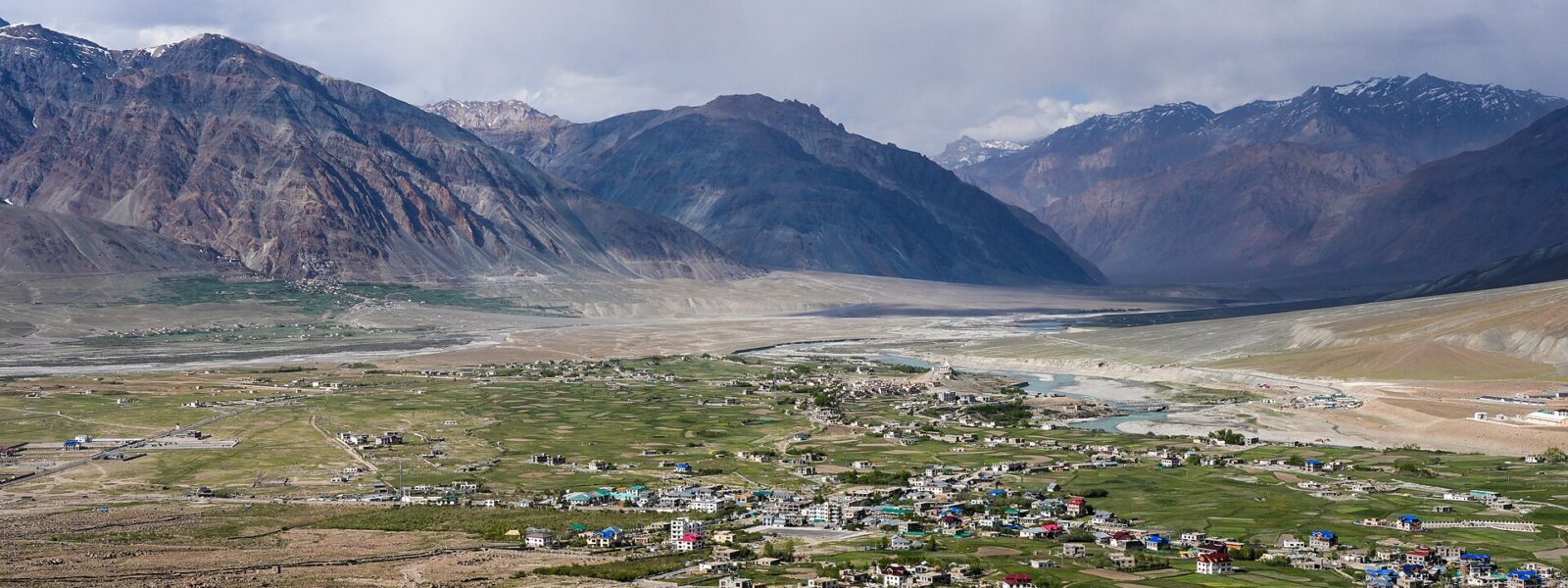
Approaching Padum, the landscape opens abruptly. After days of narrow passage, the basin feels almost excessive in its width. The plain stretches outward, flattening sound and distance. The bus seems smaller here, its movement diluted by space.
Tungri Gompa passes briefly on one side, its form outlined against open ground. The plain absorbs it quickly. The scale of the basin alters perception. Distances appear shorter than they are, while time seems to loosen its grip. Padum does not assert itself as a center. It accommodates.
Closed shops and a town that isn’t performing
In the bazaar, many shops remain closed. Shutters are pulled down, their paint faded by sun and dust. Those that are open operate without emphasis. Goods are arranged simply, transactions completed without negotiation. There is no effort to present the town as lively or complete.
A familiar traveler appears briefly, a reminder of earlier routes intersecting again. The visit to Stakrimor Gompa unfolds without urgency. The palace stands nearby, visible but unaccented, its outline present without insistence. Padum offers no narrative of arrival. It continues on its own terms.
Day 5 — Walking Toward Karsha
Crossing the plain on foot
The walk toward Karsha begins along the road, shared intermittently with passing vehicles. Conversation fades quickly. Distance is measured through repetition: steps, breath, the unchanged horizon. The plain offers little variation, encouraging attention to settle into rhythm.
A vehicle stops without prompting. The offer of a ride is made with a gesture rather than words. It is accepted in the same way. Movement resumes, the transition absorbed without remark.

A monastery clinging to rock
Karsha Gompa rises vertically from the hillside, its structures layered and irregular. From below, its scale becomes clear. The monastery appears to grow directly from the rock, adapting its shape to the surface rather than imposing one.
Below, a river cuts through the valley, crossed by a narrow bridge. The arrangement of water, stone, and built form feels resolved through long adjustment. Nothing appears ornamental. Everything serves.
Day 6 — Dorje Zong and the Old Palace
Descending toward water
From Karsha, a narrow path descends toward the valley floor. The surface is uneven, requiring attention to footing. At the base, a clear stream runs cold and fast, its movement precise. Crossing to Dorje Zong is an exercise in balance rather than speed.
Inside the nunnery

Dorje Zong functions as a nunnery. Hospitality is offered in a small room, furnished with necessity rather than comfort. A meal is prepared—momos, vegetables, instant noodles—served without ceremony. The exchange is practical, unadorned, shaped by routine rather than performance.
Images that do not fit categories
Inside the main hall, figures with multiple faces occupy the space. Their forms resist simple classification. The impression is of layered histories, preserved without explanation or emphasis. Belief here does not resolve into a single line. It accumulates.
Departure — Padum Without Resolution
The valley does not conclude
Leaving Padum offers no sense of closure. The road resumes its earlier pattern, neither improved nor diminished by return. Scenes remain discrete, unassembled into lesson or summary. Zanskar does not present itself as an experience to be completed. It remains in motion, continuing beyond the limits of observation.
Sidonie Morel is the narrative voice behind Life on the Planet Ladakh,
a storytelling collective exploring the silence, culture, and resilience of Himalayan life.