
When the High Cold Desert Turns, Briefly, to Colour
By Sidonie Morel
The Season of Small Miracles
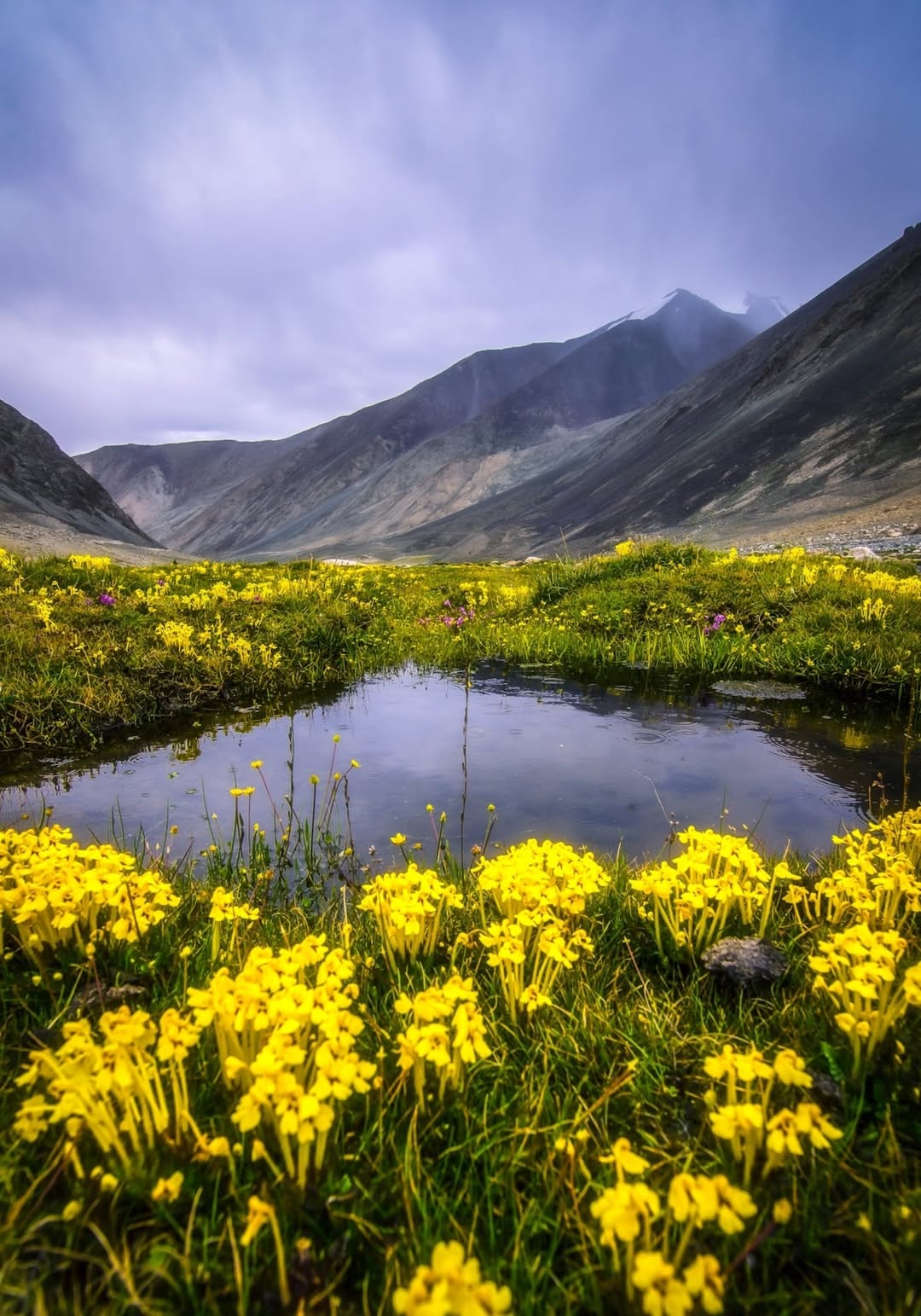
The first petals after the long hold of winter
In Ladakh, spring does not arrive as a softening. It arrives as permission. Snow loosens its grip in small negotiations: a darker patch of earth at the base of a stone wall; a thread of meltwater running where yesterday there was only grit; a slope that stops shining and begins to look, again, like ground. The air still has its clean edge. In the mornings, water freezes in shallow trays. By midday, it runs in narrow, impatient lines, and by evening it slows, as if reconsidering.
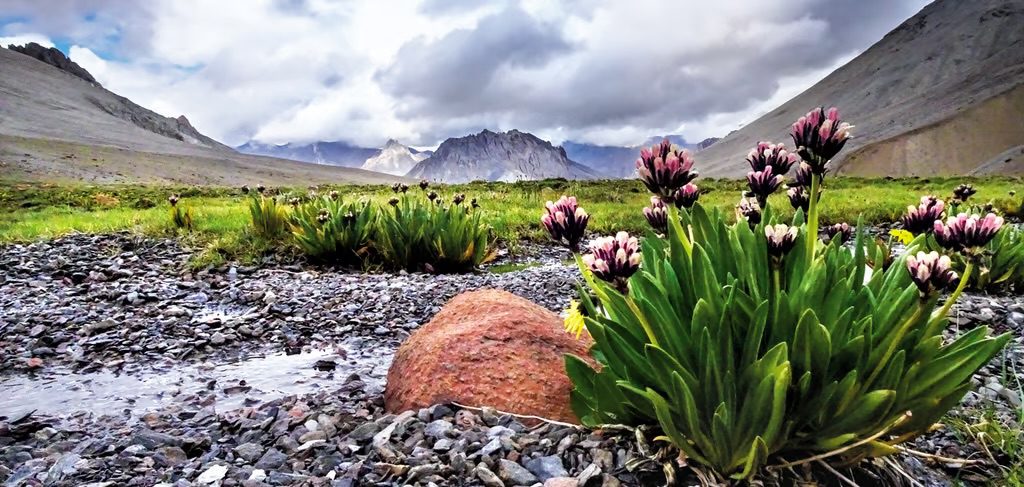
Wildflowers in this high cold desert appear in the same spirit: not as decoration, but as evidence that the season has shifted enough for life to risk itself above the surface. The first blooms can be so low you nearly miss them. A small tuft close to a boulder, a scatter of colour no larger than a coin, a cluster tucked beside a trickle that will vanish by afternoon. Their scale changes your pace. You stop looking “at” the landscape and start looking “into” it.
European summers train us to expect abundance, and to read the countryside from a distance: fields, hedges, slopes. Ladakh asks for a different kind of attention. The light is direct, the ground is spare, and the flowering season is short enough to feel like a borrowed interval. High-altitude plants know this. They keep their stems compact, their leaves close, their blooms efficient. They do not grow for spectacle. They grow to complete a cycle before the weather changes its mind.
July and August: a brief window written in meltwater
Talk to anyone who walks or works outside—drivers, shepherds, women carrying bundles of grass, a gardener turning soil in a small courtyard—and you’ll hear the same practical timeline. The weeks that matter are the weeks after the thaw has become reliable and before the nights begin to bite again. In many parts of Ladakh, that means mid-summer: July and August, sometimes stretching into early September depending on altitude and exposure. The flowering is rarely a single wave. It moves in pulses, linked to water that appears and disappears.
Meltwater is the real calendar here. It comes down off shaded gullies and snowfields, spreads into shallow braids, and sinks fast into gravel. It collects where the land allows it: at the edges of streams, in depressions near springs, along irrigation channels cut and maintained by hand. These are the places where you find a denser scatter of blooms—where a plant can afford to lift a flower because its roots have access to moisture for a few more days.
What makes Ladakh’s wildflowers striking is not only their colour but their context. A pale pink primula near a cold wet margin, a yellow bloom at the seam of dust and damp, a violet tucked beside a stone that radiates warmth late into the day—each one is a signpost to the microclimate that produced it. Field guides and checklists can give you names and families, but the lived lesson comes from watching where the plant has chosen to survive: the lee of a rock, the edge of a seep, the thin strip beside a footpath where water occasionally pools.
Reading the Ground Like a Map
Scree, river edges, and the quiet geometry of survival
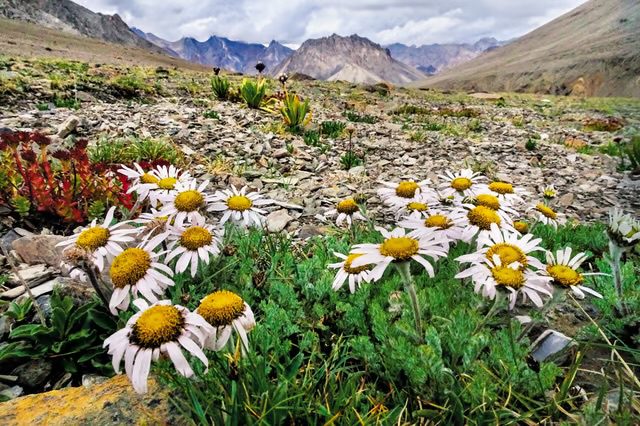
Ladakh’s terrain makes its own rules about where plants may exist. A scree slope looks like pure movement—stones sliding, dust shifting—yet it contains pockets of stability where finer soil gathers. River edges can be deceptive: the bank may be green for twenty metres and then become bare again, the moisture stolen by wind or drained by gravel. Alluvial fans spread like open hands below side valleys, their surfaces patterned with old channels and fresh scars. From a distance, these features read as geology. Up close, they become botany.
Walking slowly through such ground is less romantic than it sounds. Your boots fill with dust. The sun, even when the air stays cool, feels close. Wind picks up without warning, carrying grit that finds your eyes and the corners of your mouth. The practical result is that you learn to scan for shelter: a low ridge, a stand of scrub, the shadow of a wall. Plants do the same. You begin to notice how often a flower appears where something else breaks the wind for it—an eroded lip, a stone terrace, a pile of rubble at the edge of a field.
High-altitude flora is often described in terms of hardiness, but “hardy” can sound like a compliment given from comfort. A better word is economical. Many alpine and cold desert plants grow close to the ground not only to resist wind, but to hold a small layer of warmer air around their leaves. Their roots are less a single anchor than a network designed to make the most of brief moisture. In places where soil is thin, a plant may live in the space between stones, using shade and trapped silt the way a city plant uses a crack in pavement.
Wetlands and high lakes: life gathered at the margins
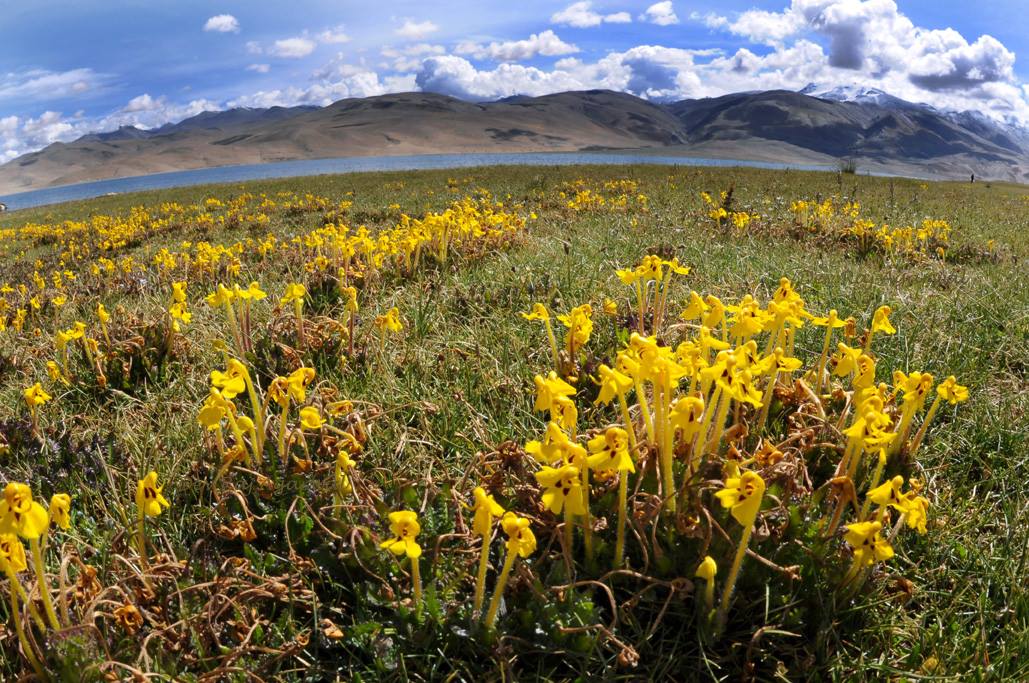
When you reach a high-altitude wetland or lake edge, the change is immediate. The air is often cooler. The ground, instead of crunching dry underfoot, begins to give slightly. The smell shifts too: less of dust and more of something faintly vegetal, even when the vegetation is still low. Birds appear in greater number. You see more insect movement close to water. And the plant life responds with a kind of concentration, as if everything that can grow has learned to gather where water lingers.
These wetlands matter not only for flowers but for how Ladakh holds itself together as a lived place. They feed grazing grounds and support birds, and they act as reservoirs of moisture in an environment that is otherwise quick to dry. Studies of high-altitude wetlands in the region make this plain in a scientific way—species lists, families counted, distribution patterns mapped—but you feel it in the simplest observation: the edge of water is where colour can afford to last.
A lake like Tso Moriri is often spoken of for its openness, for the long band of blue against pale slopes. Yet if you want to understand wildflowers here, you don’t stand back. You move to the margins—the shallow inlets, the wet patches near springs, the places where sedges and grasses can take hold. That is where you might find primulas and other moisture-loving blooms, small and deliberate, holding their petals above a cold substrate that never fully warms.
Along the Wetlands, the Colour Deepens
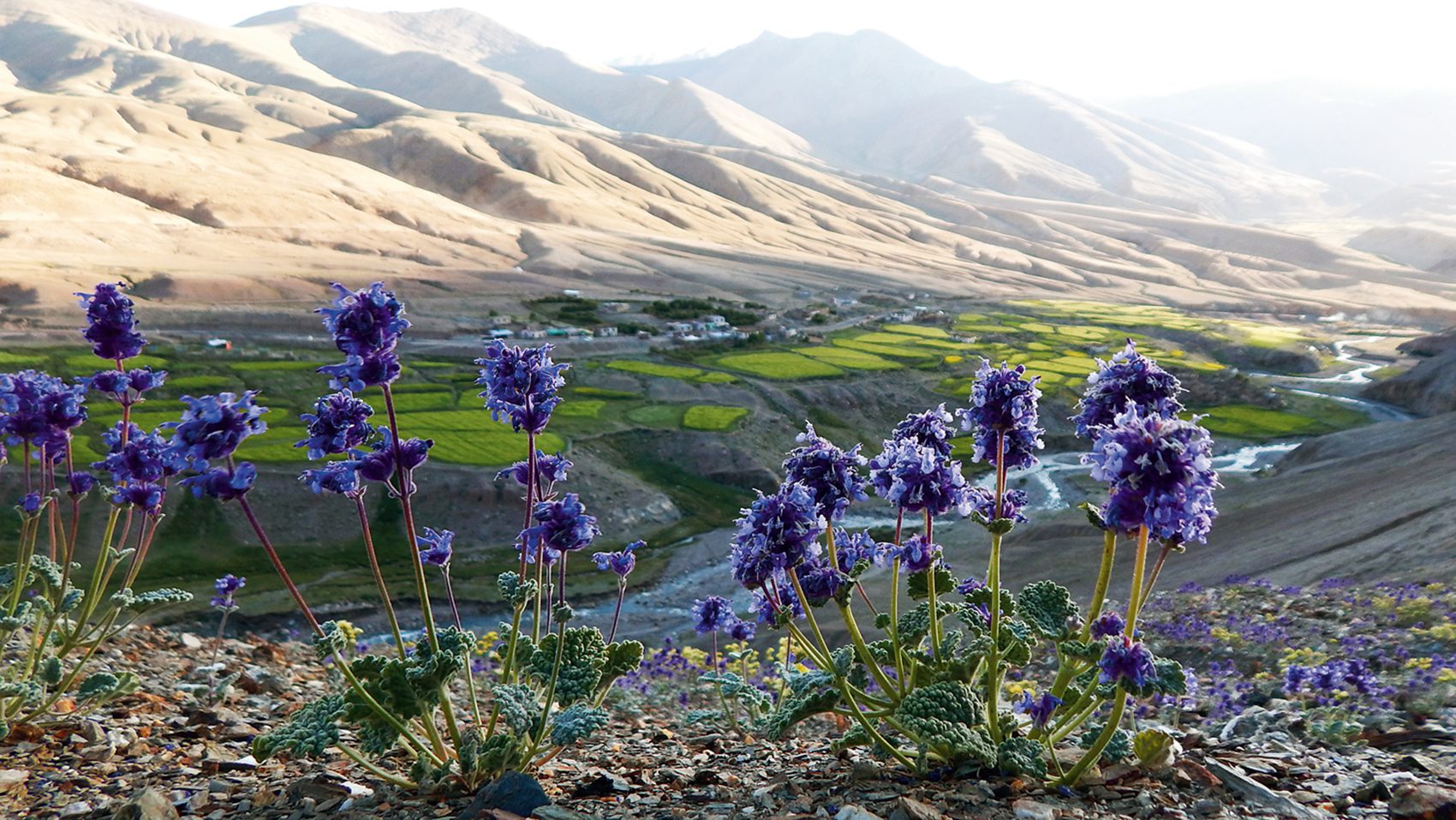
Morning at the lakeside: sound, light, and the patience of edges
At a wetland edge early in the day, the light arrives cleanly, without the soft haze you might know from lower altitudes. Shadows are crisp. The water has a different sound than a lowland river: less continuous rush, more a set of small movements—lapping, trickling, a brief splash when a bird drops in. If there is frost on the ground, it melts unevenly, leaving a pattern of damp and dry patches like a map drawn by temperature.
You can spend an hour in a space no larger than a courtyard and see more variety than you expected. The trick is not to walk through it too quickly. Wildflowers here can be small enough to disappear when you stand. You need to crouch, to let your eyes adjust to scale. Then you notice the differences in leaf shape, the way one plant forms a tight rosette while another sends up a thin stem, the way some blooms sit almost on the soil while others lift themselves a few centimetres higher, as if to catch an extra degree of warmth.
In photographs, it is tempting to isolate a flower from its surroundings—to make it seem as though it grew in a studio. But the real interest is often the relationship between the bloom and everything around it: damp sand, cracked mud, a strand of grass, a pebble embedded like a nail. The wildflower is part of a working edge. It shares space with grazing routes, with footpaths, with the occasional tyre track when a vehicle comes too close to the water. The wetland is not a sanctuary sealed off from life. It is one of the places where life concentrates, and therefore where pressure also gathers.
Herbs, Hands, and Mountain Kitchens
Foraging as a domestic practice, not a performance
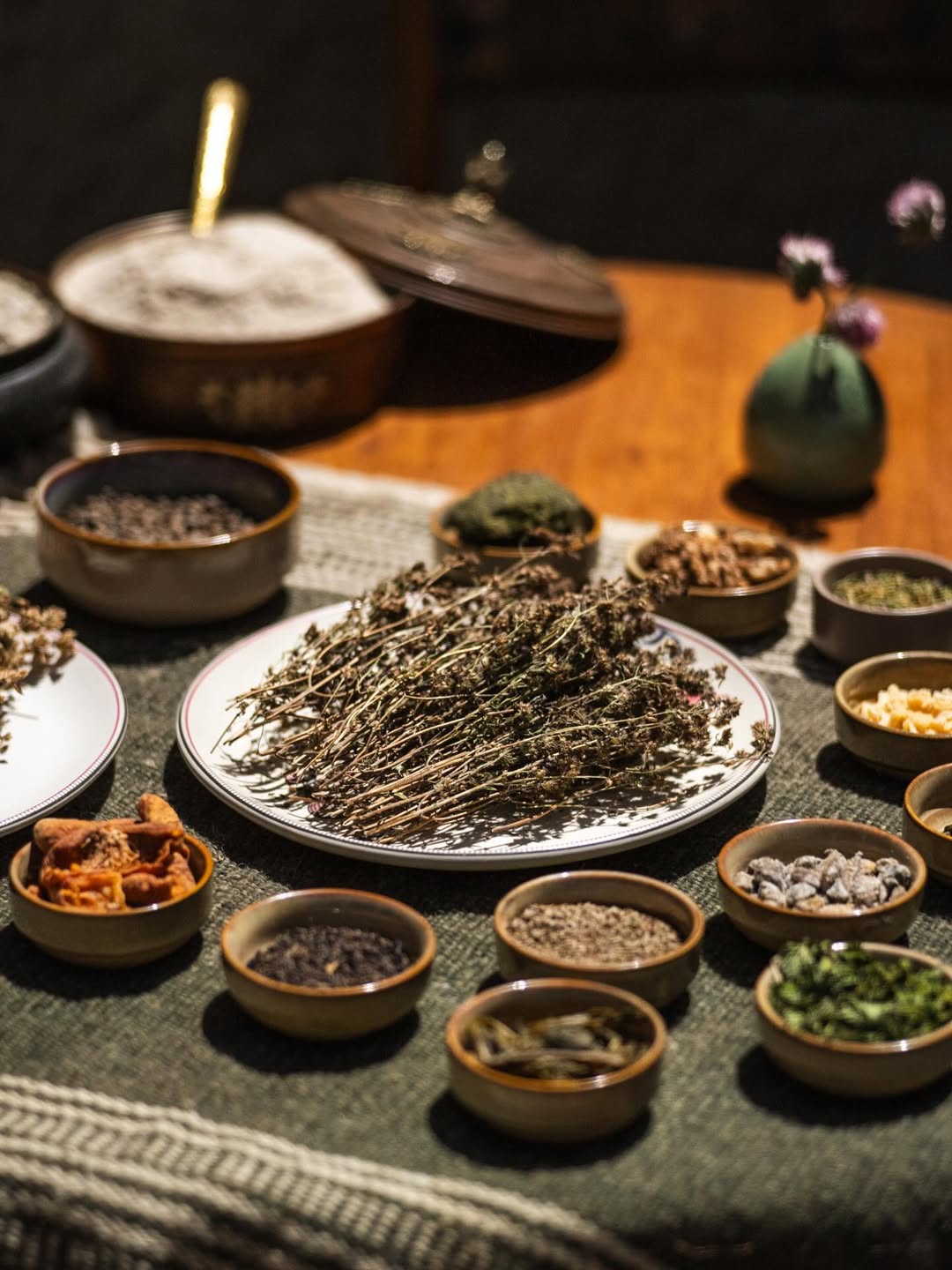
If you stay long enough in a village, wild plants stop being something you “spot” and start being something you hear discussed in passing. A handful of leaves brought in with fodder. A stem used for flavouring. A plant dried and stored because it has a particular role when the air turns colder or when someone has a cough that won’t settle. The language around these plants is often practical, threaded into everyday decisions the way Europeans talk about oil, vinegar, salt—things that are simply there, part of a household’s working knowledge.
Ethnobotanical research in Ladakh makes clear how wide this knowledge can be: plants used for medicine, for food, for ritual, for fuel, for dye. On paper, it reads like a catalogue. In life, it appears as routine. Someone knows where a certain herb grows—near a spring, on a particular slope, in a patch of ground that stays damp longer than it should. Someone knows the right time to collect it, the part to take, the part to leave, the way to dry it without losing what matters. This is not the language of “wellness.” It is the language of living with limited resources in a climate that does not allow carelessness.
In summer, drying happens everywhere. Clotheslines carry laundry and, sometimes, bunches of plants. Flat roofs become work surfaces: grain spread to dry, apricots laid out, herbs arranged carefully in the sun. The smell is a mixture of dust, fruit, smoke, and crushed green. If you are writing about wildflowers, this matters. It keeps the subject from floating away into pure aesthetics. Flowers and herbs are not separate worlds here. They are different faces of plant life, seen through different needs.
Names, Stories, and the Limits of Knowing
Local words, Latin names, and the discipline of attention
There is a particular moment that comes with field guides. You lean over a plant, compare leaf shapes, count petals, look for the arrangement of stems. You find a likely match. You learn a name. The name is useful—it allows you to cross-reference, to read more, to place the plant in a larger family. It also changes your relationship to what you are seeing. The flower stops being anonymous. It enters a shared vocabulary.
But naming can also become a kind of hunger. The temptation is to identify everything, to turn a walk into a checklist. Ladakh, with its compact flowering season and its intense light, makes that temptation sharper. There are not endless fields. There are clusters and pockets, the sense of rarity, the awareness that you might not see this again until next year. The impulse is to capture, to record, to pin the moment down with a label.
Restraint is part of the practice. Many local plant names carry information that Latin names do not: hints about use, taste, location, or a story attached to a place. Some plants are known by what they do rather than what they “are.” If you are a visitor, you may not be given those names easily—not out of secrecy, but because knowledge is earned through time and trust. The most honest approach is to let the limits remain visible. You can describe what you see—the texture of a leaf, the colour of a bloom, the dampness of the ground around it—without forcing the scene into an encyclopaedia entry.
Fragile Abundance
Grazing routes, collecting pressure, and the quiet economics of “useful plants”
In mid-summer, when the ground is finally giving something back, the landscape is busy. Animals move along familiar routes. People cut grass and carry it in loads that look heavier than they should be. Vehicles travel between villages and markets. In this working season, wildflowers exist in the same space as livelihoods. They are stepped around, grazed near, sometimes collected, sometimes left.
Conversations about medicinal plants in the region often turn, sooner or later, to pressure. Demand for certain “useful” plants can travel far beyond a village. What is gathered for household use can become something gathered for sale. Once money enters the picture, the scale changes. Researchers documenting medicinal plant use and availability in Ladakh have noted concerns familiar in mountain regions everywhere: overharvesting, habitat disturbance, and the vulnerability of slow-growing species in a short season.
Yet the story is not only one of loss. There are also efforts shaped by local participation: mapping where certain plants grow, discussing community rules, prioritising conservation of particular species and patches of habitat. In practice, this can look modest—meetings, shared knowledge, a decision not to collect in one area for a season. The impact is not always visible to a traveller. What you can see, if you pay attention, is the logic behind it. In a cold desert, regeneration is not quick. A trampled wet margin does not simply spring back. A plant removed at the wrong time may not set seed. The vulnerability is built into the climate.
Walking Slowly Enough to See
A small ethics of attention: distance, patience, and leaving the moment intact
It is easy to talk about respect for nature in broad terms. It is harder, and more useful, to describe what that respect looks like in the body. In Ladakh, it begins with where you put your feet. A flowering patch by a seep can be small enough that one careless step changes it. The ground may look durable because it is made of stone, but the living parts are often held in thin layers: a little soil, a little moisture, a little shelter. The difference between a flower surviving and not surviving can be the difference between a boot landing two centimetres to the left or the right.
Patience is a kind of practicality here. If you wait, the wind settles. If you crouch and hold still, you see more: the insect movement, the way petals respond to light, the subtle colour differences between two blooms that looked identical at first. If you stay on a path instead of cutting across a wet edge for a photograph, you leave something intact not only for the next visitor, but for the plant’s own next stage—seed, dormancy, return.
The most enduring images of Ladakh’s wildflowers are often not the close-up portraits. They are the ones that keep the setting present: a small bloom at the base of a rock, with dust on its leaves; a scatter of colour along an irrigation channel, with the sound of water moving through a stone-lined groove; a flower near a pasture edge, with hoofprints in the damp ground beside it. In these scenes, the wildflower is not a symbol. It is a living detail in a landscape that works hard, season after season, to keep living possible.
a storytelling collective exploring the silence, culture, and resilience of Himalayan life.