

Where the Valley Teaches You How to Cross Into Silence
By Declan P. O’Connor
I. Sankoo — The Meadow Where the Journey First Breathes
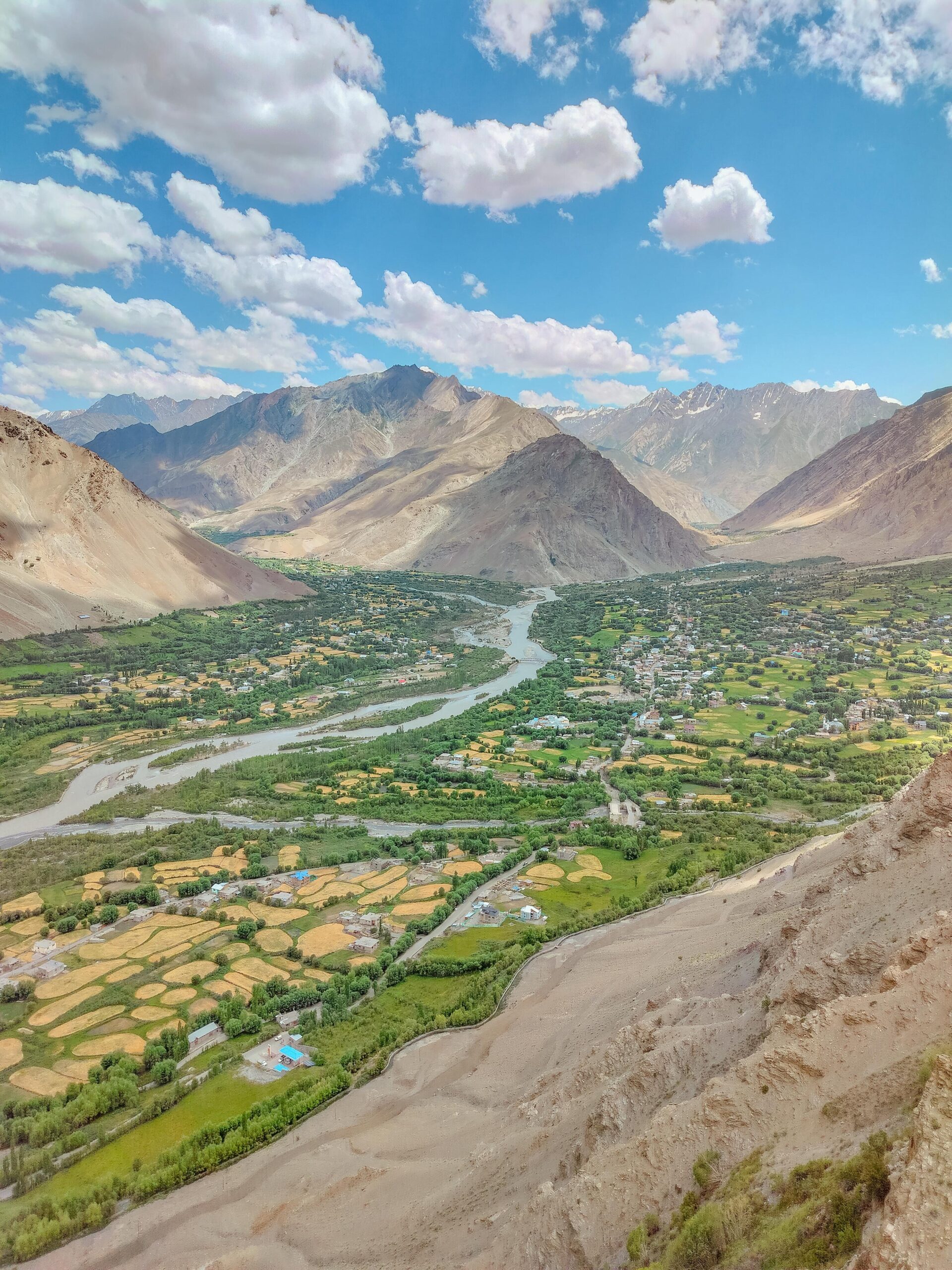
Sankoo is the sort of village that appears not as an introduction but as a gentle reassurance that the road ahead will reveal itself in its own time. The Suru River widens here, softening the valley into a broad basin where poplars line the fields, and barley terraces shimmer in the morning wind. European travelers often expect the Himalayas to declare themselves suddenly, with a sort of theatrical grandeur, but Sankoo teaches a quieter truth: mountains often begin with meadows, and drama begins with restraint. As you walk along the irrigation channels, you see how the families of Sankoo have, for generations, negotiated this interplay of abundance and exposure. It is a place that carries the fragrance of apricot orchards and the faint murmur of the mountains forming their first arguments in the distance. Conversations with villagers tend to unfold slowly, usually over salted tea, and with a quiet sense of mutual curiosity. At the same time, the geography hints at the transitions to come. The Suru–Zanskar Transitional Corridor begins to whisper through the narrowing topography, through the firmer ridgelines that flank the village, and through the slow shift in architectural rhythms as wooden frames gradually concede to stone. Sankoo’s beauty lies in this duality — it is both a sanctuary of green and a ceremonial threshold, a place where the valley gathers its strength before leading travelers into more demanding altitudes. And if one pays attention, this is where the psychological map of the journey begins: a soft beginning that teaches you to observe, to slow down, and to understand how landscape shapes memory long before it shapes altitude.
II. Panikhar — Where the Valley Tightens and the Wind Learns a Sharper Tone
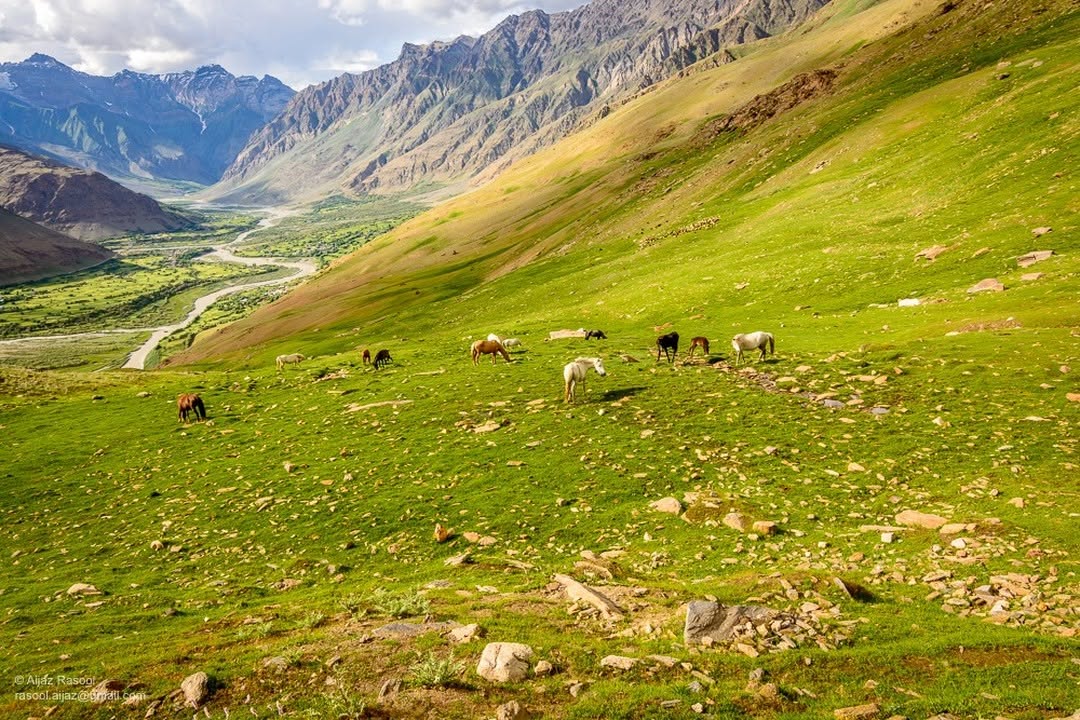
Panikhar is the moment when the Suru–Zanskar Transitional Corridor begins to step forward with a firmer voice. The fertile expanses around Sankoo yield to a more dramatic convergence of stone, river, and glacial air. The village sits beneath towering ridges whose shadows move across the barley fields like slow, deliberate brushstrokes. Here, the landscape becomes more architectural, narrowing into a corridor that feels carved rather than grown. The winds arriving from the higher reaches are colder, carrying hints of the icefields that loom above the valley. Travelers often remark on how Panikhar feels both intimate and monumental — a place where shepherds still guide their flocks across ancient routes, yet where the mountains rise in a way that demands a more deliberate contemplation. The cultural shift is also noticeable: linguistic transitions soften, and the village’s stories begin to blend Balti influences with the philosophical cadence of the Buddhist world waiting further ahead. In the evenings, the sound of flowing water becomes sharper, echoing off stone houses that have adapted to the narrowing valley. For those continuing toward Zanskar, Panikhar often marks the moment when anticipation turns into humility. The road grows steeper, the river grows louder, and the sense of distance from city life grows more profound with every bend. It is a place where the first real silence arrives — not the absence of sound, but the arrival of a deeper register of landscape that begins to speak beneath the surface of travel itself.
III. Penzi La — A High Pass of Glacial Memory, Statso/Langtso, and the First True Threshold of Zanskar
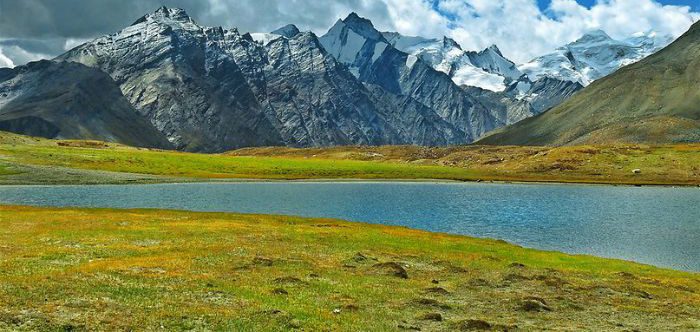
Crossing Penzi La is not merely a geographical shift but an existential one. The ascent begins with a tightening of the air, the valley falling away until only the raw bones of the mountains remain. Glacial tongues descend toward the road with a severity that feels ancient, as though the landscape has not yet fully decided whether to welcome travelers or test them. The Statso and Langtso twin lakes appear like forgotten mirrors placed high above the valley floor, their surfaces reflecting the pale blue light that defines these altitudes. They are not lakes that simply “sit” in the landscape — they articulate it, giving shape and silence to the pass. The air at Penzi La feels older, thinner, more deliberate. The Suru–Zanskar Transitional Corridor becomes a lived sensation here, as if the valley itself pauses to acknowledge that one world is ending and another is about to begin. The glaciers, fractured and luminous, seem to breathe in long intervals, whispering a geological patience that human travelers can rarely match. For many, the emotional shift is immediate: Zanskar feels close, not because of proximity but because of a certain spiritual gravity that begins to settle around the pass. Even the dust moves differently here, swirling in small cyclones that seem to sketch invisible maps in the air. Penzi La is a border not marked by authority, but by memory — a place where the green certainties of Suru dissolve into the ochre vastness of Zanskar’s interior.
IV. Akshu — The Quiet Opening Notes of the Zanskar Interior

Akshu is the first village that feels unmistakably “Zanskari” in its stillness and architectural posture. The houses, built more compactly and with heavier stonework, seem designed not just to withstand winter but to negotiate its philosophy. The wind turns sharper, carrying dust and fragments of ancient trade routes. While Akshu is small, it functions as a psychological landing after Penzi La’s starkness. Travelers often pause here longer than expected, finding themselves drawn into the cadence of village life — the slow pacing of livestock returning from the fields, the muted conversations of families preparing for evening, the distinct dryness in the air that announces the plateau’s presence. The cultural transition deepens: prayer walls appear more frequently, stupas rise from unexpected corners, and the silhouettes of distant gompas begin to punctuate the horizon. What distinguishes Akshu most, however, is its narrative function within the corridor. It offers the first tangible sense of Zanskar’s resilience, of a life negotiated not through abundance but through rhythm and adaptation. The fields are smaller, the streams thinner, yet the sense of community feels denser. Akshu teaches travelers that Zanskar is not a place of dramatic gestures alone, but also of subtleties—a world shaped by small decisions, quiet adjustments, and the enduring human impulse to create shelter in the shadow of mountains.
V. Phey — The Cliffs of Silence and the Caves of Dzongkul Gompa

Phey is where stone becomes narrative. The cliffs rise with a deliberate severity, narrowing the valley into a stone corridor that feels as if it has been carved for meditation rather than habitation. Dzongkul Gompa, the famous cave monastery associated with revered yogic masters, is not simply perched along these cliffs — it emerges from them, as if the rock itself had once softened to allow the carving of these meditative chambers. Inside the caves, the air hangs still, carrying a faint residue of centuries of chanting. The walls bear impressions of ancient soot, stories whispered in the flicker of butter lamps, and the philosophical quiet that clings to monastic spaces in the Himalayas. Travelers who come here expecting spectacle often find something else entirely: an intimacy that resists photography and narration. The monks of Dzongkul speak softly, aware that the landscape has already said most of what needs saying. The village of Phey below mirrors this contemplative tone — fields arranged in careful geometry, paths that run close to cliff edges, and clusters of houses shaped by the logic of wind and winter. It is a place where the Suru–Zanskar Transitional Corridor becomes personal. The cliffs, the monastery, the silence — all of these shape not just the journey but the traveler’s internal landscape. To understand Phey is to understand that some parts of Zanskar are not meant to be conquered or even “visited,” but witnessed with humility.
VI. Su — The Gentle Fields and the Ancient Calm of Sani Monastery
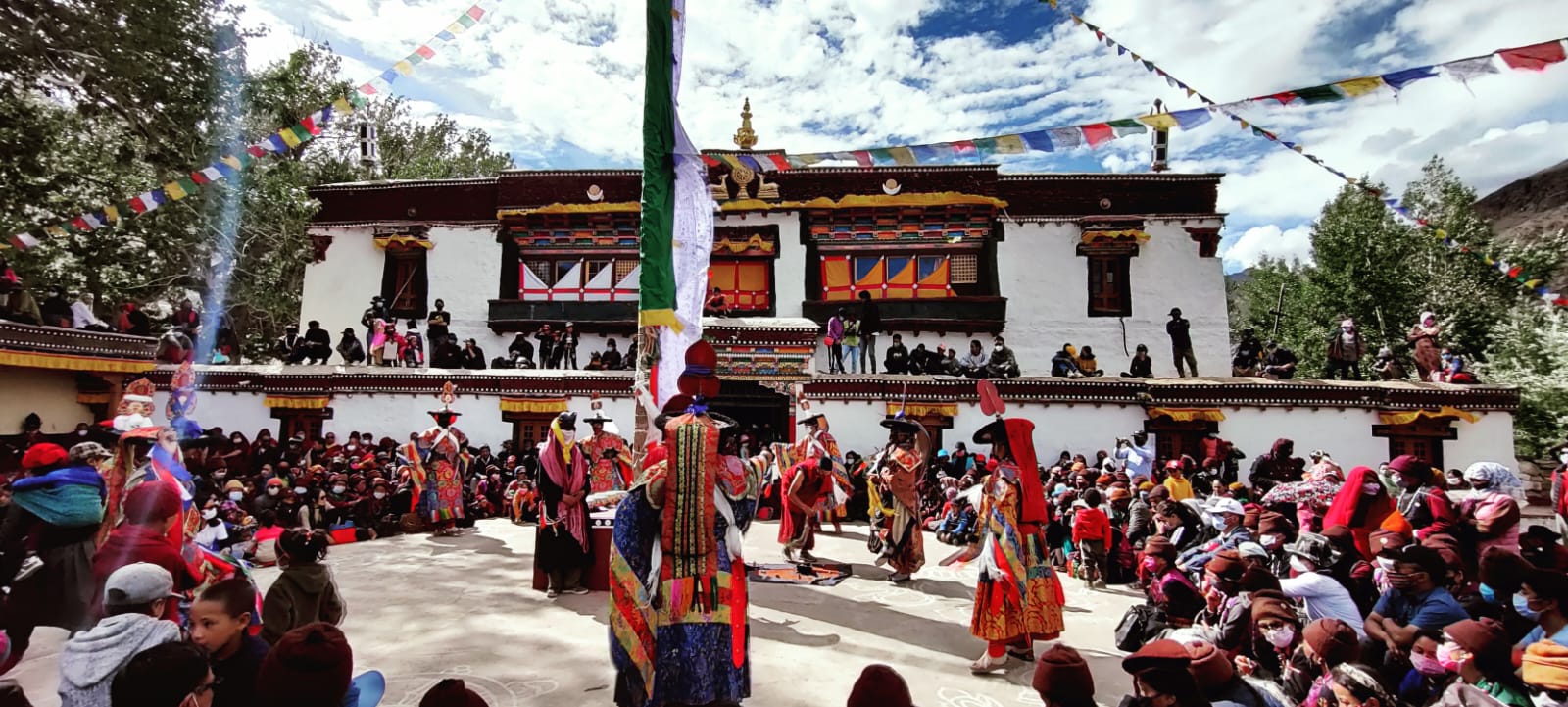
Su is a village of surprising softness, especially after the stone severity of Phey. Fields widen slightly, the river’s voice grows less urgent, and the valley seems to exhale. Su’s proximity to Sani Monastery makes it one of the cultural anchors of the entire Zanskar region. Sani is among the oldest monastic sites in the Himalayas, carrying legends that stretch across kingdoms and centuries. Its stupa stands in a field where time seems to fold, and its courtyards hold a quiet that feels distinctly different from the mountain-facing gompas of the region. The monastery is known for ancient murals, intricate statues, and a spiritual lineage that links Zanskar to broader Himalayan traditions. Travelers often describe Sani as the “emotional midpoint” of their journey — a place where the rawness of the landscape finally meets the warmth of human history. Su, as its accompanying village, captures this duality beautifully. The homes are arranged with understated confidence, the pathways feel worn yet welcoming, and the villagers move with the calm certainty of people who understand the seasons intimately. Visiting Su and Sani is not an excursion but an immersion — a chance to see how culture, faith, and geography interlace to define life along the Suru–Zanskar Transitional Corridor.
VII. Padum — The Basin Where All Roads Learn to Rest

Padum is not merely the administrative center of Zanskar; it is its emotional basin. After days of narrow roads, steep ridges, and austere passes, Padum feels unexpectedly open, as though the land itself has decided to offer travelers a reprieve. The valley widens, the river braids across the plain in silver threads, and monasteries such as Karsha and Stongde rise in elegant silhouette against the ridgelines. Padum’s market buzzes with a quiet resilience — shops selling dried cheese and barley flour, schoolchildren crossing dusty lanes, and herders negotiating supplies before long journeys. While it serves as a logistical hub, Padum is also a cultural archive. Its communities preserve layers of history, from ancient Buddhist lineages to the shifting caravan routes that once threaded through Zanskar’s isolation. Yet Padum remains humble, refusing to present itself as a “destination” in the conventional sense. Instead, it functions as a place of reflection. Many travelers realize only upon arrival how deeply the Transitional Corridor has reshaped their sense of scale, solitude, and beauty. Padum offers a space to absorb these realizations, to rest before further explorations, and to understand that journeys through the Himalayas are rarely linear — they expand inward long after the road stops moving.
FAQ — Practical Questions From Curious Travelers
Q: What is the best time to travel through the Suru–Zanskar Transitional Corridor?
A: The ideal months are late June to early September, when the roads across Penzi La are reliably open and the valleys offer both green expanses and clear mountain views. During this window, the corridor reveals its full seasonal identity — from Sankoo’s orchards to Zanskar’s ochre plateaus. While temperatures vary significantly with altitude, this period provides the most accessible and comfortable conditions for European travelers seeking both narrative landscapes and cultural encounters.
Q: Do I need special permits to visit villages such as Phey, Su, and Padum?
A: Most travelers can access the Suru–Zanskar Transitional Corridor without specialized permits, though certain regulations may apply depending on road conditions and ongoing local policies. Visitors should always check recent updates before travel, particularly regarding Penzi La openings or temporary restrictions due to weather. The primary requirement is sensitivity — monasteries such as Dzongkul and Sani request respectful behavior, modest clothing, and quiet engagement.
Q: How difficult is the journey for first-time visitors to high-altitude regions?
A: The journey is accessible but requires patience. Altitude changes quickly between Suru Valley and Zanskar, especially at Penzi La. Travelers should acclimatize gradually, hydrate consistently, and avoid rushing the route. The corridor rewards those who listen to their bodies and travel deliberately. While the terrain is demanding, the experience is profoundly rewarding when approached with mindfulness and preparation.
Conclusion
The Suru–Zanskar Transitional Corridor is not just a sequence of villages — it is a slow revelation of how landscape, memory, and culture shape one another. With each bend in the road, each shift in altitude, and each encounter with the people who call these valleys home, travelers discover a geography that teaches as much as it astonishes. To journey through Sankoo, Panikhar, Penzi La, Akshu, Phey, Su, and finally Padum is to witness how mountains sculpt stories, and how stories continue to sculpt the traveler.
Sometimes the quietest roads offer the most enduring conversations — not with people, but with the land itself.
Final Note
If you allow the corridor to unfold at its own pace, you may find that the journey leaves a mark deeper than the destination. Zanskar does not ask for haste — only attention.
About the Author
Declan P. O’Connor is the narrative voice behind Life on the Planet Ladakh,
a storytelling collective exploring the silence, culture, and resilience of Himalayan life.