
A Road Between Breath and Blue
By Sidonie Morel
Leh, Before the Engine Starts
Morning metal and the first practical decisions
In Leh, departure is rarely dramatic. It is, more often, a small sequence of checks performed in a cold courtyard: the boot lifted, the spare tyre tapped, a water bottle weighed in the hand as if the body already knows it will need it. The car is usually a white taxi or an Innova that has done this route too many times to pretend it is new. The driver moves quietly, without ceremony. Your bag is placed where it will not shift on broken tarmac. A blanket might be folded in the back seat; not for comfort, but because the air above the pass can turn sharp even in sunlight.
This is where the Leh to Pangong Lake road trip begins to reveal its real shape: not as a “day excursion,” but as a string of thresholds. The first is not Chang La, not the lake. It is the moment you accept that the day will be governed by road, altitude, and small permissions. If you are travelling in season, someone will ask for copies of your Inner Line Permit; if you are travelling out of season, someone will ask whether the pass is open at all. Even when everything is in order, there is a faint administrative rhythm to the journey—photocopies in a folder, names spelled out clearly, a pen passed around the car as naturally as a packet of biscuits.
Many visitors do what is sensible and spend time in Leh before going anywhere higher. The city sits above 3,500 metres, which is already enough to make a brisk walk feel oddly deliberate. The first days can be unglamorous: a headache at breakfast, a slower climb up stairs, a new respect for the pace of local life. On the morning of departure, you see the consequences of that acclimatisation in small ways. People who have waited a day or two speak normally, laugh without stopping for air, and drink tea as if it is simply tea. People who have arrived the night before often sit very still, watching the road ahead as if it might be negotiated by willpower alone.
Outside the hotel gate, Leh is already awake. Shopfront shutters lift. A dog crosses the road with the authority of someone who knows traffic will hesitate. In the light, the town’s edges are visible: low walls of mud and stone, poplars, and beyond them the pale, hard slopes that make vegetation look like an afterthought. The driver may say little. The engine warms. The first turn of the key is not a beginning in the romantic sense, but it is a clear signal: from this point, the day will be decided by what the road allows.
The City Falls Away, and the Plateau Takes Over
Leaving the ordinary oxygen behind
The first hour out of Leh can feel almost familiar: road signs, small roadside stalls, the occasional cluster of houses. Then the built world thins, and the landscape begins to take over with a firmness that is difficult to ignore. The light here is not gentle. It hits stone and dust without much softness, and the air has a dryness that sits at the back of the throat. Through the window, the surface of the land looks worked by wind and water rather than by people: loose gravel, pale sand, and the occasional ribbon of green along a stream where willows hold on.
The car’s interior becomes its own microclimate. Sun warms the glass; the floor stays cold. A scarf is pulled up, then put down again. Someone opens a sweet or a piece of dried fruit and the smell briefly changes the air inside the cabin—apricot, sugar, plastic wrap—before the road asserts itself again. Conversation, if it happens, tends to be practical: how long to the pass, whether the tea stall is open, whether the road is better this year. When the road begins to lift, voices often get quieter. It is not reverence. It is breathing.
There are stretches where the tarmac is intact and the car hums with steady speed. Then, without warning, the surface breaks into patched gravel and potholes that force the driver into a careful slalom. That change in texture is one of the route’s recurring themes. The Leh to Pangong Lake road trip is often described as a “drive,” but it is not a smooth European drive. It is a negotiation. You feel it in the way your shoulder meets the door on sharp bends, in the way a bottle rolls and is caught, in the way a passenger’s hand rests briefly on the seat in front when the car drops into a rough section.
Outside, traffic is a mixture of local vehicles, tourist taxis, and military trucks. The army presence is not a background detail here; it is part of the day’s visible reality. Convoys move with a certain force, and private cars give way quickly. At times the road narrows to a single lane, and patience becomes less of a virtue than a survival tactic. Dust rises behind vehicles and hangs in the air, catching sunlight. When you stop—perhaps to let an engine cool, perhaps to take a photograph—dust settles on your shoes and the cuffs of trousers in a fine layer that feels almost like powder on the skin.
Checkposts and the brief rituals of passage
Checkposts arrive without drama: a gate, a barrier, a low building, a man in uniform who knows exactly how many cars will pass today and exactly how long it should take to write them down. Papers are handed over. Names are copied into a ledger. The process is usually polite, efficient, and faintly impersonal, as if the landscape itself has instructed people to conserve effort. There is often a moment of waiting where you look at the mountains in front of you and realise that the road is not the only line being managed here.
For travellers, these stops can feel like interruptions. For the route, they are part of its structure. The car moves, then it pauses. The body notices the pause. Someone stretches their fingers; someone adjusts a jacket. The driver might step out to speak with another driver, the conversation carried by the tone rather than the content. The barrier lifts, and the car continues. That alternation—movement and stopping—shapes the day as much as altitude does.
It is worth noticing what happens in the car after each checkpost. The driver’s focus sharpens. Passengers often fall silent. The road begins to climb more insistently, and the surroundings look less like a valley and more like a corridor of rock. You pass prayer flags tied to poles or strung between stones, their fabric snapped into frayed ribbons by wind. You pass small chortens or heaps of stones that suggest people have been marking this route long before it became a tourist itinerary. These are not decorative. They are signs of how humans behave when a landscape is bigger than their plans: they leave small markers, they make small requests.
Chang La: The Pass That Tightens Everything
Snow walls, thin air, and the economy of movement
Chang La is often introduced with a number—around 5,360 metres—and the number is not just for boasting rights. It is the simplest explanation for why people get out of the car and immediately move differently. Steps become shorter. Gestures become economical. A light bag feels heavier than expected. A laugh ends early. The air has a bite that is not purely cold; it is also the dryness of altitude, the way moisture seems to leave the body faster than you can replace it.
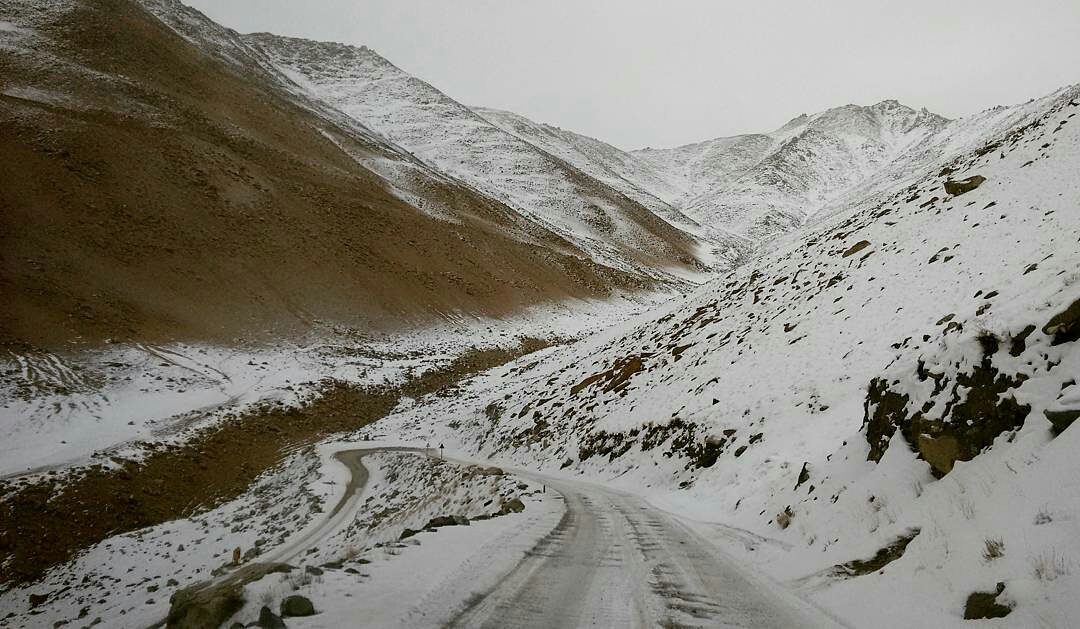
At the top, there is often snow even when Leh is bright and dry. Snow banks are pushed back by bulldozers into rough walls, greyed by dust and exhaust. The surface is uneven, packed and slick. The pass is not a clean viewpoint; it is a working place. Vehicles pull in, engines idle, and people step out to take in the signboard that announces the altitude. There are prayer flags, always—strung thickly, fluttering at a speed that makes fabric look like a tool rather than a decoration. The wind can be blunt. It presses into the ears. It turns cheeks red quickly. If you stay outside too long, your fingers start to lose their certainty on the zip of a jacket.
There is usually tea available: sweet, milky, served in small cups that warm the hand. Sometimes there are instant noodles. The smell of fuel, wet wool, and frying oil mixes in the air. This is not a “mountain café” in the European sense; it is a survival pause. People drink quickly, take photographs quickly, and return to the car with the brisk urgency of those who understand, even without being told, that this is not a place for lingering. The driver watches. Drivers always watch. They know who is struggling and who is simply cold.
High passes create a particular kind of camaraderie between strangers. People exchange small advice without being asked: drink water, do not run, take it slow. Someone offers a seat to someone who looks unsteady. A young man sits on a low wall and stares at his shoes, counting his breath. A couple pose with the signboard and then stand quietly, their bodies clearly working harder than their smiles suggest. On Chang La, the body is not a private matter. It is visible.
The pass as a hinge in the day
From the driver’s seat, Chang La is less a destination than a hinge. It is the point at which the road’s character changes. The climb demands attention—tight turns, patches of ice, sections where the surface is broken or washed out. The descent demands a different kind of care: brakes, speed control, the unpredictability of gravel. At the pass, you can feel that transition even before the road drops away. The car’s engine changes pitch. The driver’s hands settle on the wheel with a particular steadiness.
If the weather turns, Chang La is where the day can suddenly feel precarious. Cloud can arrive quickly, bringing snow or sleet that changes visibility and traction. Even without a storm, sunlight can be harsh enough to trick you into underestimating cold. When wind rises, it lifts grit that stings the eyes. People squint, hunch, pull their collars up. The pass has a way of stripping away the theatrical side of travel. It insists on function.
And yet, despite its bluntness, Chang La also offers a certain clarity. The landscape is reduced: rock, snow, sky, flags. Distractions are minimal. The road’s purpose becomes obvious. It is a line drawn through a place that does not need it. For a few minutes, most travellers stop trying to interpret what they see. They simply register it: the sound of flags snapping, the cold through the soles of shoes, the way breath is audible in a way it is not at lower altitude. Then they return to the car, and the day continues with renewed respect for the distance still to come.
Down Toward Tangtse, Where the World Softens
Relief in the hands, warmth in small increments
After Chang La, the first change is often felt in the fingers. They stop tingling. They begin to move again with more confidence. The road descends into a landscape that looks less sharpened by altitude and more open to human presence. Tangtse appears as a scatter of buildings, a few shops, a line of roadside activity that feels almost domestic after the pass. There may be a small place selling tea, biscuits, and basic supplies. The smell of cooking oil and spice can drift out into the road. A kettle whistles. Someone is always sweeping dust from a threshold, a gesture that makes perfect sense here where dust arrives with every vehicle.
The pause in Tangtse is not mandatory, but many cars stop. It is an instinctive recalibration. People stretch their legs. Drivers speak with other drivers, comparing road conditions ahead. In the car, someone may check a phone for the first time in hours, only to find that reception is unreliable. The road has pulled you away from the networked world, and it does so without drama; it simply removes the signal.
From here, the landscape begins to widen. The valley opens into a series of long views where the ground looks brushed flat by wind. The road can be deceptively simple—straight stretches that invite speed—then suddenly broken by rough patches that jolt the car. The texture of the journey remains inconsistent, and that inconsistency is part of what makes the arrival at Pangong feel earned. You are not gliding toward it. You are being carried toward it over a surface that keeps reminding you it is provisional.
Roadside pauses: stones, ravines, and the quiet work of looking
There are moments on the approach where the car slows not because of traffic or a checkpost, but because the view insists on it. A ridge falls away to reveal a broad plain. A line of water appears—a stream, a river channel—glinting briefly. The mountains change colour: grey to brown to a red that looks like it has been baked into the rock. In bright sun, the land can look almost bleached. In shadow, it gains depth and a muted richness.
Some travellers treat these moments as photo stops. Others simply look. The difference matters. Photographs have a way of compressing the route into a handful of dramatic images—pass sign, prayer flags, turquoise water. But the actual experience of getting from Leh to Pangong is built from long stretches of being inside a moving vehicle, watching a landscape repeat and change in small increments. It is built from the sound of tyres on alternating surfaces, from the way the body tenses when the road drops, from the way a scarf is adjusted again and again because the cabin warms and cools unpredictably.
On the roadside, you sometimes see small evidence of how travellers cope: discarded plastic bottles, scraps of packaging caught in stones, the occasional tyre mark where a vehicle has pulled off too quickly. It is worth noticing this because it is part of the place’s reality, not a moral lesson but a fact. Pangong has become popular, and popularity leaves traces. In the car, you can feel the tension between the desire to see and the responsibility of being there. Most people behave well. Some do not. The landscape, indifferent to intention, collects the evidence all the same.
When Pangong Appears, It Arrives Like an Interruption
First sight: colour, scale, and the sudden change in sound
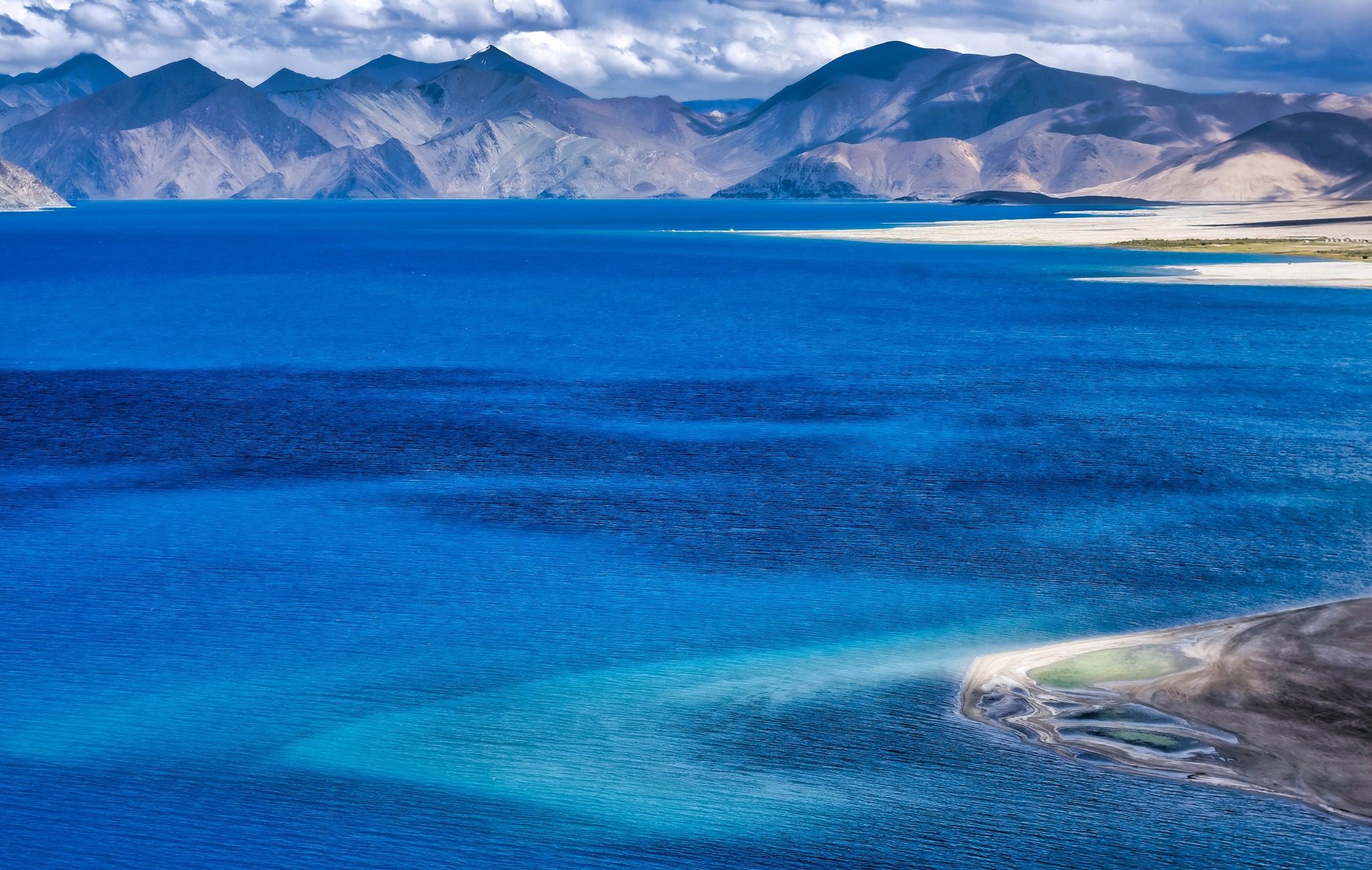
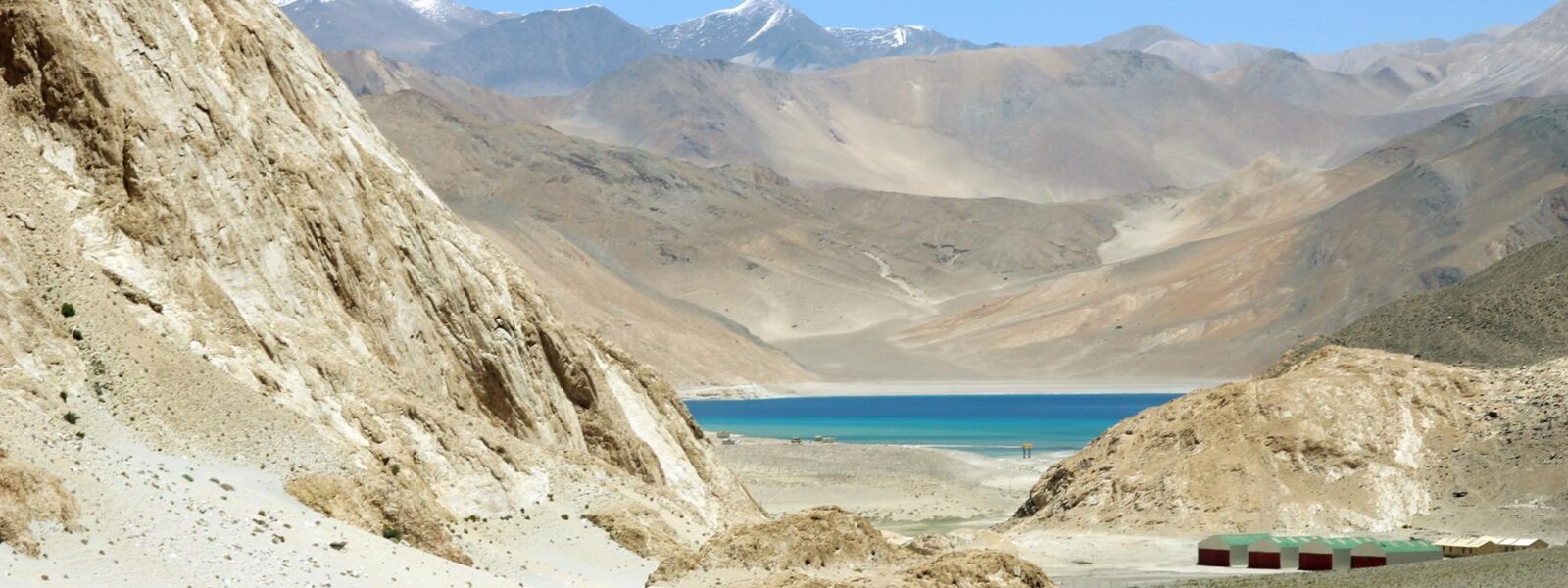
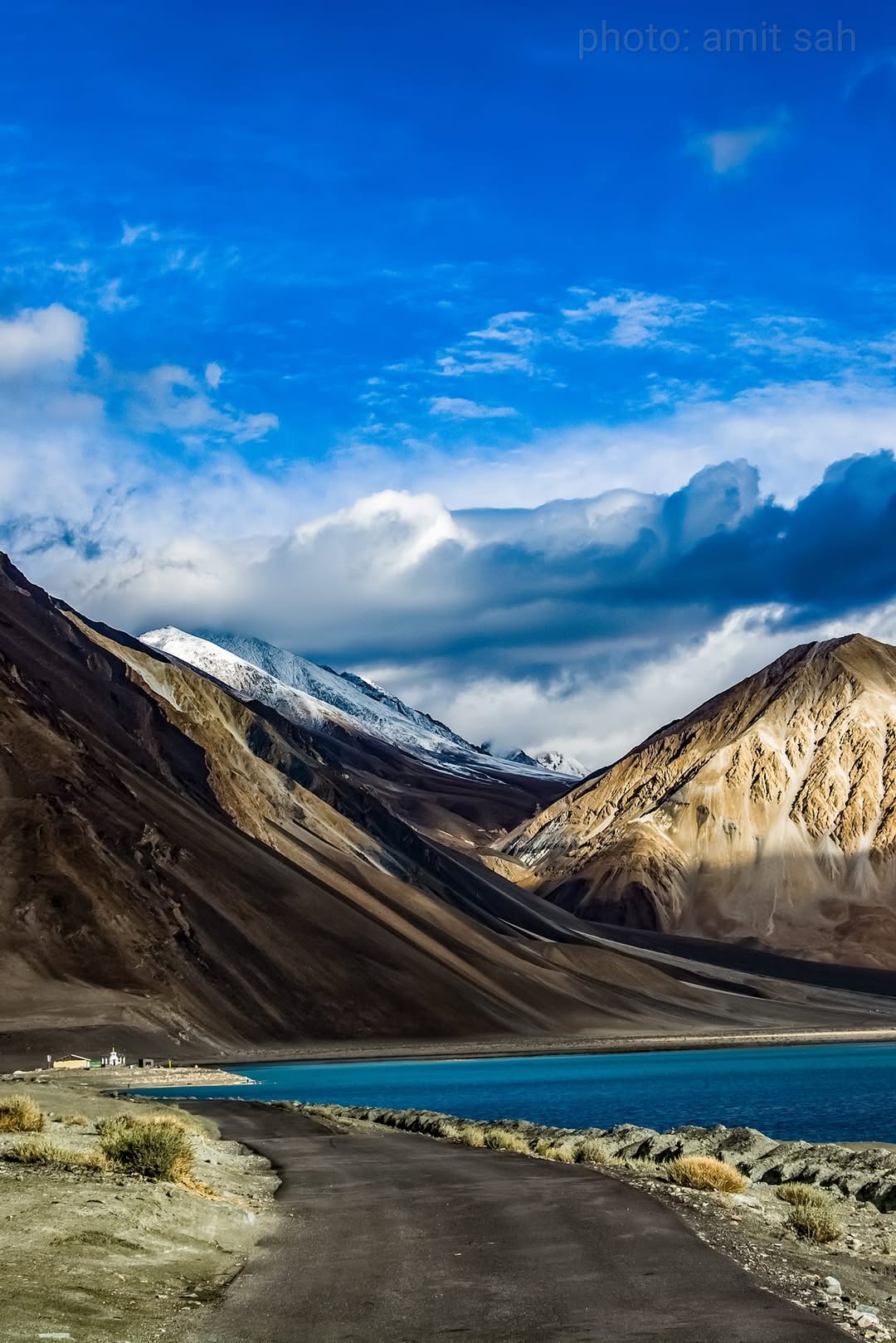
Pangong rarely announces itself with a grand reveal engineered for visitors. It appears, more often, in fragments: a thin strip of colour beyond a rise, a flash of blue that looks almost artificial against the earth. Then the strip widens, and the mind has to adjust its sense of scale. The lake is long, set between mountains, and its surface catches light in a way that makes the colour shift from one minute to the next. In bright sun, it can look pale and opaque. Under cloud, it deepens. When wind moves across it, the surface becomes textured, and the colour breaks into a pattern that looks like brushed fabric.
Cars often stop near the shore where access is easiest. Doors open. People step out and fall quiet, not because they have been instructed to, but because the wind and the space do something practical to the body. It is colder here than many expect. The lake sits above 4,200 metres, and the air has the same dryness that accompanied you from Leh, now sharpened by water. The wind can be persistent. It moves through clothing. It carries a faint mineral smell—water, stone, salt—mixed with the diesel scent of vehicles and, occasionally, smoke from a kitchen somewhere near the settlement.
The shoreline is not uniformly soft. There are patches of sand, then stones, then sections where salt crusts the ground. Underfoot, it can crunch. The sound is distinct—dry, brittle—like stepping on thin ice, though the ground is not ice. When people walk, they tend to do it carefully, looking down, then up, then down again. The lake invites attention in two directions: outward, toward the water and the mountains; inward, toward the ground that can surprise you.
On busy days, the human element is unavoidable: tourists, vendors, a line of vehicles, perhaps a group posing for photographs. On quieter days, you notice different things: the way a bird skims low over the water, the way wind makes small waves that slap against stones, the way the light catches the ridges of distant slopes. It is possible to stand here and pretend the lake is untouched. It is also possible to look honestly and see the signs of visitation. Both views exist at once. The lake accommodates them without comment.
Walking the edge: small objects, small behaviours
To make Pangong legible, it helps to walk. Not far, not fast. Just enough to leave the densest cluster of people and let the place speak in smaller sounds. You begin to notice what travellers bring to the edge of the lake: thermoses, scarves, cameras with long lenses, packets of snacks. You see how people handle cold: hands shoved into pockets, shoulders raised, hats pulled down. You see how altitude shapes behaviour even when no one mentions altitude: slower movement, longer pauses, a tendency to sit rather than stand.
Some travellers pick up stones and place them on existing piles, adding to the informal architecture of the shore. Others crouch and run fingers through sand, as if testing whether it is real. Children chase each other and then stop suddenly, winded in a way that surprises their parents. A couple from Europe—perhaps French, perhaps Italian—stand with their faces turned toward the water, speaking softly, their voices almost lost in wind. A driver keeps an eye on the time, not because he is impatient, but because he understands how quickly Chang La can change later in the day.
There is a discipline in watching. Pangong is not a place that needs to be “conquered” in an afternoon. It asks for a kind of restraint that is easier to practise when you accept the day’s limits. You can see this restraint in the better behaviour: people staying back from fragile patches of shore, not pressing too close to wildlife, not treating the lake as a stage set. You can also see the lack of it—feet in places that look easily damaged, litter dropped without thought. The lake records these choices in simple ways: footprints, crushed crust, small bright plastic against pale ground.
When the wind rises, the lake’s surface changes quickly. The water darkens in bands. Small waves appear. The colour becomes less “photogenic” and more complex, more realistic. It is in these moments, when the lake refuses to perform, that it feels most convincing. The road has brought you to a place that is not arranged for your comfort. The lake is simply there, moving under weather, reflecting the sky it is given.
Weather Turns, and the Plateau Reclaims the Hour
Cloud, cold, and the practical moment of leaving
In high country, weather does not announce itself politely. It arrives. A clean horizon can take on a thin veil. The light changes. The wind shifts direction. People begin to tug at collars and pull hats down. Someone who has been cheerful becomes quiet, not out of melancholy but out of cold. The lake’s far shore becomes less distinct. Mountains that looked sharp an hour ago soften into silhouettes.
This is when the most experienced travellers make a decision that often feels counterintuitive: they leave before they have had their fill. Not because Pangong becomes less interesting, but because the route home matters. Chang La is not a pass you want to meet late, tired, and in worsening weather. Drivers know this. They glance at the sky, at the line of cloud, at the way sunlight has flattened. They do not give speeches. They simply begin to move toward the car with the quiet authority of someone who has seen roads close.
There is sometimes disappointment in the group—one last photograph, one last look, a reluctance to break the moment. But the lake does not disappear when you leave. It remains. What changes is your relationship to it. As you walk back, you feel the wind more sharply. You notice how quickly your skin dries. You taste dust on your lips. The lake, in the end, is not only a view. It is a set of conditions: altitude, wind, light, cold. You have been inside those conditions for a few hours, and now you step out of them.
For some, the day includes an overnight stay near the lake. That shifts the rhythm entirely: sunset light, the drop in temperature after dark, the sound of wind at night, the limited facilities that make you aware of what you take for granted elsewhere. For others—many others—the visit is a long day trip, and the practical arc is always the same: arrive, walk, look, leave. If the day is clear, you may stay longer. If it is not, you may leave earlier. Either way, the lake asks you to accept that time is not entirely yours.
The Return Road: The Same Route, a Different Story
Dusk, fatigue, and the intimacy of headlights
On the way back, the car feels different. Everyone has been working—breathing, bracing against the road, staying alert. The body’s fatigue is not dramatic. It is a quiet heaviness in the shoulders, a warmth that feels earned when you sit back in the seat. Conversation resumes briefly, then fades. People drink water more deliberately. A packet of biscuits is opened again. Someone checks on a companion: are you all right, do you need to stop, do you feel sick. These are ordinary questions, and in high country they matter.
Light changes quickly. The warm colour of late afternoon can turn, in minutes, into a colder tone that makes the landscape look stern again. Shadows lengthen across the road. The mountains regain their authority. Tangtse passes in reverse, familiar now. Checkposts appear again, the same ledgers, the same barrier. There is a curious sense of being recognised by the route itself. You have passed through once; now you pass through again, and the road seems to measure you differently.
Chang La on the return can feel harder. Not always, but often. You are tired. You are less curious. You want to be back in Leh with its warmer air and its easy tea. At the pass, people move even more quickly than they did in the morning. They step out, glance at flags, maybe take one last photograph, then climb back in. The tea stall, if open, is once again a working place: cups lined up, steam rising, hands wrapped around warmth. The wind does not soften because you have already been here. It is the same wind. What has changed is your capacity for it.
As darkness comes, headlights create a narrow world: a strip of road, the edge of gravel, the occasional reflective marker. The driver’s focus becomes visible in his posture. He sits forward. He scans for oncoming vehicles, for animals, for sudden patches of ice. Passengers watch the driver, and in that watching there is a kind of trust that forms quickly when you have spent a day together in a place where the road is not forgiving. When you finally descend into lower altitude, you feel it without needing to name it. Breathing becomes simpler. The cabin feels warmer. The day loosens its hold.
Back in Leh, the return is anticlimactic in the best way. Streetlights, familiar corners, the sight of small shops still open. The car stops, the door opens, and you step out into air that suddenly seems generous. The road to Pangong is over, but it does not evaporate. Dust remains on your shoes. The faint taste of altitude remains in your mouth. If you empty your pockets, you might find a crumpled permit copy, a receipt for tea, a small stone picked up without thinking. These are not souvenirs in the tidy sense. They are evidence of a day spent between pass and water, on a route that asked for attention and rewarded it with a place that refuses to be simplified.
a storytelling collective exploring the silence, culture, and resilience of Himalayan life.