


In Ladakh, Every Necessary Walk Can Become a Pilgrimage
By Sidonie Morel
The First Steps Are Not Spiritual, Yet
A doorway, a threshold, a small errand that turns into distance

In Ladakh, the day often begins with something ordinary: a kettle that needs filling, a matchbox that has gone missing, a note that must be delivered before the wind rises. These are not announced as pilgrimages. No one ties a scallop shell to a backpack. There is no stamp book, no ceremonial farewell. Yet the first steps out of the house carry a quiet seriousness, because a short walk here is rarely short in the way it is elsewhere.
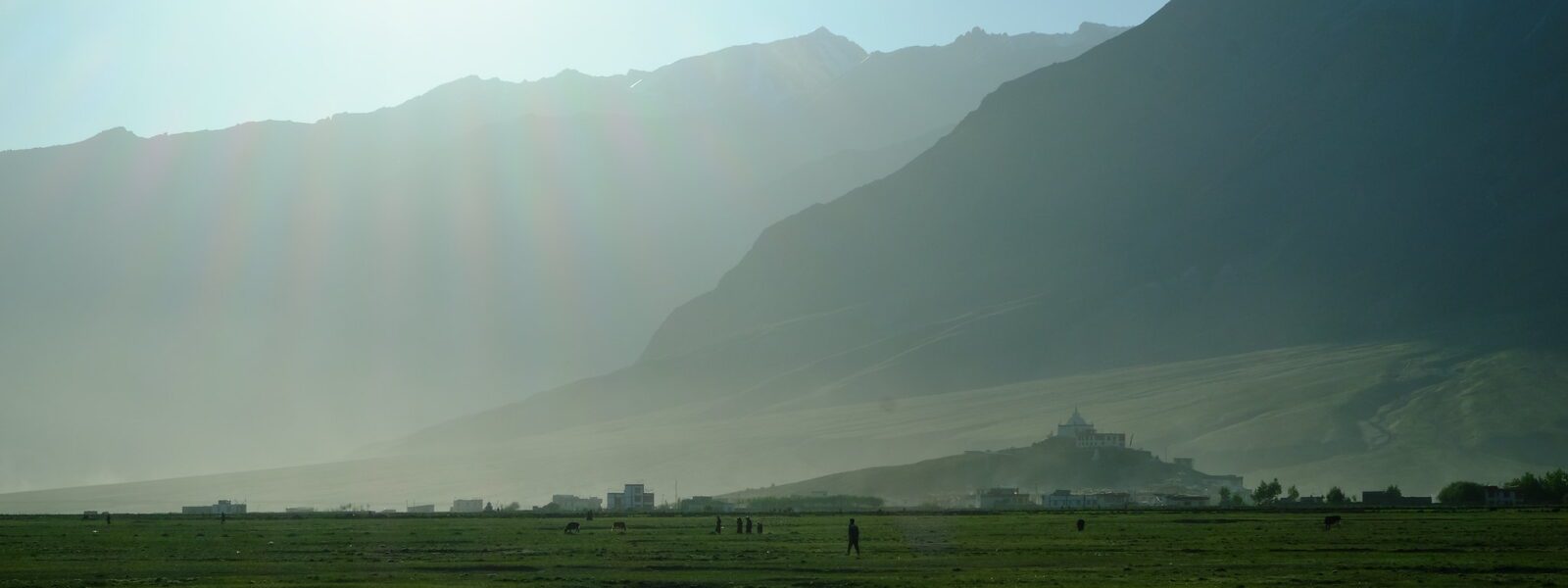
The path is concrete enough to count: a strip of compacted earth between low walls of stone; a bend that keeps you out of sight of the road; a narrow crossing where the channel is cut to feed fields. In the morning, the ground is firm with cold. By mid-day it loosens into powder that lifts with each footfall and settles on cuffs. A dog sleeps half on the sunlit side of a doorway. A woman, shawl drawn over her head, carries something wrapped in cloth. No one makes a show of endurance. People simply keep moving, because movement is how the house continues to function.
Altitude edits the body’s grammar. The first incline, even a modest one, changes the sentence you can speak. The lungs work in short, efficient syllables. Pace becomes less a preference than a measurement. You notice the difference between walking on the flat along the valley floor and walking where the village rises in steps. You learn, quickly, that a good rhythm is not heroic; it is economical. When the breath is kept steady, the mind stays open enough to register what is happening around you—stone underfoot, the scrape of a strap, the thin brightness of morning light on dust.
If the Camino teaches you that the sacred can hide inside repetition—boots, breakfast, a line of bodies leaving a town at dawn—Ladakh offers a similar truth with different materials. Here, the repeated walk is stitched into the day’s smallest responsibilities. It is not a journey set apart from life. It is life, stretched out across a landscape that refuses to be hurried.
How altitude edits the body’s grammar—breath, pace, silence

You can feel the change in the air without needing to name it. In the early hours, the cold has weight; it sits against skin and makes cloth behave differently. Hands become practical instruments, not expressive ones—fingers tuck scarves tighter, adjust straps, keep a grip on what must not be dropped. The sun climbs quickly, and with it comes a dryness that draws moisture out of everything: lips, wood, leather, the surface of the path. People walk with their shoulders slightly forward, conserving warmth at first, then shifting as the day warms. This is not a posture of hardship; it is a posture of accuracy, as though the body has learned the exact angle at which it spends the least energy.
Silence in Ladakh is not always absence of sound. There are small noises that survive the spaciousness: the clack of prayer beads in a pocket, the soft rasp of wool on wool, the sudden bright call of a bird you cannot see. From a distance, you may hear a drum from a monastery courtyard, faint but unmistakably structured, like a pulse. In a village lane, you hear the friction of everyday objects: a metal lid set down, a bucket moved, a latch lifted. These sounds are not scenic additions. They are the day’s ledger, audible proof that people are doing what must be done.
On long-distance pilgrimages in Europe, strangers often fall into companionship because the road offers a shared script: the same arrows, the same hostels, the same evening fatigue. In Ladakh, walking does something else. It keeps people close to the real distances between households, fields, temples, and water sources. It measures the day not in kilometres but in tasks completed without waste. The body learns to accept pauses—not as defeats, but as part of correct pacing. A short stop, a sip of water, a hand briefly on the knee. Then onward.
This is how the Ladakh pilgrimage begins: not with vows, but with attention. A walk that starts as an errand becomes a practice of moving carefully through a place where nothing is effortless, and where effort is never performed for applause.
What Makes a Pilgrimage When You Don’t Call It One
Ritual without announcement: turning left at the same shrine, every time

There are gestures in Ladakh that belong to the path itself. You see them repeated with such calm consistency that you understand they are not invented for visitors. A man approaches a chorten and moves around it in the customary direction, not pausing to explain why. A woman touches a wall of carved stones—mani stones—and continues without breaking stride. A group of schoolchildren, noisy moments ago, quiets as they pass a small shrine, as if the lane has a rule that does not need to be written.
These are not dramatic acts. They are small edits to a route, small courtesies paid to what is held sacred. On the Camino, the sacred is sometimes carried as a story you tell yourself while walking: repentance, renewal, escape, or simply a desire to be moving among others who have chosen movement. In Ladakh, the sacred is more often embedded in the layout of daily life. It is placed where people must pass, and because people must pass, the act of passing acquires a shape.
You begin to notice how often the path asks you to circle rather than cut across. It is a different geometry from the European instinct to take the shortest line. Here, the respectful line is not always the efficient line, and yet it becomes efficient through repetition. The body learns it. The feet stop arguing. A turn that once felt like detour becomes simply the way the lane is walked.
If you walk with someone local, you may not receive a lecture. Instead, you receive the lesson by imitation. A slight slowing near a prayer flag. A lowered voice near a monastery wall. A momentary pause at a doorway where an elder sits. These micro-rituals make a pilgrimage out of the most practical route, not because the route is transformed into theatre, but because it is lived inside a shared sense of order.
Belief as texture: dust on cuffs, prayer murmurs, the sound of a strap against cloth

In the West, we often speak of belief as something interior: a private conviction, a personal philosophy. In Ladakh, belief frequently has a public surface. It is stitched into fabric, hung from roofs, painted on rocks, arranged in the direction you move. Prayer flags fade on their own schedule, a colour calendar of sun and wind. Mani walls collect lichen and dust; the carved syllables remain legible long after the paint has dulled. The physical world holds these signs the way a household holds tools—visible, used, maintained when possible, replaced when needed.
Walking in this landscape becomes a kind of reading. Not the reading of a guidebook, but the reading of what people have put into place to hold meaning steady. A low murmured prayer as someone passes a shrine. The brief sound of a strap flicking against a coat as a load shifts. The tick of beads. These noises are not staged. They arrive and disappear like the wind itself, and you realise they are part of what walking here is for: not to conquer distance, but to move through a world where meaning is distributed across objects and routes.
On pilgrim roads elsewhere, you might collect tokens: stamps, stones, small crosses. In Ladakh, the tokens are less likely to be collected than encountered. You do not carry the shrine away. You carry the memory of how the shrine changed the lane around it. The pilgrimage becomes a habit of noticing these changes—how the sacred interrupts the ordinary, and how the ordinary calmly makes room for it.
Paths That Remember More Than Maps Do
Old footpaths beside fields: the shortest line is rarely the one you take
Maps are useful in Ladakh, but they do not tell you which paths are real. A line on a screen cannot show whether the route is choked with loose stone after last week’s rain, whether a crossing is possible after snowmelt, whether a track passes through a field that has been newly planted. The true map is carried in the knowledge of people who walk, and in the way the ground itself keeps certain habits.
Some footpaths run beside barley fields, skirting the edges where irrigation channels cut the earth. You see how the land is organised to catch and hold water. The channels are narrow but deliberate, the stone edges placed by hand, repaired when they crumble. A path that looks like a shortcut may be avoided because it would damage the channel. Another path may be preferred because it passes a place where one can stop without blocking anyone else. This is how walking becomes social: the route is chosen not only for the walker, but for everyone who uses it.
On the Camino, a pilgrim can surrender to a system of arrows, knowing that the infrastructure exists to guide you. In Ladakh, guidance is often implicit. The best route is the one that does not create trouble. You learn to read the signs that matter: where footprints continue when a path seems to disappear; where stones have been moved aside; where a narrow track is polished by repeated passage. The land itself tells you, quietly, how it is meant to be used.
There is an intimacy in this kind of navigation. It keeps you near the ground. It keeps you from the fantasy that travel is purely personal. Every step is on a surface shaped by others, and your job is to tread in a way that does not undo their work.
Stonework and devotion: mani walls, chortens, the gentle insistence of circling

Stone in Ladakh is not merely material; it is memory. Walls are built to protect fields, to define lanes, to hold back earth. But some stonework has a different purpose. Mani walls—long, low accumulations of carved stones—stand like sentences written into the landscape. Chortens rise at crossings and edges, whitewashed forms that catch light at odd angles and make you adjust your route.
The insistence of circling is gentle but constant. You do not push through the sacred; you go around it. This is not only religious etiquette; it is an embodied discipline. It makes you slow down at points where you might otherwise hurry. It makes you aware of direction, of orientation, of where you are in relation to something that is not negotiable.
Pilgrimage elsewhere can sometimes become an exercise in personal narrative—what you seek, what you leave behind. Here, the narrative is less private. The path keeps reminding you that you are moving through a shared world with established forms. A chorten at a bend, prayer flags on a ridge, a monastery wall that extends the length of a village. These are not decorations. They are instructions: move respectfully, move attentively, move as if the day belongs to more than you.
When you accept this, walking becomes lighter. You are no longer trying to impose your own story on the land. You are allowing the land’s story—written in stone and habit—to shape your pace.
Companions: The Unwritten Contract of Walking Together
Two people, two speeds—how the day becomes a negotiation
Walking with someone in Ladakh reveals the quiet negotiations that make a day possible. Two bodies rarely move at the same speed for long. One person’s lungs adjust quickly; the other’s legs may be stronger on inclines. One has a heavier load. Another has a shoe that rubs. None of this needs to be dramatised. It is simply part of the day’s arithmetic.
On long pilgrim routes, companionship often forms through shared hardship, shared meals, shared end-of-day relief. In Ladakh, companionship is also built through shared errands, shared responsibility. You wait not because you are being kind in a sentimental way, but because waiting keeps the group intact. You slow because the path narrows and passing would be rude. You stop because someone needs to adjust a strap, and because doing it now prevents a worse problem later. These are practical acts, yet they create a bond more durable than forced intimacy.
Conversation on such walks has a particular rhythm. It begins with facts: where you are going, who you might see, what needs to be done before dusk. Then it shifts into observations: the condition of the path, the state of a field, the sound of wind. Only later, sometimes, does it touch on the private. Not as confession, but as something that arises naturally when two people share the same pace for long enough. Even then, silence returns easily. It is not awkward. It is simply what happens when the landscape demands a portion of your attention.
This is one of the lessons the Camino offers at its best: the road creates a temporary republic of strangers. Ladakh offers a smaller republic, often composed of family, neighbours, and local obligations. The effect is similar. You are reminded that walking is not only about you. It is about staying in step with others, in a way that makes the day workable.
When conversation runs out, and something truer replaces it
There is a point on many walks when the talking ends. It is not a failure. It is the moment the body decides it needs resources elsewhere. Breath becomes more important than words. The eyes start scanning the ground for loose rock. The ears listen for a vehicle on a road above, or for the faint call of someone behind.
In that quieter stretch, you begin to notice what the day has been saying all along. The friction of cloth at your shoulder. The way dust settles on the back of your hand. The slight heat where the sun touches exposed skin, and the quick chill when you step into shadow. These details do not require interpretation. They are simply the evidence of being present.
Pilgrims sometimes speak of “finding themselves” on the road. It can be a tired phrase, too polished. Here, what you find is often smaller and more useful: a workable pace; a tolerance for silence; an ability to keep going without turning the effort into drama. These are household virtues as much as spiritual ones. They help you live, not just travel.
Hospitable Geometry: Homes, Kitchens, and the Night’s Small Republic
Salt tea, warmth, and the pause that resets a mind

Evening is when the Ladakh pilgrimage shows its domestic heart. After a day of walking, it is not the scenic panorama that restores you so much as the architecture of hospitality: the doorway that opens, the low table, the room warmed by what the household can spare. Salt tea arrives as a matter of course—hot, briny, sustaining. Sometimes there is bread, sometimes a simple stew, sometimes something fried that smells faintly of oil and flour and home.
The kitchen is where the landscape becomes intimate. Utensils are handled with practiced economy. Firewood is stacked where it can dry. Metal pots bear the marks of years. Someone turns a lid with the edge of a cloth to avoid burning fingers. These are not picturesque details. They are the way life is managed in a place where resources are finite and winter is long.
On pilgrim routes in Spain, the night often belongs to the hostel: a shared room, a line of boots, a chorus of showers, a communal meal. In Ladakh, the night belongs to the household. The social space is smaller, the generosity more direct. You sit near a wall, careful not to disrupt the arrangement of the room. You learn where to place your shoes. You learn how to accept what is offered without asking for more.
The pause of evening resets the mind. Not through grand reflection, but through the simple fact of being cared for in an ordinary way. A blanket placed over your legs. A cup refilled. A question asked quietly—where you have come from, where you are going—without the expectation of a performance in return.
Guests, hosts, and the quiet economics of generosity in a Himalayan village
Hospitality in Ladakh is often practical rather than sentimental. It is offered within the limits of what a household can afford. This is precisely what makes it honest. You see the calculation in small choices: how much tea is poured, how the food is shared, how the warmest place is given to the guest without fuss. The host does not announce generosity; they simply enact it.
There is also a kind of local intelligence in how guests are handled. Advice is given not as a lecture, but as a correction in the moment: wear this, not that; take this path at this hour; do not linger there when the light changes. It is the same kind of guidance you might receive from an experienced pilgrim on the Camino—where to stop, what to watch for—except here it is integrated into the household’s own knowledge of weather, distance, and time.
In Europe, it is easy to romanticise the idea of “authentic” hospitality, as though it exists for the traveller’s education. Ladakh resists that fantasy. Hospitality is part of a social fabric that would exist whether you arrived or not. It is shaped by the same constraints that shape everything else: altitude, winter, work. To receive it well is to understand that you are being folded briefly into someone else’s day.
This is where the Ladakh pilgrimage differs most sharply from the tourist itinerary. A pilgrimage is not a list of sights. It is a relationship, however temporary, with the structures that keep life going—paths, homes, kitchens, and the quiet agreements that link them.
The Body Keeps the Ledger
Feet, shoulders, sunburn—how the day writes itself into skin
By the second or third day of steady walking, the body begins to record the route with precision. Not in sentimental memory, but in small adjustments: how you place your foot on loose stone, how you shift a load so it does not rub. Skin changes. Lips dry. The bridge of the nose takes sun even when the air feels cold. Dust collects in the folds of fabric, especially at the wrists and ankles, where movement is constant.
These are not complaints. They are information. A pilgrim learns quickly that comfort is not guaranteed, and that the pursuit of perfect comfort can become its own burden. Better to accept a certain level of roughness and keep moving. Better to focus on what prevents injury and fatigue, rather than on what creates luxury.
This is one of the quiet lessons shared across pilgrim traditions. On the Camino, many learn that the body is not an obstacle to the spiritual; it is the medium through which the road is understood. In Ladakh, the lesson is sharpened by the environment. The body becomes a tool that must be maintained, because maintenance is what allows the household and the journey to continue.
You notice how local walkers dress for this maintenance: layers that can be adjusted without ceremony, head coverings that manage sun and dust, shoes chosen for familiarity rather than fashion. The body’s ledger is respected here. It is not ignored in pursuit of a narrative.
The dignity of repeating: step, stop, sip, step again
Repetition is the true engine of walking. Not the dramatic day, not the spectacular pass, but the repeated cycle: step, stop, sip, step again. In Ladakh, repetition is not boredom. It is competence. The day becomes manageable through the steadiness of these small acts.
The dignity of repetition is something pilgrim essays sometimes struggle to capture, because we are trained to seek turning points. Yet the turning points on a road are often subtle. The moment you realise you no longer need to check the path every few metres. The moment you can carry a load without thinking about it. The moment you recognise a certain light as the sign that you should turn back, not because you are afraid, but because you have learned the landscape’s timing.
In the West, we often treat walking as leisure or self-improvement. In Ladakh, walking is also care—care for the body, care for the day’s tasks, care for relationships that depend on arriving when you said you would. The pilgrimage is not separate from this care. It is made out of it.
Monasteries Without Postcards
Morning rooms of sound: drums, low chanting, a courtyard of cold light

A monastery in Ladakh is not only a destination; it is an active part of the soundscape. If you arrive in the morning, you may hear drums and chanting carried across stone courtyards. The sound is structured and repetitive, not performed for visitors, but made for those inside the practice. The courtyard light is often cold at first, even in sun, because stone holds night’s chill longer than you expect.
The atmosphere is not theatrical. The objects are practical as well as sacred: cushions worn by use, wooden beams darkened by smoke, metal bowls that catch light as they are moved. You may be offered tea or told where to sit. You may be asked to keep your voice low. These instructions are given calmly, as if they have always been part of how one behaves in such a place, which they have.
On pilgrim roads elsewhere, churches and cathedrals can become checkpoints, places to photograph and move on. Here, the monastery asks for a different kind of attention. Not admiration, but stillness. Not explanation, but presence. You watch the way people move through the space—how they sit, how they stand, how they leave. You understand that the monastery’s time is not your time.
This is a form of pilgrimage that does not demand emotional display. It does not require you to feel transformed. It requires you to observe how a community holds practice day after day, and to let that observation adjust your own pace.
Why certain places ask for less explanation and more attention
It is tempting, when writing about sacred places, to translate them immediately into familiar categories: religion, spirituality, culture. But some places resist this conversion. In Ladakh, the most honest approach is often to describe what can be seen and heard and leave the interpretation light. A line of butter lamps. The smell of smoke and incense in a small room. A monk adjusting a cloth without looking up. A visitor turning quietly, following the established direction. A bell rung at a particular moment.
These details are not exotic; they are specific. They allow a reader to understand the place without being told what to think. Pilgrim essays at their best do this too. They do not flatten the road into a moral lesson. They show the road’s texture and let meaning gather on its own.
In Ladakh, attention is also a form of respect. It keeps you from turning sacred practice into a souvenir. It keeps your writing honest. And it keeps the pilgrimage rooted in what is real: a place where people live, work, pray, and walk for reasons that do not require your approval.
Modern Shadows on Ancient Roads
Roads, engines, and the new speed that rearranges distance
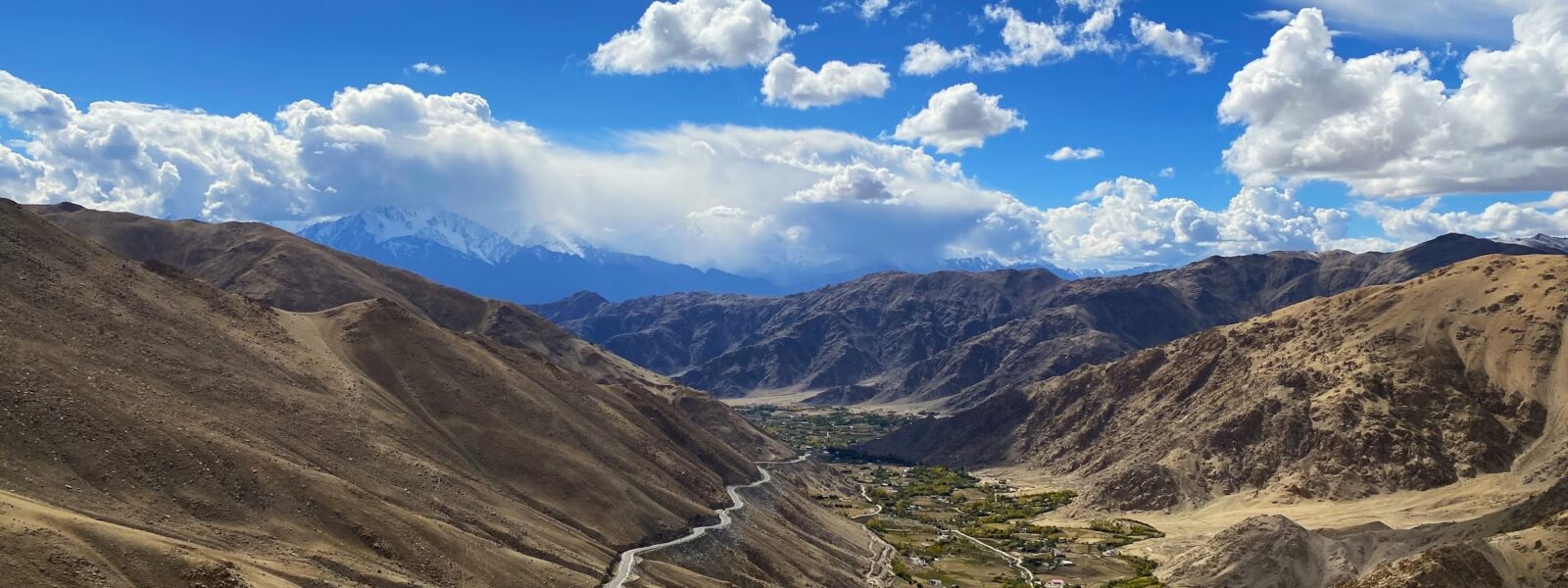
Ladakh is not a museum. Roads cut through valleys. Engines bring goods, visitors, noise, and opportunity. The new speed is useful. It can reduce the time it takes to reach medical care. It can bring supplies that make winter safer. It can connect villages to markets and schools. It also changes the meaning of distance in a way that walking reveals sharply.
When a road is nearby, a footpath becomes something else. It can become quieter, used only by those who prefer it or need it. Or it can become more vulnerable, ignored until it erodes. The relationship between old paths and new roads is not simple nostalgia. It is a negotiation between convenience and continuity.
Pilgrimage essays sometimes note how modern infrastructure sits alongside ancient routes: cafés beside Roman roads, highways visible from medieval paths. The Camino itself has long been shaped by this tension—between spiritual journey and tourist industry, between solitude and popularity. Ladakh faces its own version. Walking here can feel, at times, like stepping into a slower timeline, even as the sound of an engine reminds you that the present is pressing in.
The question is not whether modernity is good or bad. The question is what it does to the practices that keep a place coherent. Walking is one of those practices. It is a way of knowing distance that no vehicle can replace.
Safety, solitude, and the gendered reality of walking anywhere
Any honest account of walking must acknowledge safety, because safety shapes who can walk freely and how. Pilgrim narratives in Europe have increasingly addressed this—especially for women, for solo travellers, for those who do not feel equally protected by the social contract of the road. Ladakh is no exception. The landscape can be spacious and quiet, but quiet does not automatically mean safe. It means you must be attentive.
Local advice matters. Where to walk at what time. Which paths are used regularly. When weather changes quickly. When a route is too empty to be wise alone. These considerations are not romantic. They are part of walking as household practice: the day is planned so that errands and visits and obligations can be met without unnecessary risk.
Solitude is often praised in travel writing, but solitude is not experienced equally. A responsible pilgrim’s attention includes awareness of this difference. It can be written without turning the essay into a manifesto—simply by showing how people make choices, how they move with care, how the social fabric supports or fails certain walkers. The reader understands, from detail, that walking is never purely personal. It is shaped by the world you move through.
After the Last Step, the House Still Moves
A practice, not a story: walking as a household rhythm
When the walk is finished—when you return to the doorway where you began—the day does not resolve into a neat lesson. The house still requires attention. Water must be heated. Food must be prepared. Someone will go out again, perhaps to check an animal, perhaps to deliver something forgotten. This is how the Ladakh pilgrimage remains grounded. It does not end with a certificate or a stamped passport. It folds back into daily life.
On famous pilgrim routes, there is often a ceremonial arrival: a cathedral, a square, the sense of reaching a recognised endpoint. Ladakh has endpoints too—monasteries, villages, crossings—but the emotional punctuation is quieter. The significance is in what walking changes about your timing, your habits, your understanding of what is necessary. You begin to see walking not as exercise or escape, but as an organising principle. It keeps the household connected to its world.
This principle travels well. A reader in Europe may not live at altitude, may not walk village lanes lined with stone. Yet the idea of walking as household practice is portable. It suggests a way of measuring a day by attention rather than by speed. It suggests that care can be enacted through repeated, ordinary movement: visiting, carrying, returning. Not as a moral, but as a practical rhythm.
How Ladakh changes the meaning of “enough”
What remains with you is not a single dramatic scene. It is a pattern: how people in Ladakh treat effort as normal, treat repetition as competence, treat hospitality as a shared duty rather than a performance. “Enough” here is not a lifestyle slogan. It is visible in how resources are handled, how distances are accepted, how the day is planned to avoid waste.
Walking makes this visible because walking is slow enough to register the costs of everything. You feel the weight of what you carry. You notice how often you stop to adjust something rather than push on and suffer later. You understand why certain routes exist and why others are avoided. You see, in the simplest motions, a culture of maintenance: repairing channels, circling shrines, sharing tea, choosing pace over pride.
The Ladakh pilgrimage is not a separate chapter from life. It is life lived with a clear-eyed sense of distance, weather, and responsibility. It is walking that belongs to a household, to a community, to a landscape that does not reward haste. The road begins at the doorstep, and it keeps going—not as an adventure, but as a practice that holds a day together.
Sidonie Morel is the narrative voice behind Life on the Planet Ladakh,
a storytelling collective exploring the silence, culture, and resilience of Himalayan life.