
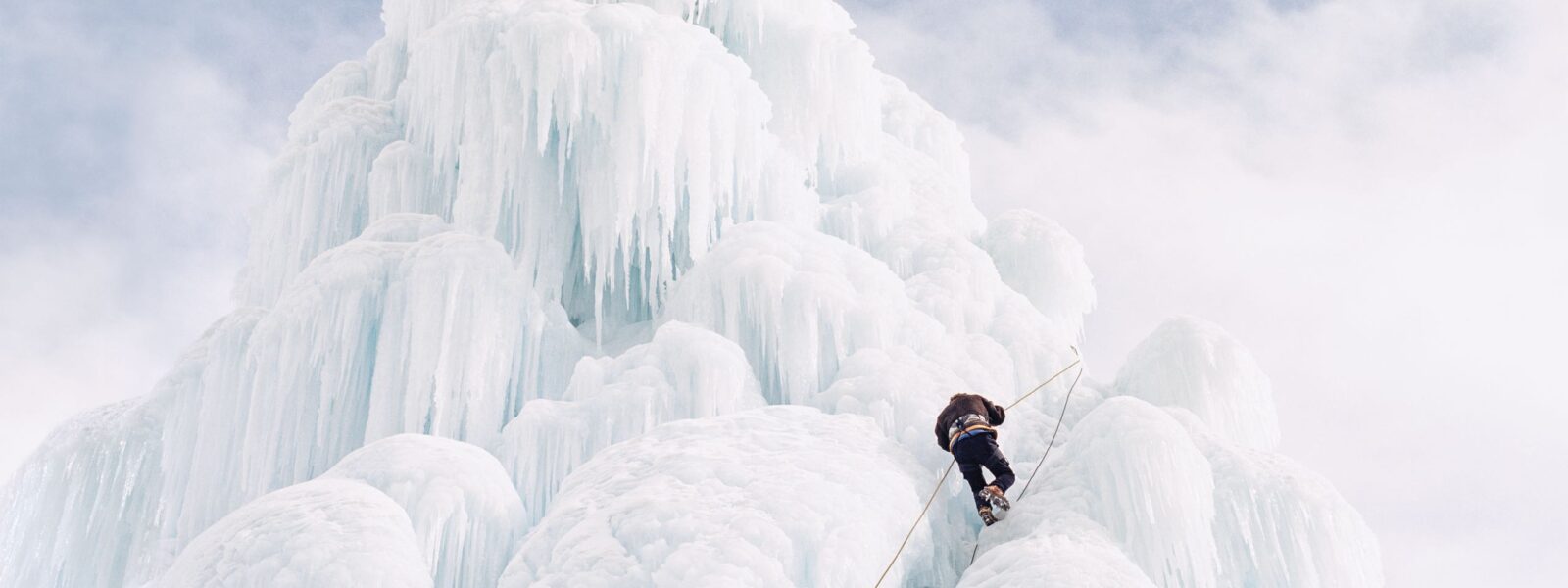
One of our team members climbs the ice stupa in Shara.
In Sanskrit, “stupa” means “heap” and traditionally refers to structures that house Buddhist relics. For thousands of years, stupas have been constructed from materials like wood, stone, clay, and brick, ranging from simple domes to elaborate tiered towers.
The first ice stupa was created in 2013 in Ladakh, Kashmir. Ladakh is a high-altitude desert surrounded by the Himalayas, and its villages rely mainly on glacier meltwater. With glaciers retreating due to climate change, water flow has become unpredictable. Sometimes there is too much water causing flash floods, while at other times there is a severe shortage. The ice stupa, an idea by Ladakhi engineer Sonam Wangchuk, aims to address this issue by storing water in the form of artificial glaciers.

Step 1:
Polyethylene pipes connect the ice stupa to a high-altitude water source, channeling water downstream.

Step 2:
Galvanized iron pipes carry water from the base of the ice stupa to a sprinkler system. Sprayed water collects on a dome-shaped structure covered with nets, where it freezes.

Step 3:
As ice accumulates, additional piping can be added to increase the structure’s height.

Step 4:
A 50-foot ice stupa can be built within a month, storing over 250,000 gallons of water.

Step 5:
Ice stupas are often constructed above riverbeds to supplement communal water supplies. One proposal suggests collecting water from the ice stupas into tanks or reservoirs connected to drip irrigation systems.

Villager Tsewang Yotul from Takmachik.

Takmachik’s 70-foot ice stupa produces over 500,000 gallons of water in one season.

In the high-altitude desert of Ladakh, where annual rainfall is about 4 inches, shrinking glaciers have led to frequent water shortages for farmers.

Padma Tenles and his father helped build the Shara ice stupa and frequently visit to assist with maintenance.
Ice stupas are created during winter using snowmelt and spring water channeled underground or downhill. Water is released at night when temperatures drop below freezing, sprayed into the air through sprinklers, and freezes. Over the season, a sophisticated conical structure forms, resembling sandcastles built by children at the beach.
Ice stupas can reach the height of a ten-story building. They begin to melt in March, and at higher altitudes (some villages in Ladakh are over 15,000 feet above sea level), this process can extend into July. The meltwater aids farmers during the crucial spring sowing season for vegetables, barley, and potatoes. (The region’s average annual rainfall is about 4 inches.)
“Ladakh is a high-altitude desert, and the agricultural season happens only once a year,” explains Simant Verma, the project manager for the ice stupa. “So, if they miss the water in that month, they miss their chance.”
In contrast to rapidly shrinking natural glaciers, artificial glaciers are on the rise. The ice stupa project began with a single prototype, but this winter, stupas were built in at least ten villages in Ladakh. Stupas have also been created in the Alps, and inquiries have come from Canada. Verma and other members have prepared manuals on how to create ice stupas and provide them to interested parties.
“We don’t see ice stupas as just a solution to climate change,” he said. “That’s not our goal. We’re promoting innovation to generate other ideas.”

Three women from Gya village visit their first ice stupa, completed in March 2019.

Inside the ice stupa in Shara.

Solar panels near Fay village reflect the Himalayas.

Traditional stone stupas in Shey. Ladakh is home to thousands of these Buddhist relics.

The village dog in Jingral.

An archer from Gya village.

Agriculture, livestock, and tourism support Ladakh’s economy.

The Himalayas have other water collection methods. For decades, farmers have created ice sheets that melt into a network of canals during the growing season, increasing water supply.

During Ladakh’s eight-month winter, snowfall often blocks roads, cutting off access to surrounding areas.
The Reference Article The Ice Stupas