
A Road of Small Markets, High Passes, and Carved Stone
By Sidonie Morel
The first thing you notice on the road from Khalsi to Kargil is how quickly the day becomes a series of tasks: finding tea before the chill settles into your fingers, choosing where to stop without blocking the traffic line, learning the rhythm of honks around blind curves, watching for trucks that drift wide on a turn as if the mountain itself were pushing them. This is not a road for speeches. It is a road for details.
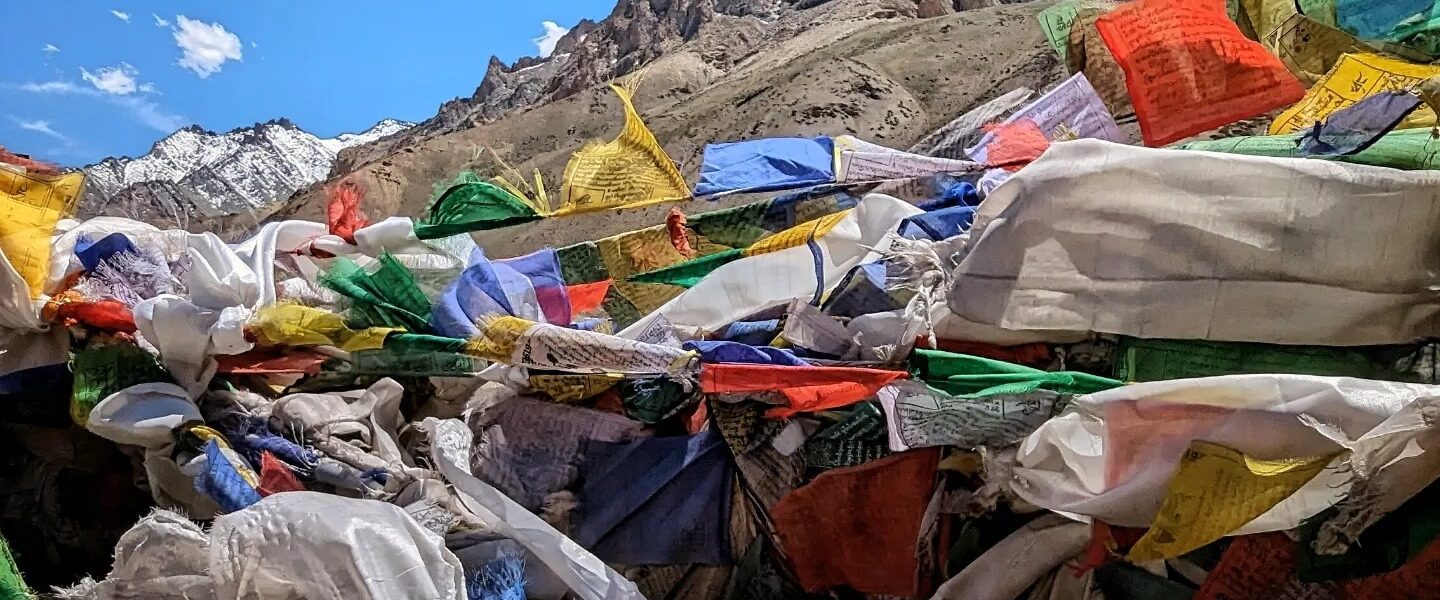
Between Passes and Prayer Stones is a good title, but it is also an accurate description of the Srinagar–Leh highway’s Kargil side, where altitude and devotion appear not as ideas but as objects you pass: a braided line of prayer flags tied to a pole, a stone wall repaired with fresh mud, a whitewashed chorten that has caught a season of dust, a carved figure in a cliff face that makes traffic slow down without needing a sign.
This stretch from Khalsi to Kargil can be done in a long day if you start early and you are not trying to collect the whole landscape. Most travellers treat it as transit—Kargil as a stopover, Lamayuru as a photograph. But the road has its own geography of attention. It teaches you to look at the working edges: the roadside dhaba where the cook’s hands are blackened with soot; the small shop selling biscuits that have travelled as far as you have; the pass where someone has left a stone under a cairn and moved on without applause.
Khalsi: Morning Noise, Metal Shutters, and the First Taste of the Road
The market as a small weather system
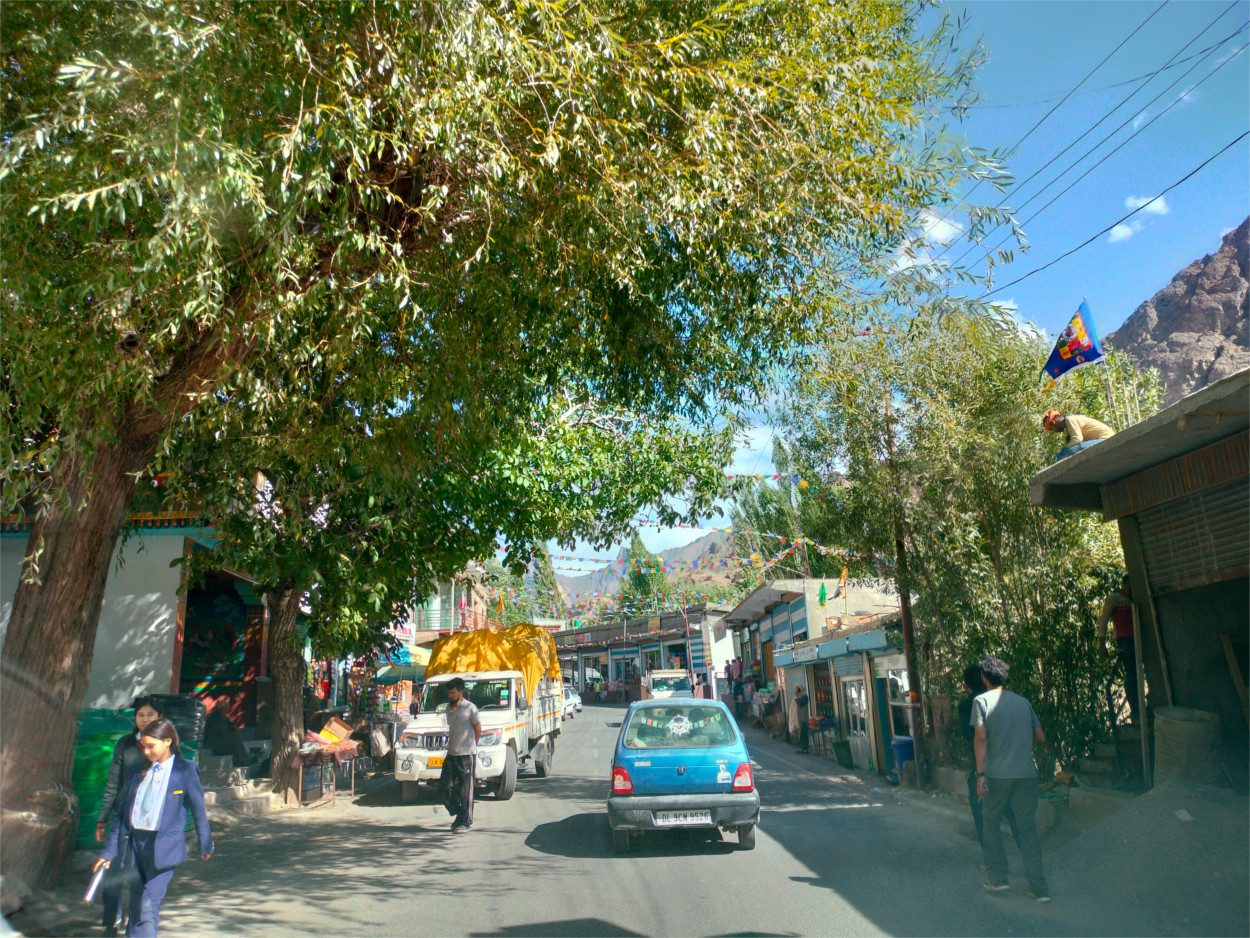
Khalsi wakes in layers. Before the shops are fully open, there is already movement: a man turning a key in a metal shutter that complains as it rises; a woman carrying a sack of onions that bumps against her knee with each step; a boy on a bicycle wobbling under the weight of two plastic jerrycans. The air near the Indus is often softer than what you will meet later—less brittle, less dry—and the smell of the market carries on it: tea leaves, diesel, damp burlap, the faint sweet-sour note of fruit that has been stored a little too long.
It is not a “bazaar” in the cinematic sense. It is practical and small, with a few stalls that sell what the road demands: thermos flasks, biscuits, cigarettes, phone recharges, packets of noodles, cheap gloves, and bright plastic that promises to solve problems the mountains will not allow you to forget. The best information comes from the smallest talk. A shopkeeper will tell you, without drama, if the pass ahead has wind or if roadwork is slowing traffic near Lamayuru. Drivers will mention the state of the asphalt not as a complaint but as a calculation—time, fuel, daylight.
If you are travelling in a private vehicle, this is where the day can be set gently. A quick cup of chai, a few minutes to buy water, a glance at the sky. It is also where you can notice a human scale before the road takes you into wider emptiness. A bus unloads passengers with bags that look too light for the distance they have travelled. A mechanic wipes his hands on a rag that is more dust than cloth. Someone opens a packet of sweets and shares it without ceremony. The road begins here not with a dramatic gate but with a mundane generosity: people doing what they do every morning, knowing that the passes are waiting and that the day will not pause for anyone who is late.
Lamayuru: Moonland, Monastery Walls, and a Silence That Isn’t Empty
Dust like flour; cliffs like broken pottery
Beyond Khalsi, the green along the river thins. Trees become smaller, then rarer; the land opens into slopes where the soil seems to have been sifted. The “Moonland” name appears on itineraries and roadside signs, but the terrain does not need a metaphor to be understood. It looks like erosion made visible: pale ridges, sharp folds, and a powdery surface that moves when the wind touches it. When a truck passes, dust lifts and hangs for a moment, softening the edges of everything, as if the landscape has briefly changed its mind about being seen.
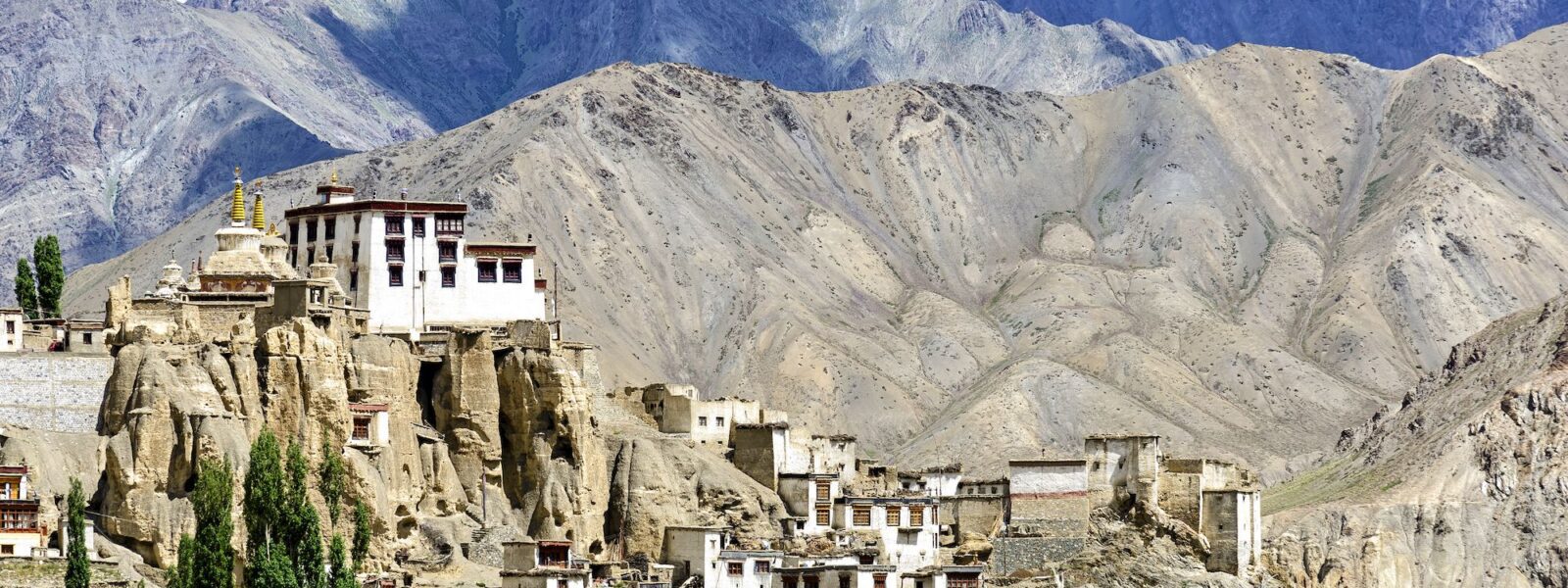
Lamayuru arrives as both place and punctuation. There is a settlement, there are guesthouses and a few shops, but the monastery sits above in a way that changes how you hold your body: you look up, you slow down, you lower your voice without being told. The walls are not precious. They are thick, weathered, familiar with seasons. The flags are faded. The stone steps show the abrasion of years of shoes. Here, religion is not a performance; it is part of the architecture, like drainage channels and retaining walls.
If you stop, you notice practical things first. The air is cooler in the shade. Water is carried in containers that are already scuffed. A dog sleeps where the sun warms a patch of ground. Visitors take photos, then move on. What lingers is not grandeur but the quiet logistics of an inhabited high place: a monk crossing a courtyard with a bundle of something wrapped in cloth; a child waiting with an expression of boredom that feels universal; a shop selling biscuits and prayer beads in the same glass case.
Lamayuru is also a reminder that this road is used. It is not a scenic corridor built for travellers. It is a route of supply and return—food, fuel, school bags, spare parts, sacks of flour. Between Passes and Prayer Stones can sound like a romantic promise, but at Lamayuru you see the everyday truth behind it: prayer stones exist beside tyre tracks, and both are part of the same day.
Fotu La: The Pass Where Breath Turns Practical
Thin air, sharp sun, and the body’s quiet arithmetic
The climb to Fotu La is steady rather than dramatic. The road works up through bare slopes, sometimes with patches of snow lingering in shadow if the season is early, sometimes with gravel pushed aside by bulldozers if maintenance is underway. You feel altitude most clearly not as a sensation to be admired but as a small change in behaviour: you drink water more often; you stand up more slowly when you get out of the car; you become slightly less interested in talking.
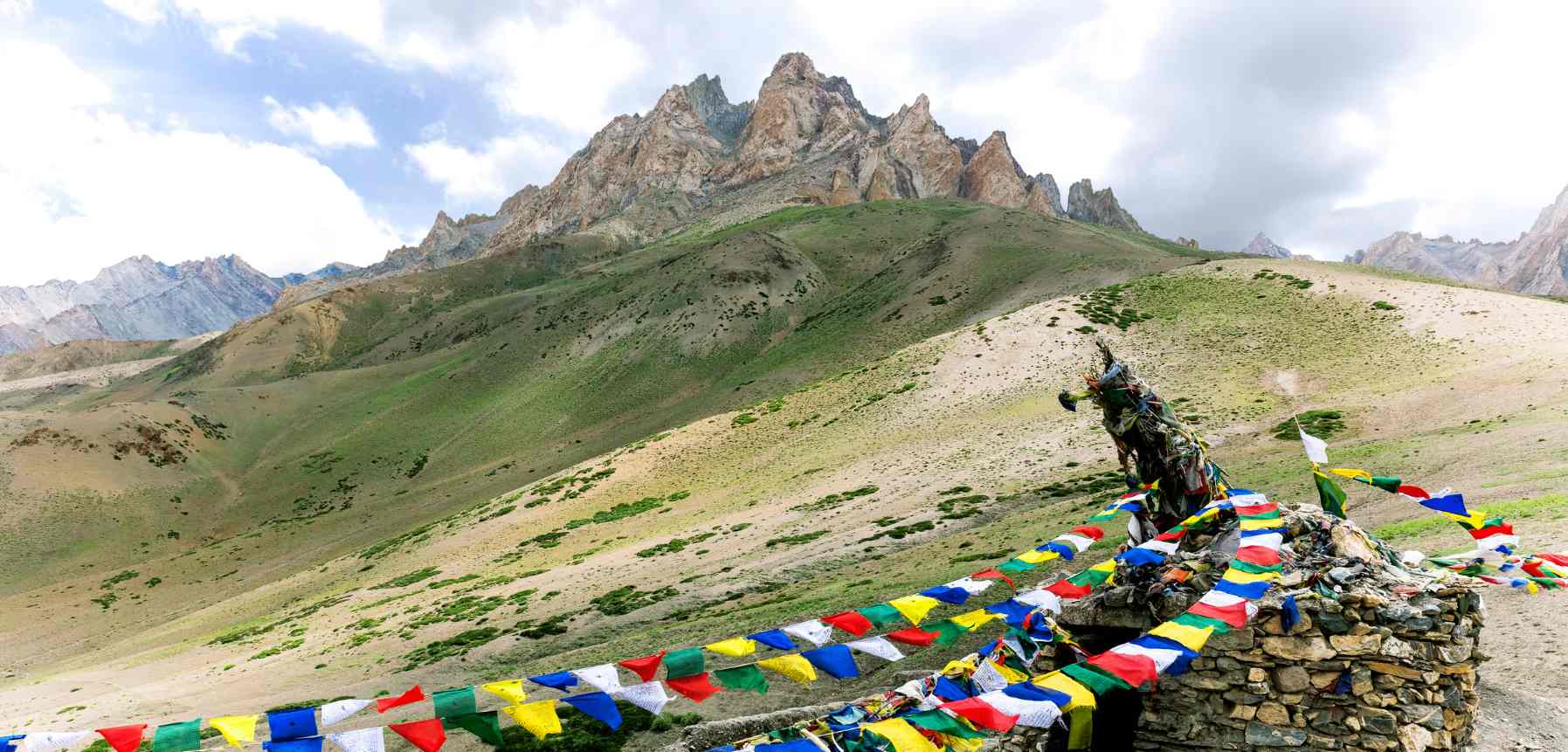
At the top, prayer flags and cairns mark the place in a way that is both ceremonial and practical. They tell you: this is the high point; this is where people stop; this is where wind is strong enough to tear cloth into ribbons. There is often a brief traffic jam of photographs—people stepping into the frame, stepping out, wrapping scarves tighter, checking phones for a signal that appears and disappears. Trucks idle, a low vibration under the whole scene.
What makes Fotu La memorable is how quickly it returns you to the road. The view is wide, yes, but it is also instructive. You can see lines of ascent and descent, the way the highway threads through the terrain without ever pretending it belongs there. The pass is not a climax; it is a hinge. You can smell cold stone and warm engine, the faint tang of exhaust, and sometimes, on a lucky day, the clean smell of air that has been scraped of moisture.
For travellers coming from lower elevations, this is also where acclimatisation becomes real. It is common sense to spend time in Leh to adjust before going higher into Changthang or remote valleys, but even on the Kargil side, passes remind you that the body has limits. A driver will often offer a simple instruction—walk slowly, don’t run, drink water—not as advice but as a routine, the way you might tell someone to fasten their seatbelt. The mountain does not punish; it simply does not negotiate.
Between Passes: Small Settlements, Long Shadows, and the Road’s Private Vocabulary
Roadside dhabas: steam, salt, and the warmth that arrives too fast
After Fotu La, the highway gives you a series of small, matter-of-fact scenes. Roadside dhabas appear at intervals, sometimes just a tin-roofed structure with benches and a stove. Inside, the air is thick with the smell of frying oil and boiled tea. The cups are often metal, warm enough to hold with both hands. There are biscuits in plastic jars, and sometimes a plate of boiled eggs. The menu is short—dal, rice, noodles, omelettes—and the food arrives quickly because it is designed to keep drivers moving rather than to impress anyone.
These stops do something important for the narrative of the road: they return you to scale. In a landscape that can feel immense and indifferent, a dhaba is a small enclosed world, held together by heat and routine. The cook’s hands move with practiced speed; someone wipes a table with a cloth that is already stained; a driver leans back and closes his eyes for two minutes, not sleeping but resetting. If there is a radio, it plays low. If there is silence, it is filled by spoons against metal and the hiss of a kettle.
Outside again, the road speaks in its own vocabulary. You learn to read piles of gravel as signals of upcoming work. You notice where the asphalt has been patched, where water has cut a groove, where rockfall has left fresh scars on a slope. You begin to recognise the sound of different vehicles: the heavy growl of trucks labouring uphill, the higher pitch of a small car accelerating to pass, the brief sharp brake of someone surprised by a blind bend.
For European readers used to motorways that separate you from the landscape, this road can feel intimate. There are no long barriers, no thick margins. You travel close to the terrain. You watch people walk along the shoulder with sacks and bundles. You pass small bridges where the water below is a thin ribbon, but the stones around it show that in another season it can become a force. Practical information lives in these observations. Weather changes quickly; daylight matters; stops are fewer than they look on a map. The road does not ask you to be brave. It asks you to be attentive.
Bodh Kharbu: A Soft Fold in the Valley
Monastery calm against the restless traffic line
Bodh Kharbu feels like a crease in the day. There is a monastery presence here—white walls, a quiet authority—and the valley around it has a gentler rhythm than the passes. You can see small fields, irrigation channels, and the careful human work of keeping a high desert hospitable. The houses are built to endure: thick walls, small windows, roofs that carry winter. In some seasons you will see green patches that look almost improbable after the bare slopes; in others, the fields are brown and stubbled, waiting.
On the highway, traffic does not stop being traffic. Trucks continue to push through, buses continue to carry people between towns, and travellers continue to glance out of windows as if the landscape were a film. But if you slow down in Bodh Kharbu, you notice the quieter layer beneath: someone sweeping a yard with a bundle of twigs; a child standing near a doorway watching cars go by; a dog trotting along a wall, uninterested in the drama of transit. The place does not perform itself for you. It simply exists beside the road.
In travel writing, it is easy to make villages into “stops,” but the most honest approach here is to treat them as lives adjacent to your route. Bodh Kharbu reminds you that between passes and prayer stones, there are also water channels, storage sheds, sacks of grain, and small domestic objects that keep people warm: blankets airing in sunlight, a kettle blackened by fire, a plastic basin used for washing. If you are looking for the “meaning” of the road, it may be here, in the way daily maintenance and devotion share the same limited resources—time, fuel, water, hands.
Namika La: A Second Threshold, Cooler and More Serious
Altitude again—this time with fewer words
Namika La arrives after you have already crossed one high point, which makes it psychologically different from Fotu La. The novelty is gone; the body’s adjustments are already underway; the day has become a line you are following. The climb can be quiet. Drivers focus. Conversation thins. The road surface changes in places—smooth asphalt, then rough patches, then gravel where repairs are ongoing—and you feel these textures through the seat more than you see them.
At the pass, the wind often has a harder edge. Prayer flags again, stones again, but the atmosphere is less festive. People still stop for photos, but there is less laughter. Many are thinking about time: how far to Kargil, whether they will arrive before dark, whether the next stretch has roadwork. In high places, practicality becomes a kind of courtesy. You do not waste others’ time; you park carefully; you move on.
What you can observe clearly at Namika La is how the terrain shapes the highway’s behaviour. The road is not straight because the mountain does not allow straightness. The route follows contours, avoids unstable slopes where it can, and accepts compromises where it must. Rockfall protection appears in sections—wire netting, concrete barriers—evidence of constant negotiation with gravity. Even a traveller with no interest in engineering can understand the logic simply by looking: where the cliff is fractured, the road hugs the safer side; where water cuts down a gully, the road lifts slightly.
Namika La is also where you begin to feel Kargil approaching. The landscape subtly changes: the valley begins to gather more signs of habitation, more tracks, more small structures. The day tilts away from the monastic quiet of the high plateau and toward a town rhythm—shops, families, evening meals, the sound of television through a window. Between Passes and Prayer Stones remains true, but another pair of words starts to accompany it: between distance and arrival.
Wakha: Where the Valley Narrows and the Road Starts Speaking in Rock
Riverbeds, wind-cut slopes, and the sudden intimacy of cliffs
Wakha is one of those names you can miss if you are staring only at the dramatic parts of the journey. The valley narrows, the rock feels closer, and the road begins to run alongside dry riverbeds that look harmless until you notice how broad they are. Their width is a story of sudden water—snowmelt, storms—and the stones inside them are polished in places, showing that movement has been violent enough to smooth sharp edges.
Here, the hand-feel of the journey changes. Dust becomes finer, more insistent; it finds seams in clothing and settles into the corners of windows. The air can be cool even in sun because the wind has a clear channel through the valley. You see small clusters of houses, often built with stone that matches the terrain so closely they appear to be part of it. From the road, you can observe the way life clings to the workable patches: where there is a flatter section, there is a field; where there is water, there is green; where there is shade, there is a place for animals to stand.
For travellers, Wakha can be a segment rather than a destination, but it does something important in the sequence: it prepares you for Mulbekh and Shargole, where the relationship between rock and belief becomes visible. Here, rock is not merely background. It is infrastructure and shelter, it is threat and resource. You see walls built from flat stones stacked with skill. You see repairs—fresh mud, new stones—evidence that the road and the villages are not static. They are always being made again.
It is also a section where the road’s safety logic becomes obvious. The turns are sometimes tight; the sightlines are short. You pass vehicles that appear suddenly, close enough to make you hold your breath for a second. Then the moment passes, the driver corrects, and the day continues. There is no heroism in it. There is competence, and a shared understanding that everyone wants to arrive.
Mulbekh: The Maitreya in the Cliff and the Strange Comfort of Time
The carved figure: not an attraction, a witness
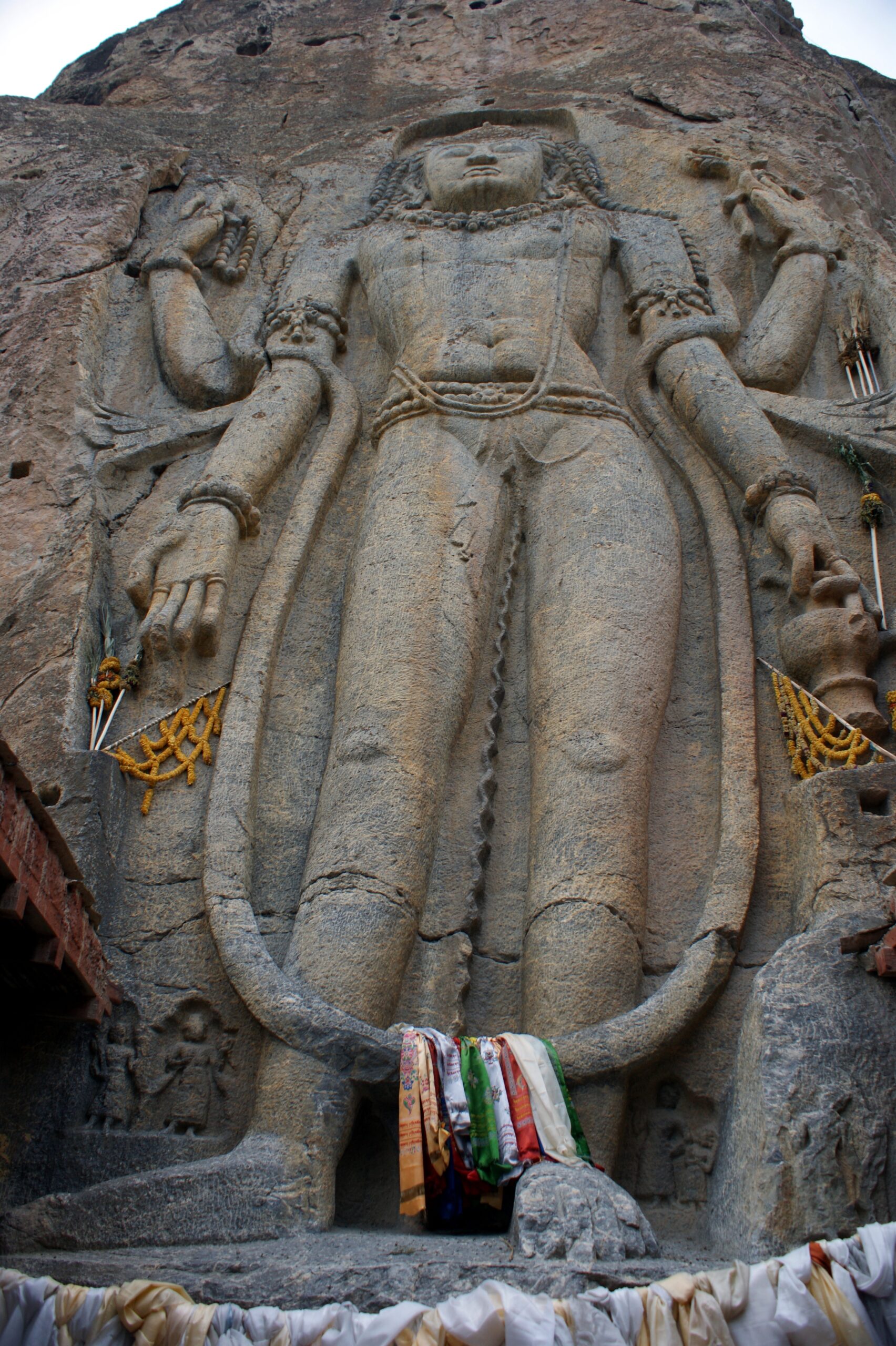
Mulbekh is where many travellers finally slow down for something other than tea. The reason is carved into the cliff: the Maitreya, a standing figure cut into rock, weathered by sun and snow, visible from the roadside in a way that makes it impossible to pretend you did not notice. People stop. They step out of vehicles. They look up. Cameras appear, but so do folded hands. The pause is not uniform, but it is real.
The carving is not polished. It is not protected by glass. It bears the marks of time and the abrasions of the environment. If you stand close, you can see how the rock surface changes—smooth in some areas, rough in others, a texture that feels more like a cliff than a sculpture. Offerings may be present: a few flowers, a scarf, a smear of colour, a small pile of stones placed deliberately. There may be a low wall, a small shrine structure, a place where someone has lit incense. Smoke rises thinly, then disappears into wind.
It is tempting to treat this as a “highlight,” but the more honest observation is that Mulbekh makes you aware of how belief sits in the landscape. It is not separated into a special zone. It is part of the route. The road runs beside it. Trucks pass. People climb down from buses and then climb back in. The sacred and the logistical share the same air. Between Passes and Prayer Stones feels literal here: the prayer stones are not decorative; they are physical work, placed and carried and maintained, as real as the asphalt beneath your feet.
Mulbekh also gives you a sense of time that is different from travel schedules. The carving has outlasted countless journeys, countless political shifts, countless seasons of road repair. You can observe this without needing to declare it. The surface itself tells you. In a world of fast movement, a figure in stone asks you to measure duration differently—by weathering, by touch, by the slow accumulation of dust in crevices that no one cleans because it is part of being outside.
Shargole: Cave Monastery, Cool Shade, and the Road’s Hidden Rooms
Entering a darker pocket of air—relief, then reverence
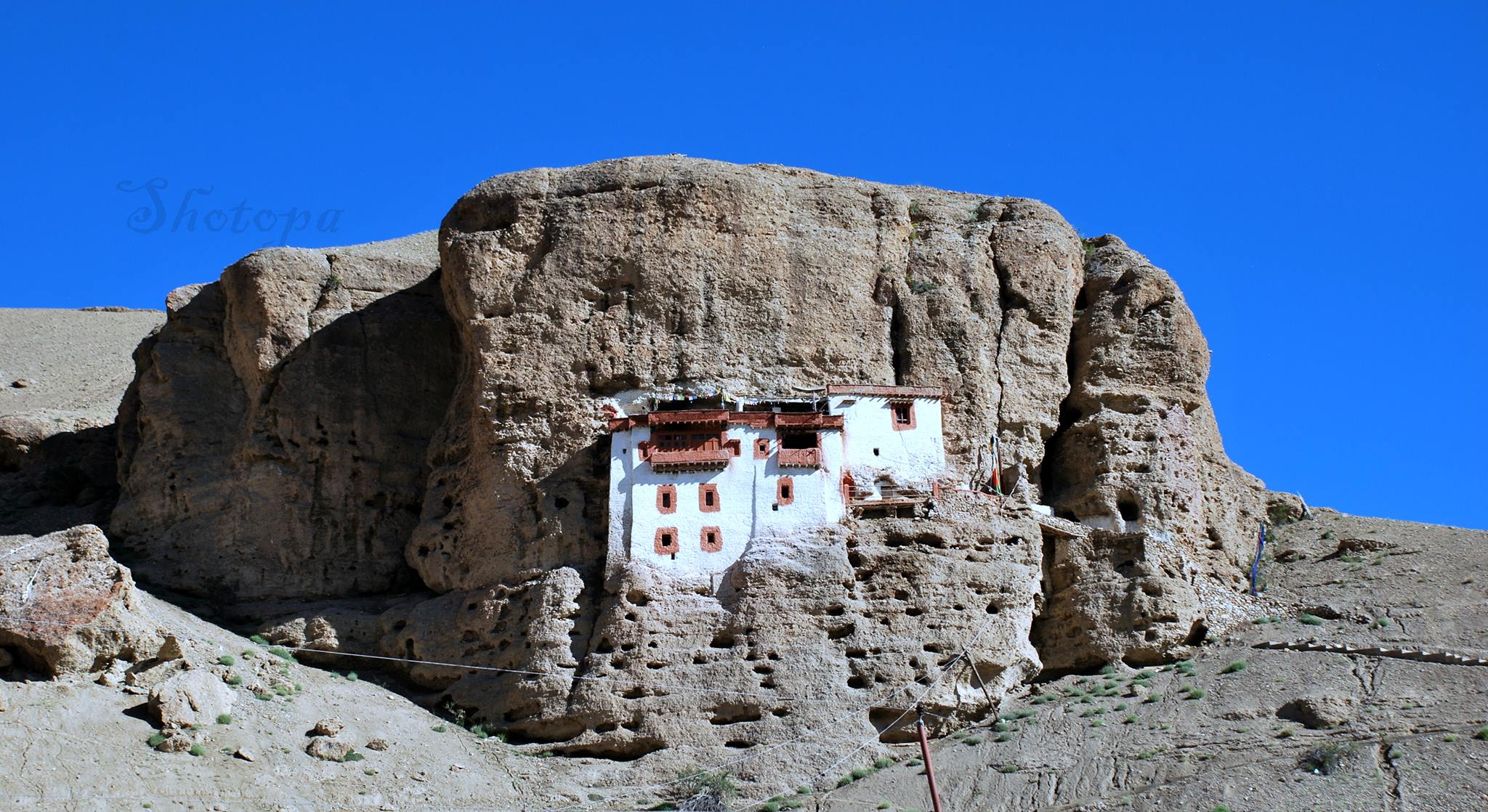
Shargole does not announce itself with grandeur. The landscape continues to fold and unfold, and then there is a cliff face with openings that look like they belong to geology rather than architecture. The cave monastery sits there, rock-cut, shaded, and immediately different in temperature. If you step inside, the air changes. It becomes cooler, denser. Your eyes adjust slowly. Sound changes too—traffic noise dulls, voices lower, footfalls become careful.
The interior is not designed for crowds. It feels like a place made for small numbers, for people who know how to move in tight spaces without knocking into walls. The stone holds a faint smell of damp and old dust. If there are painted surfaces, they are often muted by time. If there are lamps, their light is soft, not theatrical. What you notice most is the sensation of being inside the mountain—inside the material you have been watching all day from the road.
For a traveller, Shargole offers relief from exposure. After hours of sun and wind, a shaded rock space is not only spiritually interesting; it is physically satisfying. This is part of why the site matters in a road essay: it reminds you that the sacred is also practical. People have always used caves for shelter. To turn them into monasteries is to shape refuge into ritual. The boundary between those two functions is not sharply drawn.
Shargole also sits in a region where border narratives are never far away. But the cave monastery refuses to be reduced to a headline. It is an ongoing place of practice, visited by people who live nearby, maintained with the quiet labour of cleaning, repairing, and keeping a space usable. If you want to write responsibly about this stretch, it is better to stay with what can be observed: the worn steps, the soot marks, the way someone removes shoes and straightens a scarf before entering. The larger context exists, but it does not need to be shouted to be understood.
Kargil: Not a Symbol, a Town with Evenings, Families, and Warm Bread
Arriving in the ordinary: shops, voices, headlights, and relief
By the time you reach Kargil, the day has collected itself into fatigue. The town arrives not as a dramatic finale but as a return to density: more buildings, more signs, more people on foot, more vehicles moving in different directions. The traffic pattern changes. The road becomes a street. You see storefronts with bright packaging, mechanics’ shops with spare parts hanging, bakeries with trays behind glass. There is a smell of cooking that is different from roadside dhabas—more varied, more domestic.
If you are staying overnight, Kargil offers a practical comfort: running water, a room that holds heat, a place to wash dust from your hands. For European readers who may be planning an itinerary that includes both Kashmir and Ladakh, Kargil often functions as a hinge between landscapes and climates. It is also a sensible place to break the journey, especially if you want to avoid driving mountain roads after dark. The highway can be unpredictable—roadwork, landslides, slow convoys—and arriving before evening gives you margin.
But to treat Kargil only as a stopover is to miss its human texture. In the evening, you see families walking, schoolchildren with bags, shopkeepers closing shutters, people buying vegetables, bread, and small necessities. Tea is poured again, but now it has the rhythm of home rather than transit. The day’s dust shows up in small ways: in the creases of clothing, in the corners of shoes, on the cuffs of sleeves. People brush it off without comment.
If you have written the road honestly, you do not need to announce what it “meant.” Kargil itself will show you the quiet outcome: you have moved through passes and prayer stones, through villages and rock spaces, and you have arrived in a place where life continues in a different tempo. Headlights pass on the street. A dog sleeps near a doorway. Someone laughs in a room above a shop. The road remains behind you as a line of tasks completed—tea, passes, stops, attention—and as a series of objects now lodged in memory: a metal cup warm in both hands, a flag snapping in wind, a carved figure in a cliff that made traffic slow down.
The Same Highway, Seen Differently on the Way Back
When passes are no longer obstacles but familiar faces
Many travellers return the same way, heading from Kargil back toward Lamayuru and Leh, and the repetition changes the road. What was unfamiliar becomes readable. You begin to recognise bends, dhabas, the place where the valley opens, the section where the asphalt is newly repaired. You may stop at Mulbekh again, this time with less urgency, noticing details you missed: the way stone holds heat on one side and stays cold on the other, the small pile of offerings shifted by wind, the scuff marks near the base where countless shoes have stood.
The passes also feel different. Fotu La and Namika La are still high and still windy, but they are no longer surprises. You know to move slowly. You know that the body can be cooperative if you treat it well: water, patience, light food, small pauses rather than sudden effort. The road’s etiquette becomes clearer too. You understand why drivers honk at certain turns, why they choose specific passing points, why they avoid stopping in narrow sections. Familiarity does not make the road safe, but it makes it less mysterious.
On the return, the “prayer stones” part of Between Passes and Prayer Stones can come into sharper focus because you are no longer chasing arrival. You have time to see the small marks of devotion that are easy to miss when you are focused on kilometres: a tiny chorten by the roadside with fresh paint; a line of stones stacked with care; a few flags tied to a shrub; an elderly man walking slowly, turning prayer beads with a hand that knows the rhythm. None of it asks to be photographed. It simply persists beside the highway.
And then, inevitably, you come back to the first practical truths: the market at Khalsi where metal shutters rise in the morning, the smell of tea and diesel, the sound of vehicles leaving. The road from Khalsi to Kargil is not a single dramatic story. It is a sequence of lived spaces, each with its own temperature and texture, held together by movement. If you travel it attentively, it offers something valuable without insisting on it: a clear sense of how mountains organise daily life, and how people, in turn, leave small, deliberate marks on stone and air as they pass.
Sidonie Morel is the narrative voice behind Life on the Planet Ladakh,
a storytelling collective exploring the silence, culture, and resilience of Himalayan life.