


The Year of Two Returns
By Sidonie Morel
The order of the year
Autumn back to the village, spring back to the hostel
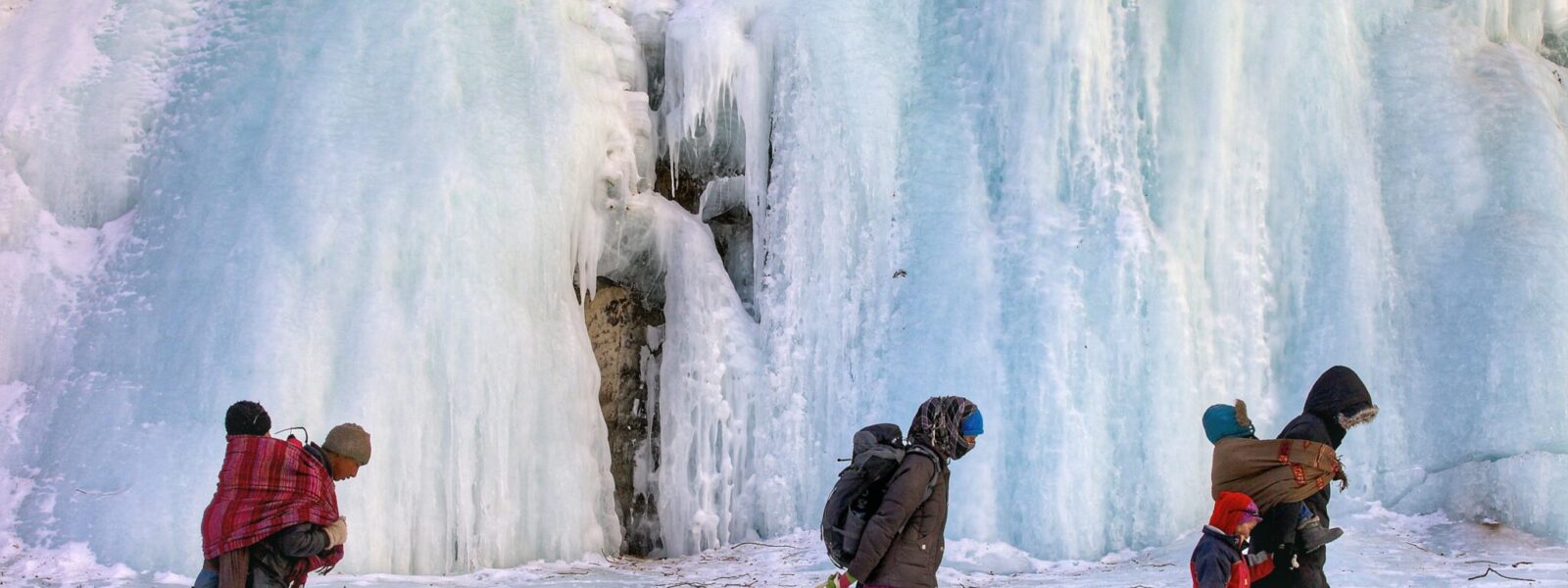
In parts of the western Himalaya where winter closes roads for weeks at a time, the school year is arranged around two long journeys. Before winter tightens its grip, children return from the boarding hostel to their home village. When spring arrives and the route becomes usable again, they travel from the village back to the hostel to begin the next stretch of schooling. The movement happens twice a year, and the direction matters.
It helps to name the sequence plainly, because the landscape can confuse the reader if it is introduced too early. First comes the autumn return: hostel to village, timed before heavy snow, ice, and rockfall make travel unreliable. Then comes winter in the village: household work, livestock care, water management, fuel management, and the small daily routes that remain. Finally comes the spring departure: village to hostel, when the river surface, banks, and paths become passable again for a sustained crossing.
People speak of this rhythm without ceremony. It is not described as an adventure. It is described as the practical requirement of sending children to boarding school in a place where roads disappear for a season. The journeys exist because the school calendar is fixed, while the terrain changes. Families solve that mismatch through timing, preparation, and routes that would not be chosen in any other month of the year.
The autumn return
Leaving school before the valley closes

The autumn journey is the return to the village. It happens while there is still enough daylight and while the surfaces are still predictable: dirt paths, stony tracks, and sections of road that may be rough but are not yet sealed by ice. There is urgency in the schedule, but it is not expressed as panic. It is expressed as a checklist. A child’s bedding comes home. Clothes return for repair. Books return for safekeeping. The household counts what it will need for the winter months and makes sure the child is present for the work that cannot be outsourced.
At the hostel, there are routines that look ordinary—packing a bag, rolling a blanket, tying a bundle—but the weight and purpose are different. The bag is built for a season away from the school. Items that are small in a city become essential here: spare socks, a torch, a container that will not crack, a knife that can cut rope or bread, a cover that protects notebooks from damp. Nothing is decorative. Everything has a use.
When the child arrives in the village, the arrival is not staged as a homecoming. It becomes visible through tasks. A pair of hands returns to the household economy. Another person no longer has to carry that load alone. If there are animals, the child takes a role in feeding, checking, and cleaning. If there is fuel to store, the child takes a role in moving, stacking, and guarding it against moisture. The school term ends, but the year does not pause. Work simply shifts location.
Winter in the village
Short routes, fixed rooms, and daily accounting
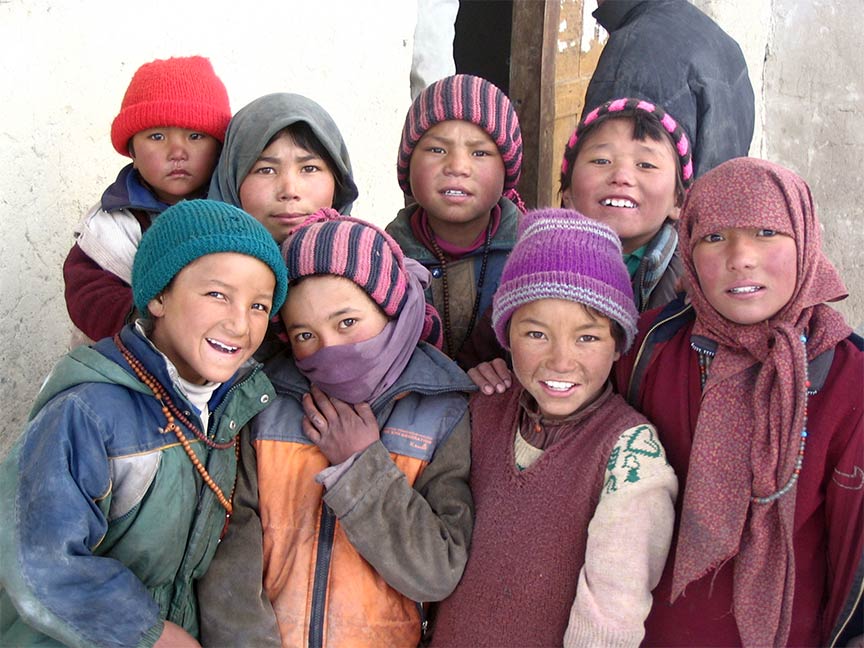
Winter reduces movement. Paths shrink to what is close and necessary: the doorway to the pen, the yard to the woodpile, the corner where snow is cleared, the point where water can still be accessed. A day is built around light because light determines the safest hours to step outside and the hours when surfaces are most stable. A place that is safe in the morning can be slick by afternoon. A shallow drift can hide hard ice. An easy slope can become a slide when wind polishes it.
Indoor work becomes the core of the day: grain measured and protected from damp, dough prepared with careful water use, containers rinsed with minimal waste, clothing dried where there is sun, clothing repaired where there is not. Fuel is counted. Butter is protected from spoilage. Tea is stretched. A kitchen often becomes the room where decisions are made because it is the room where everyone gathers and where the conditions of the day can be reviewed aloud.
For the child who will return to school in spring, winter is not an empty interval. It is the season when practical skills are reinforced: carrying loads without spilling, tying knots that hold, keeping hands functional in cold air, moving in footwear that stiffens overnight, and adjusting pace to avoid sweating that will later freeze. These are not presented as character lessons. They are basic competencies, as ordinary as learning a timetable.
Reading the conditions before spring departure
Weather judgment and a narrow window
The spring journey begins with observation. Before anyone steps onto a route that may involve ice, narrow passages, and limited shelter, families check conditions. The checks are simple in tools but careful in method: watching cloud movement, noting wind direction, looking at the clarity of distant ridges, listening for changes in weather that arrive as sound before they arrive as snow. In many families, a father or elder carries the responsibility of saying when it is safe enough to start. That judgment is not treated as intuition. It is treated as accountability.
Departure is delayed if visibility is poor, if new snow masks old ice, or if the temperature shifts in a way that makes surfaces unreliable. It is also delayed if the group cannot travel fast enough to reach a known stop before dark. Time matters because night changes the route. Ice hardens in some places and becomes more slippery in others. Snow can crust and then break underfoot. Wind can remove tracks. In such conditions, “waiting for a better day” is not laziness. It is risk management.
Packing follows the same logic. Food is chosen for calorie density and shelf life: flatbread, dried items, salt, sometimes a small amount of sugar. Clothing is chosen in layers and tested for function: gloves that allow grip, socks that can be changed, an outer layer that blocks wind. A torch is checked. A rope is checked. The bag is lifted to confirm weight. The goal is not comfort. The goal is the ability to move consistently for hours without losing hands, feet, or time.
The spring journey from village to hostel
Frozen rivers, narrow banks, and controlled pace
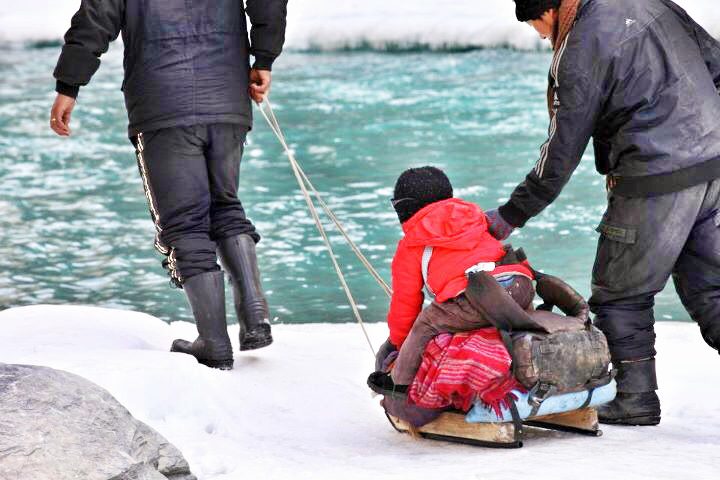
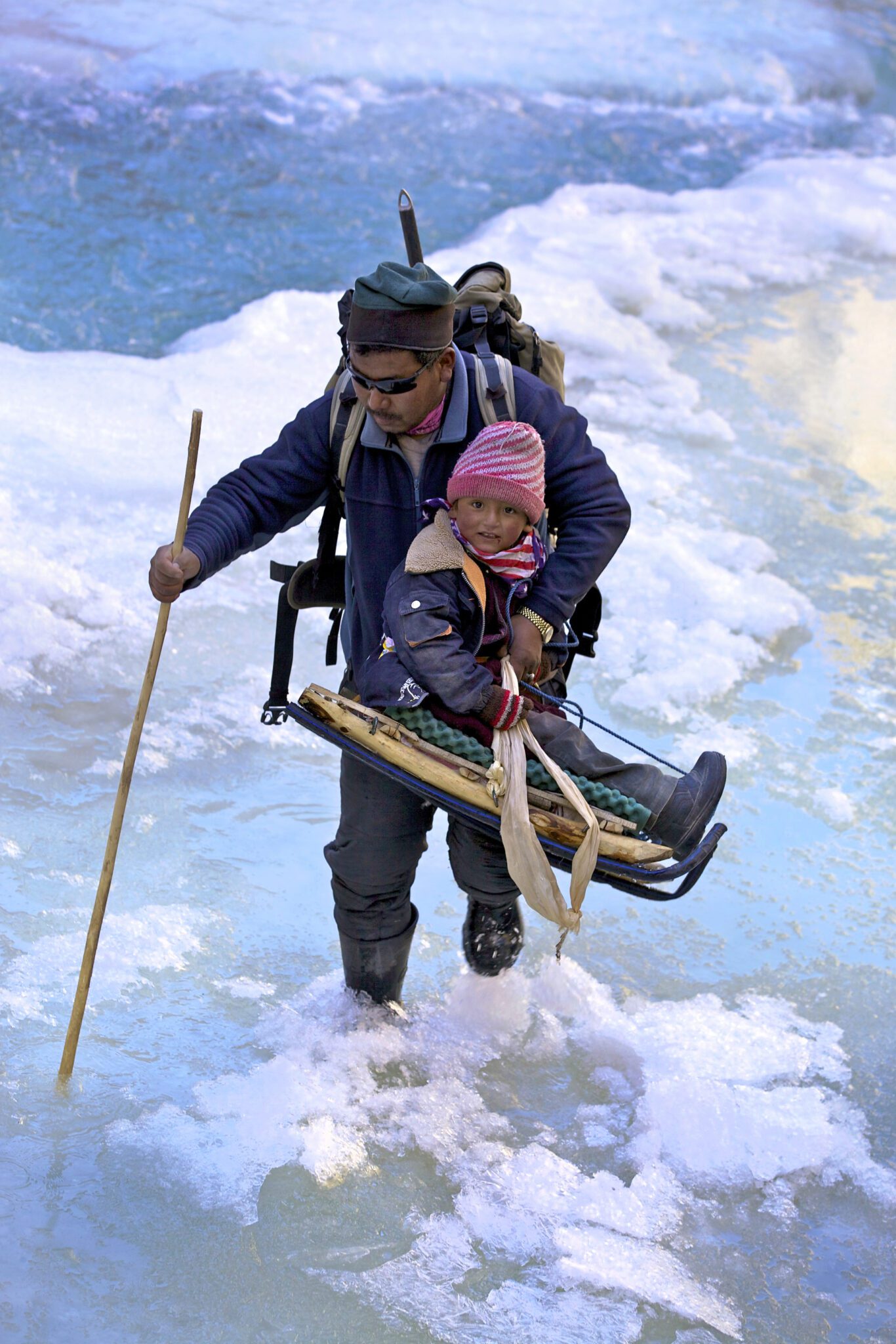
In some valleys, vehicles cannot be used at all in the early part of the season. The route becomes whatever line stays open. This can mean following the river corridor—sometimes on the bank, sometimes on the frozen surface itself—because slopes above the river can carry snow and rock, and because side paths can vanish under drifts. The river route is chosen for continuity, not for spectacle.
The surface requires constant evaluation. Ice is not uniform. There are opaque sections that are thicker and clearer sections that can be thinner. There are ridges formed by overflow that freezes in layers. There are patches where moving water undercuts the crust. There are places near bends and narrow points where the current remains strong. People who know the route pay attention to sound and to visual cues: the texture of the ice, the presence of cracks, the way snow sits on top of the surface, the dampness that indicates flow beneath.
Movement is organized to reduce error. Spacing is kept between walkers so that a slip does not cascade. Foot placement is deliberate. Breaks are timed and short. Straps are tightened before they loosen too far. When loads are heavy, they are sometimes dragged on a simple sled to reduce strain. A sled solves one problem and creates another: it can catch on ridges, tip on uneven sections, and drag behind at an angle that pulls the handler off line. The rope must be held with a grip that remains possible even when gloves stiffen. The load must be tied so it does not shift and grind through fabric.
Distance is less important than reaching a workable stop by the time light fades. People measure the day through known markers: a widening of the valley, a bend with safer footing, an outcrop that provides shelter from wind. When the route has no reliable exit points, the day’s plan becomes more rigid. The group moves because stopping in the wrong place can mean exposure and lack of shelter.
Night stops and the work of shelter
Caves, overhangs, and morning starts
If the crossing takes more than a day, the night stop is chosen for function. A cave or rock overhang can provide wind protection and a boundary that keeps snow from filling the sleeping area. The surface inside is rarely flat. Dust and soot can be present from past stops. There can be animal traces. The air can still be cold and dry. People use what they have: a ground layer, bedding, extra cloth to separate skin from rock, and careful placement of items so they do not freeze into unusable shapes by morning.
Food is handled to avoid loss. Water is managed carefully. If there is fuel, it is used sparingly. If there is not, warmth comes from layered clothing, controlled breathing, and close packing that reduces exposed surface area. Boots are kept near enough to avoid freezing stiff at a distance. Gloves are checked. Torches are checked. The next day’s movement is planned with the same constraints as the first: start early, use the firmest hours of the day, and aim for a place where shelter is possible if conditions change.
The morning is built from quick tasks. Loads are re-tied. Straps are tested. The route is re-evaluated at the first bend or exposed section. If the group has an experienced adult, the pace is controlled to avoid sweating that later becomes cold. This is where the journey’s discipline shows itself: not through speeches, but through repeated small corrections that keep the group moving.
At the hostel, the cycle becomes visible
School routines, and the next return already embedded

Arrival at the boarding hostel is a transition into a different schedule. Snow is knocked from clothing. Wet items are separated. Bedding is laid out. Notebooks are checked for moisture and damage. Hands that spent days on rope and ice now handle pens and buttons. The child enters a timetable shaped by bells and classrooms. The change is practical and immediate. Meals appear at set times. Attendance is counted. Lessons begin whether the route was easy or hard.
The return journey does not disappear when the child sits at a desk. It is present in the way supplies are stored and maintained, because the household knows the child will travel again. Clothes must last. Bags must hold their seams. Torches must keep working. When the term ends, the child will return to the village before winter closes the valley again. That autumn return is not a separate story. It is the other half of the same arrangement.
Seen from outside, the long way back to school can be mistaken for a single dramatic crossing. In practice it is a repeated route in two directions, tied to seasons and to the limits of infrastructure. Before winter: hostel to village. When spring opens the route again: village to hostel. The year turns, the household watches the conditions, and the child moves when movement is possible.
Sidonie Morel is the narrative voice behind Life on the Planet Ladakh,
a storytelling collective exploring the silence, culture, and resilience of Himalayan life.