


A Black Mountain at the Edge of Permission
By Sidonie Morel
In Zanskar, light does not merely fall; it settles, as if it has weight. It presses the valley into clarity—stone made sharper, water made colder to the eye, the dust in the air briefly revealed like flour shaken over a table. I arrived with the ordinary European hunger to “see,” to translate distance into possession. Zanskar refuses that hunger gently, the way a host refuses a second glass for your own good.

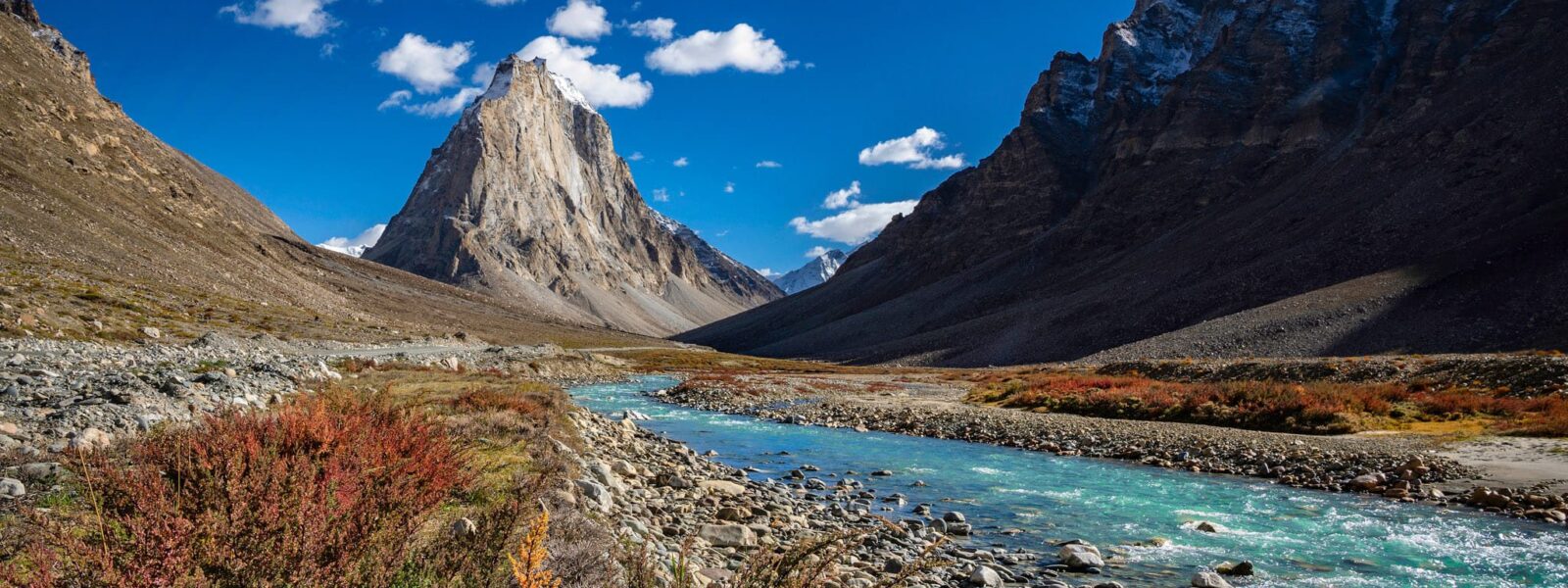
I learned this first not from a monastery wall or a sentence of doctrine, but from a dark shape that would not soften as the day warmed: Gonbo Rangjon Zanskar. It did not “welcome” me. It did not perform. It stood there in its own shade, and the valley organised itself around its refusal.
Opening Scene — Light Before Meaning
A morning that doesn’t invite conquest
The morning began with the small domestic facts that travel rarely admits are its true engine: a metal cup whose rim had cooled overnight, a mouth that tasted of yesterday’s dust, the faint stiffness in my fingers from cold that had crept through wool. Someone poured butter tea with the unhurried certainty of a person who has poured it a thousand times, and the surface shone for a moment—yellow, oily, almost tender in the pale air. I held the cup as if it were a hand warmer. It smelled of salt and smoke. It was not romance. It was comfort with a practical face.
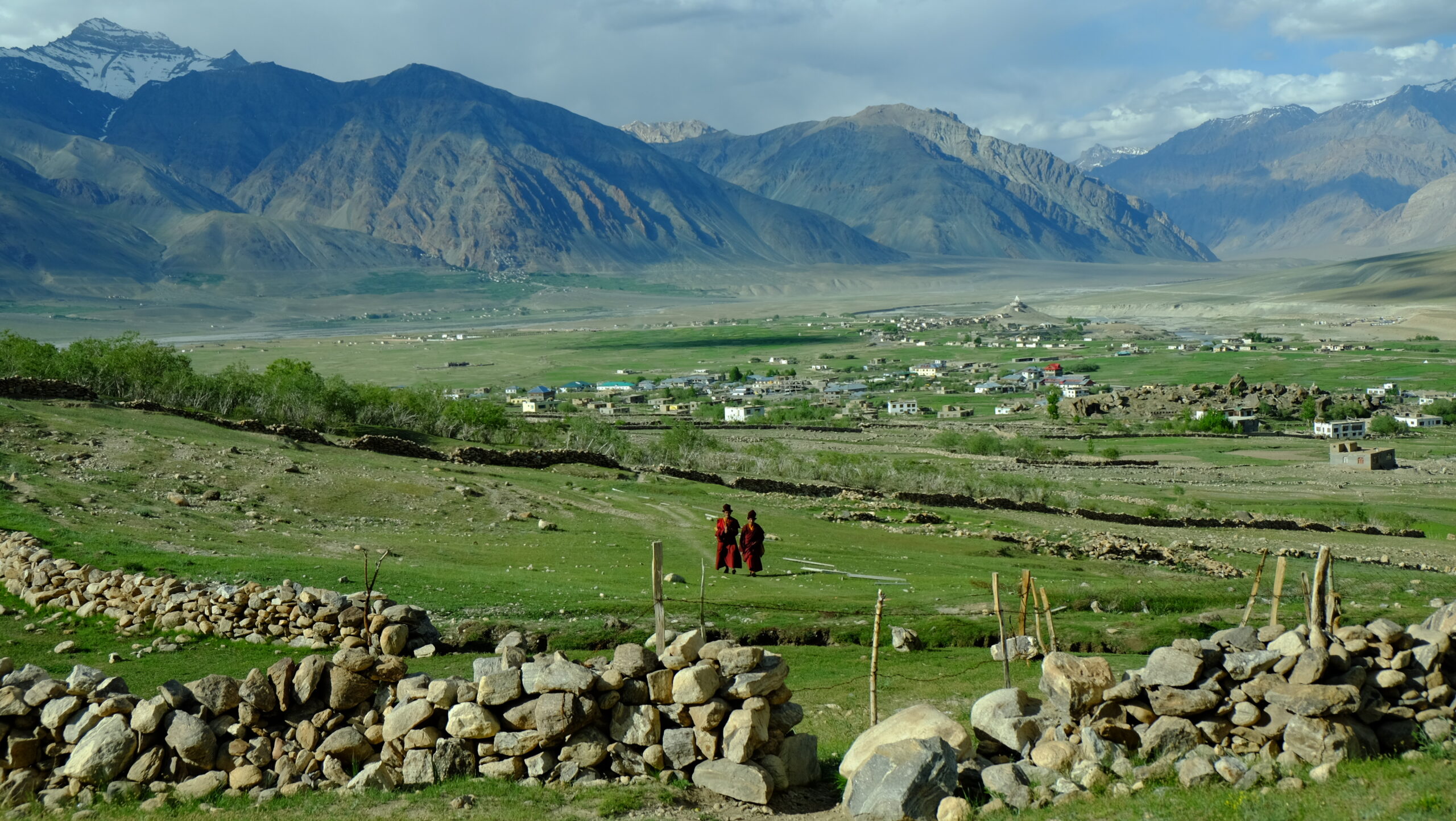
Outside, the wind moved in thin threads, testing the edges of prayer flags and the hems of jackets. A dog trotted past with the careful indifference of an animal that knows the human world is only one part of the day. The road—if you can call it a road without lying—carried a few sounds: an engine far away, then nothing, then the faint scrape of stones under a boot. It was in this quiet that Gonbo Rangjon Zanskar made itself present, not by announcing itself but by remaining unchanged while everything else shifted.
I had come, like so many of us do, with a camera cleaned the night before, batteries charged, pockets rearranged for convenience. The body prepares itself for taking. Yet the valley’s first lesson was about receiving: the sensation of cold in the nostrils, the dryness on the lips, the sun that warms one cheek while the other stays winter. In Zanskar, the simplest comfort is earned—by patience, by slowing down until your pulse stops insisting on its own schedule. In that slowed state, the mind becomes less clever, more attentive. That is not virtue. It is survival, made elegant.
I did not think, in that first hour, of “sacred geography.” I thought of the weight of my scarf, the way it scratched my throat. I noticed the colour of dust on the cuffs of my trousers: not brown, not grey, something like crushed biscuit. I watched a woman tie a bundle with a strip of cloth as if she were wrapping a gift. Practical gestures can be the most reverent. In their calm, they make room for what cannot be hurried. And that is how the day opened—without conquest, without a thesis, with the ordinary world laid out like a cloth on stone.
The first sight of the mountain (Gonbo Rangjon as silhouette)
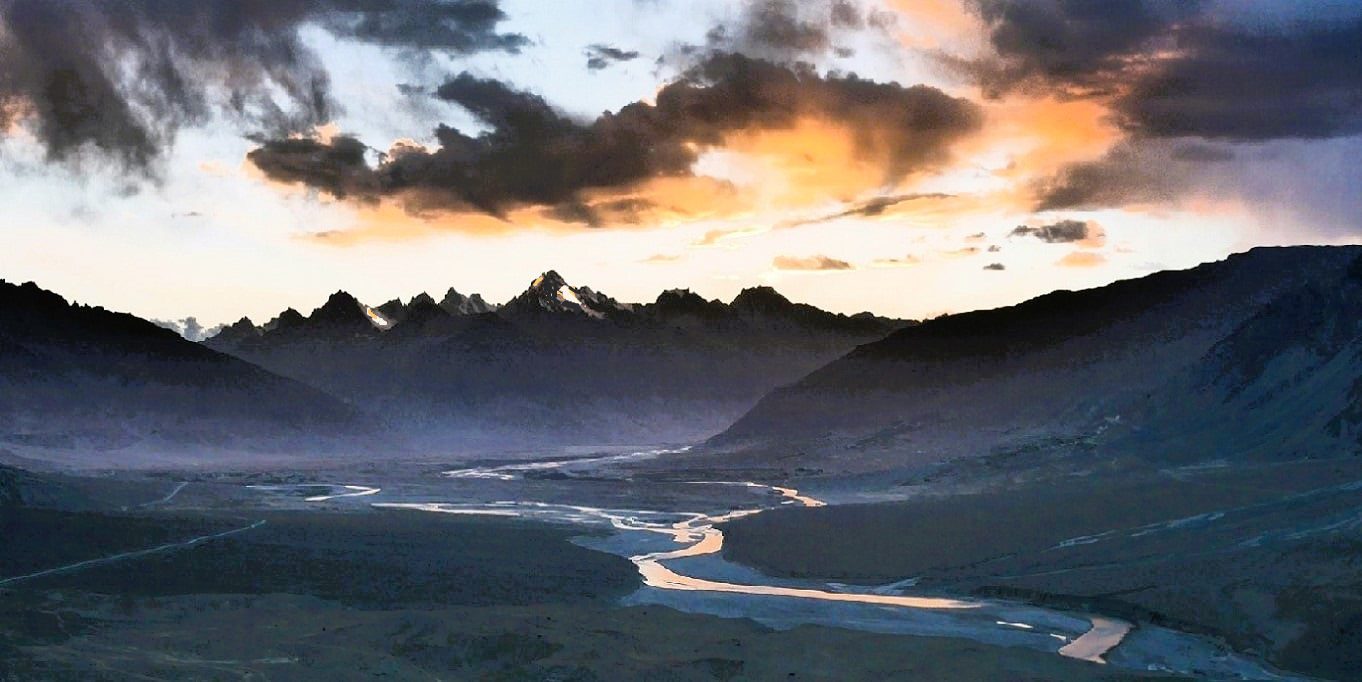
When you first see Gonbo Rangjon Zanskar, you may be tempted to call it dramatic. That would be too easy, and in Zanskar easy language feels like wearing perfume in a windy kitchen. The mountain is dark—so dark it seems to drink light rather than reflect it. Against the washed sky, its outline does not blur; it cuts. If you have ever seen ink spill onto paper and stop at the edge of a fold, you will know the sensation: a shape that looks decided.
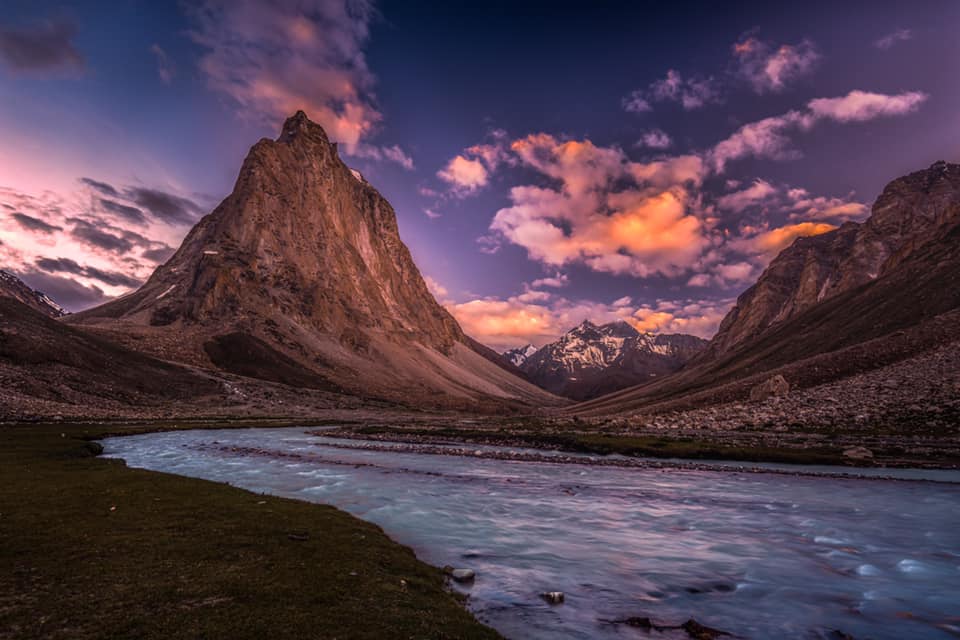
I tried—automatically—to locate it in the familiar vocabulary of elsewhere. A European mind wants to compare: it wants the Alps, a cathedral, a fortress. Yet the longer I looked, the more the comparisons fell away like coats in a warm room. Gonbo Rangjon Zanskar did not sit in the landscape like an object. It stood as if it were a condition. Around it, the valley felt slightly altered—more careful, more tuned. Even the wind seemed to thin as it approached, not in fact, perhaps, but in feeling, which is where travel truly lives.
What struck me was not only the mountain’s form but the way people spoke of it—or did not. Names in Ladakh and Zanskar are often carried with a kind of modesty; you can hear it in the half-lowered voice, the brief glance to the side, as if to check that the place itself agrees to be mentioned. Gonbo Rangjon Zanskar was not introduced to me as a “viewpoint.” It was referred to with the calmness reserved for something that does not belong to conversation. A driver said it without flourish. A shopkeeper nodded once, as if to confirm a fact that did not require elaboration. I began to understand that the mountain’s silence was not only a physical quiet but a social one: an agreement, shared without ceremony.
In that first sighting, I felt the usual impulse to step closer, to improve the angle, to make the mountain “mine” through a frame. It is a childish impulse, but we travel with our childhood still attached, like a label on new clothes. The mountain seemed to answer by remaining the same. It was not a rebuke. It was simply indifferent to my wanting. And in that indifference, something in me loosened. The silhouette was a sentence I could not paraphrase. So I let it stand.
The Boundary You Feel Before You Understand
“Approach” as a question, not a right
In Europe, we have trained ourselves to believe that beauty is public property. We queue for it. We pay for it. We photograph it until it becomes proof. In Zanskar, I discovered another logic: that some places are not “for” us, even when we are physically present. The boundary is not always marked by a sign. Often it is marked by behaviour—by the way people slow, by what they do not touch, by what they do not point at too loudly.
Around Gonbo Rangjon Zanskar, this boundary arrived in my body before it arrived in language. My steps became smaller without instruction. I found myself speaking less, as if sound were a kind of intrusion. There are moments when the traveller realises she has been moving through the world as if everything were an exhibition built for her convenience. The correction is not humiliation; it is relief. To stop being the centre of the scene is to become part of it, which is what we secretly want when we leave home.
The practical side of this is simple and almost embarrassingly human. If you are with local companions, follow their tempo. If they pause, pause. If they do not raise a camera, do not raise yours. If someone’s gaze drops, let your gaze drop too. The mountain does not need your admiration, but people deserve your discretion. In Zanskar, respect often looks like restraint. It is not theatrical. It is as ordinary as taking off your shoes before entering a house.
I noticed, too, how quickly the mind turns a sacred place into a personal narrative. “I went.” “I reached.” “I stood before.” The grammar is greedy. Gonbo Rangjon Zanskar, in its quiet bulk, encouraged a different grammar—one with fewer verbs, fewer claims. You are not the actor here. You are the witness, and even witnessing requires permission. That permission may be explicit—asked, granted, refused. Or it may be the quieter permission of understanding what is not yours to insist upon. Either way, the mountain makes the question unavoidable: not “How close can I get?” but “What am I doing with my closeness?”
When a landscape becomes an ethic
It is fashionable to say that landscapes “teach” us. Usually this means that we have projected our own lessons onto them, the way we project faces onto clouds. Yet there are places where the lesson is not invented; it is enforced by the simplest facts of living. Zanskar is such a place. Altitude shortens breath. Cold stiffens hands. Distance makes plans fragile. Even a small mistake—underestimating the weather, ignoring a local warning—stops being romantic and becomes merely dangerous.
In this environment, ethics do not arrive as slogans. They arrive as care. You learn to carry water without spilling it. You learn to keep your voice low in a room where someone is praying. You learn to accept that “no” is not an obstacle but a form of order. Around Gonbo Rangjon Zanskar, that order had a particular flavour: a sense that meaning itself was a kind of boundary. Not everything should be made available, not everything should be translated into your language.
I thought of the difference between a scenic landmark and a sacred landscape. The first invites consumption; the second invites discipline. The difference is not only spiritual. It is social. It protects people from being turned into decoration for another person’s story. It protects practices from becoming content. It protects a certain silence, which in our world is now rarer than snow.
This is where the mountain becomes more than stone. It becomes a measure. If you have ever walked into a church at midday—tourists whispering, a cleaner pushing a mop—and suddenly noticed a person kneeling in a side chapel, their stillness making the whole building feel different, you will recognise the sensation. The architecture has not changed, yet something has. Gonbo Rangjon Zanskar produced that shift in the open air. It made me aware of my own appetite—for images, for certainty, for anecdotes that end neatly. The mountain offered none of these. Instead, it offered a slow adjustment: a quiet insistence that my understanding should widen without needing to conquer.
Local Voice, Without Performing It
What is said — and what is left unsaid
In places like Zanskar, travellers often demand “explanations,” as if meaning were a service provided to outsiders. I learned quickly that this demand can be its own kind of violence. People will tell you what they wish to tell. They will also protect what is not for you. Both are gifts.

When Gonbo Rangjon Zanskar was mentioned, it was often with a careful brevity—an acknowledgement of sacredness without the urge to convert it into spectacle. I heard the mountain referred to as a presence, sometimes as the seat of a protector, sometimes simply as “that sacred place.” The most telling element was not the content of the words but their shape: no flourish, no theatre, no insistence on persuading me. There is a confidence in that restraint. It suggests that belief does not require my approval.
I thought, too, of other sacred mountains and sacred peoples—of the way certain communities guard their high places not by fencing them off but by surrounding them with meaning. The boundary is intangible, and precisely because it is intangible it is strong. You cannot climb over it by pretending not to see it. You must either honour it or reveal yourself as someone who cannot live with limits. The mountain becomes a mirror without being sentimental about it.
Some borders are drawn with ink. Others are drawn with silence—and silence, unlike ink, does not fade.
Practically, this means learning to ask better questions. Not “What is the story?” but “Is it all right if I ask?” Not “Can I photograph?” but “Would you prefer I didn’t?” Around Gonbo Rangjon Zanskar, even curiosity benefits from manners. And when answers come, they come as small fragments: a phrase, a gesture, a glance toward the mountain that ends the conversation not rudely but conclusively. In those fragments, I felt the true generosity of Zanskar: it does not offer itself cheaply. It offers itself honestly, which is rarer and, for the reader, far more nourishing.
The reader’s invitation
I do not want to turn Gonbo Rangjon Zanskar into a puzzle, because puzzles are designed to be solved, and sacred places are not. What I can do is invite you—quietly—into the texture of a day lived near the mountain. This is where the understanding begins: not with a declaration, but with the hand-feel of the world.
There is a particular dryness in Zanskar that settles into fabric. Wool becomes slightly stiff. A scarf holds the smell of wood smoke even after you shake it out. Dust collects in the seams of boots like flour in the creases of an apron. You taste it in the back of the throat. You wipe your lips and find grit, and the gesture is not elegant, but it is intimate. The mountain is there while you do this, not watching, not judging—simply present, like a large animal asleep in the sun.
The smallest objects become companions. A thermos, dented and reliable. A spoon whose handle has warmed to the touch. A string used to tie down a bundle. The world, in other words, becomes domestic again. Travel often pretends to be escape; in Zanskar it returns you to the simplest requirements: warmth, water, time, attention. Under that pressure, the mind sheds its unnecessary ornaments. You begin to see how quickly we clutter our lives with noise, and how difficult it is to sit with a silence that does not flatter us.
Here, the mountain’s sacredness is not a performance. It is a condition of living alongside something you cannot own. Gonbo Rangjon Zanskar is not impressed by your words. It does not respond to your cleverness. It simply continues. That continuation is, in its way, an invitation: to let meaning gather without forcing it, to accept that the most honest response to the sacred is sometimes to leave it untransformed by your narrative. For European readers accustomed to turning experience into explanation, this can feel like deprivation. In time it begins to feel like relief.
The Ethics of Looking — Photography, Silence, and the Unshared
What not to take
There is a particular hunger that modern travel has normalised: the hunger to take without carrying. We take images, we take stories, we take the glow of a sacred place and pour it into our own feeds, our own dinner-table anecdotes. We call this sharing, and sometimes it is. But sometimes it is simply appetite dressed as generosity.
Around Gonbo Rangjon Zanskar, I felt that appetite flare and then—slowly—subside. The mountain’s silence is not only an absence of sound; it is an absence of invitation. You can photograph it, of course. The mountain does not shatter when a shutter clicks. Yet the question is not whether you can. The question is what your photographing does to the people and practices around it, and what it does to you.
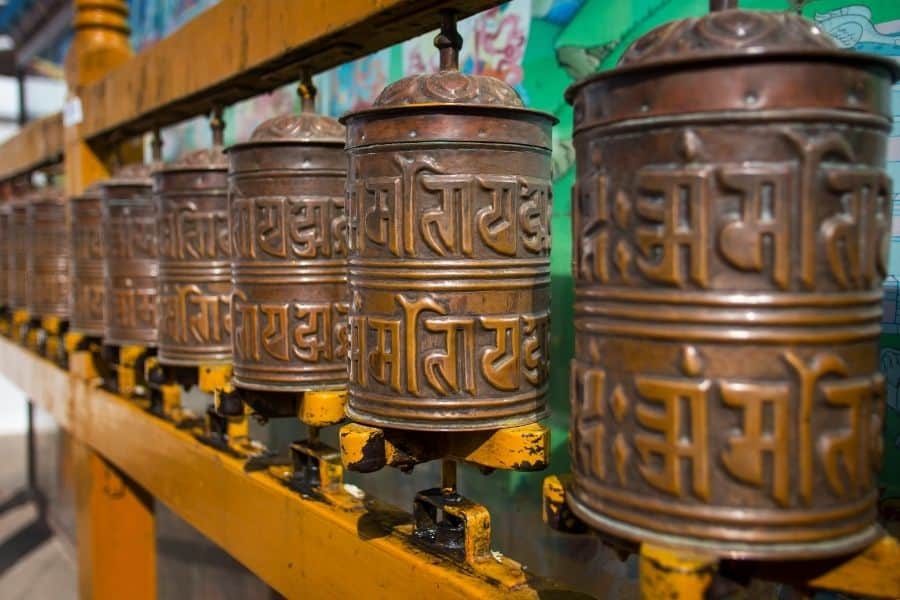
I watched myself composing frames, hunting for the angle that made the mountain “most itself,” as if there were a correct interpretation. Then I noticed that the most powerful moments were not photogenic. A hand pausing on a prayer wheel. A brief silence after someone mentioned the mountain’s name. A look exchanged between two people that said: enough, for now. These are not images you can capture without damaging them. They are held by their privacy. They are strong precisely because they are unshared.
This is where the ethic becomes practical. If someone is praying, do not turn them into scenery. If a ritual is happening, do not step closer for a better view. If a companion hesitates, treat that hesitation as information. In Zanskar, dignity is part of the landscape. Gonbo Rangjon Zanskar stands within that dignity like a cornerstone. To respect the mountain is also to respect the social fabric that holds it sacred. When you realise this, the temptation to take begins to feel slightly crude, like eating with your hands in a room where everyone else is using utensils.
A practical, gentle code of respect (not a checklist)
Practicality, in a real column, should not arrive like an instruction manual. It arrives as the small advice you would give a friend before she makes the same mistake you did. So here is what I learned, not as rules but as manners—those quiet customs that make travel bearable for both guest and host.
Ask before filming people. Ask even when you suspect the answer will be yes. The act of asking shifts the balance back toward dignity. Accept “no” without bargaining, without sulking, without the little European performance of “Oh, of course, I didn’t mean…”—as if meaning well were a substitute for behaviour. If you are offered a story about Gonbo Rangjon Zanskar, treat it like a cup of tea: something handed to you, warm, finite, not to be spilt for show.

Follow the local tempo. In Zanskar, remoteness is not a romantic adjective; it is a condition of mind. The valley’s distances do not only stretch roads—they stretch time. Plans soften. The day becomes less about achievement and more about weather, bodies, and the quiet negotiations of living. This tempo protects what is fragile. It protects conversation from being rushed into performance. It protects sacredness from being turned into spectacle. Under this tempo, Gonbo Rangjon Zanskar feels less like a destination and more like a presence you orbit.
And then, allow the modern world to stay at the edge of the frame. Phones work where they work; they fail where they fail. Let failure be part of the encounter rather than an inconvenience to be corrected immediately. The mountain does not need your constant documentation. If you must take something, take the simplest thing: the sensation of your own attention, sharpened and cleaned. That is the one souvenir that does not impoverish the place you leave behind.
The Moment the Mountain “Keeps Its Silence”
A turning point that is almost nothing
The turning point of a day near Gonbo Rangjon Zanskar was not dramatic. There was no ceremony, no sudden revelation. It was almost nothing: a pause on a path, the sun briefly hidden by a passing cloud, the valley’s colour shifting as if someone had changed a lens. A companion stopped walking. I stopped too, because stopping is contagious when you trust the person beside you.
Someone spoke a sentence I will not reproduce here, not because it was secret in the theatrical sense, but because it did not belong to me in that way. The sentence ended with a gesture toward the mountain, and the gesture was quiet, almost economical. Then silence returned—not as a void, but as a presence. The mountain “kept” it, the way a house keeps its coolness behind thick walls.
In that silence, I noticed how quickly I wanted to fill it. To ask for more. To extract clarification. To polish the moment into an anecdote with a moral at the end. Travel teaches you your own habits with an unforgiving clarity. My habit, like many of ours, was to believe that experience must become language to be real. Gonbo Rangjon Zanskar suggested the opposite: that some experiences become real precisely when you do not force them into speech.
The mountain did not “speak.” That is a cliché, and clichés are often a kind of theft. What happened was simpler. My mind, deprived of its usual entertainment, began to pay attention to what was already there: the sound of cloth against cloth, the slight squeak of a strap under tension, the way my breath shortened when I tried to talk too quickly. Under Zanskar light, the valley offered its lesson in the most modest form: silence held, not broken. A boundary felt, not explained. And in that almost-nothing moment, the day changed.
What changes in the narrator
I have always distrusted the traveller who claims to be “transformed” by a place, because the claim can be another form of possession: look what I gained, look what the world did for me. If Zanskar changed me, it did so in a quieter register, more like the way cold changes your handwriting when your fingers are stiff. The letters are still yours, but the pressure is different.
What changed first was my sense of entitlement. Near Gonbo Rangjon Zanskar, I understood—bodily, not theoretically—that closeness is not always a privilege you earn by effort. Sometimes it is a relationship you are invited into. Sometimes you are not invited. The difference matters. It is the difference between intimacy and intrusion.
What changed next was my appetite for explanation. I noticed myself becoming less eager to “understand” in the aggressive sense. Not because I stopped caring, but because I began to recognise the violence hidden in certain questions. There are questions that open a door. There are questions that push someone out of their own house. The sacred does not require you to be ignorant; it requires you to be courteous.
And finally, what changed was my relationship to the story I would later tell. I stopped trying to carry the mountain away in my language. I let Gonbo Rangjon Zanskar remain what it was: a dark presence under Zanskar light, a silence that does not need my voice. The most honest souvenir was not a perfect photograph or a neatly packaged insight. It was the discipline of leaving some part of the experience unclaimed. That discipline, for a writer, can feel like hunger. In Zanskar it began to feel like respect.
Closing — Leaving Without Taking the Mountain With You
Departure as discipline
Departure in the Himalaya is rarely sentimental. The body has its own schedule: it wants warmth, food, rest. The road insists. Weather moves in without asking for your permission. Yet leaving Gonbo Rangjon Zanskar asked for a particular kind of discipline—an inward discipline, less visible than packing a bag.
It is easy to leave with the wrong trophies. A dramatic caption. A confident explanation delivered at a dinner party. A story that makes you sound braver than you were. These trophies are light to carry and heavy to live with. They turn the world into a stage where you perform your own sensitivity. Zanskar, with its unhurried realism, discourages such performance. It has better things to do.
The discipline I mean is simpler: to leave without turning the mountain into a claim. To let the memory stay slightly rough, unpolished, resistant to neat phrasing. To accept that your understanding expanded not because you mastered a place, but because you encountered a boundary you chose to honour. Under Zanskar light, the most grown-up thing you can do is to admit that you cannot take everything with you—and that you should not try.
If you travel in Ladakh and Zanskar, you will hear many names—villages, passes, monasteries—spoken with pride and affection. Let Gonbo Rangjon Zanskar be spoken with something else: a little quiet in the mouth, a pause before the syllables, as if you were setting a cup down carefully on stone. This is not superstition. It is manners. And manners, at their best, are a kind of love.
Final image
In the late light, the valley’s colours softened. Stone warmed from grey to honey. Shadows lengthened and became less severe, as if they were tired of being sharp. The air carried that evening smell found in high places: smoke, dust, something faintly metallic, like cold iron. Someone folded a blanket with the brisk competence of a person who expects another cold night. A dog curled into itself and became a small, breathing mound.
Gonbo Rangjon Zanskar remained dark. Darkness in the mountain looked less like absence and more like concentration, as if the rock had gathered all the day’s brightness and decided not to release it. I watched the outline one last time, and the old impulse returned—briefly—to make it “mine” through a photograph. I took one image, then lowered the camera. Not out of virtue. Out of a sudden sense that the best part of the moment was happening behind my eyes, not on a screen.
There are places that flatter you. They make you feel worldly, capable, “alive.” There are places that refuse to flatter you, and in that refusal they offer something rarer: a clearer self, stripped of performance. Zanskar gave me that clarity, and Gonbo Rangjon Zanskar held it in silence, like a bowl holding water without spilling.
As we moved away, the mountain did not diminish as quickly as I expected. It stayed in view longer than the mind could hold comfortably, the way a thought stays with you after you have decided to stop thinking. Perhaps this is what sacred landscapes do. They do not ask to be understood. They ask to be approached with care. They widen you not by filling you with answers, but by showing you—quietly—how much room there still is inside your attention.
FAQ
Q: Why is Gonbo Rangjon Zanskar considered a sacred mountain in Zanskar?
Many local framings treat the mountain as more than geology: a presence bound to protection, belief, and the valley’s moral order. Visitors often sense sacredness first through social cues—restraint, lowered voices, and the feeling that some closeness is conditional.
Q: How can visitors approach sacred places in Zanskar respectfully?
The simplest approach is to follow local tempo and local consent. Ask before photographing people, accept “no” without argument, and let ritual moments remain unperformed. In places like Gonbo Rangjon Zanskar, restraint is not a loss; it is the basic courtesy that keeps meaning intact.
Q: Is it okay to photograph Gonbo Rangjon Zanskar and the surrounding area?
Photographing the landscape is generally possible, but ethics matter more than permission in the abstract. Avoid treating prayer, people, and private gestures as scenery. If your frame requires someone else’s dignity as decoration, it is the frame that should be refused.
Q: What does “sacred mountain” mean in Ladakh and Zanskar culture?
A sacred mountain can function as a boundary made of meaning rather than fences—an element of sacred geography that shapes behaviour. It is less about conquest or spectacle and more about relationship: what you do not take, what you do not demand, what you learn to leave untouched.
Q: What is the difference between a scenic landmark and a sacred landscape?
A scenic landmark invites consumption: the “best view,” the perfect photograph, the quick satisfaction. A sacred landscape invites discipline. It asks you to carry yourself differently, to accept limits, and to let certain experiences remain unclaimed rather than converted into proof.
Q: Can a traveler write about sacred sites without turning them into content?
Yes, but it requires humility in tone and precision in what you leave out. Write from sensory truth and human restraint, and avoid claiming authority you do not have. Let the sacred remain partly untranslated; often that is the most honest respect you can give a place like Gonbo Rangjon Zanskar.
Conclusion
If there is a takeaway from a day under Zanskar light, it is not a list of places to collect, but a change in how one looks. Gonbo Rangjon Zanskar offers a simple, demanding lesson: some landscapes are not there to be consumed. They are there to set terms.
The practical implications are modest and real: ask before filming people; accept refusal cleanly; follow local tempo; allow remoteness to slow your appetite for instant explanation. The deeper implication is quieter still: a sacred place can widen you without ever becoming yours.
Closing note: If you go to Zanskar, go with room inside you—room for silence, for unfinished understanding, for the small discipline of leaving something unclaimed. Under Zanskar light, a mountain keeps its silence, and that silence can become a kind of clarity you carry home without stealing it from anyone.
Sidonie Morel is the narrative voice behind Life on the Planet Ladakh,
a storytelling collective exploring the silence, culture, and resilience of Himalayan life.
She writes to keep distance honest—and attention precise.