


Three Winter Days in Leh: Losar Scenes from Market to Courtyard
By Sidonie Morel
Lead: Morning light, practical footsteps
Old town lanes before the shops fully open
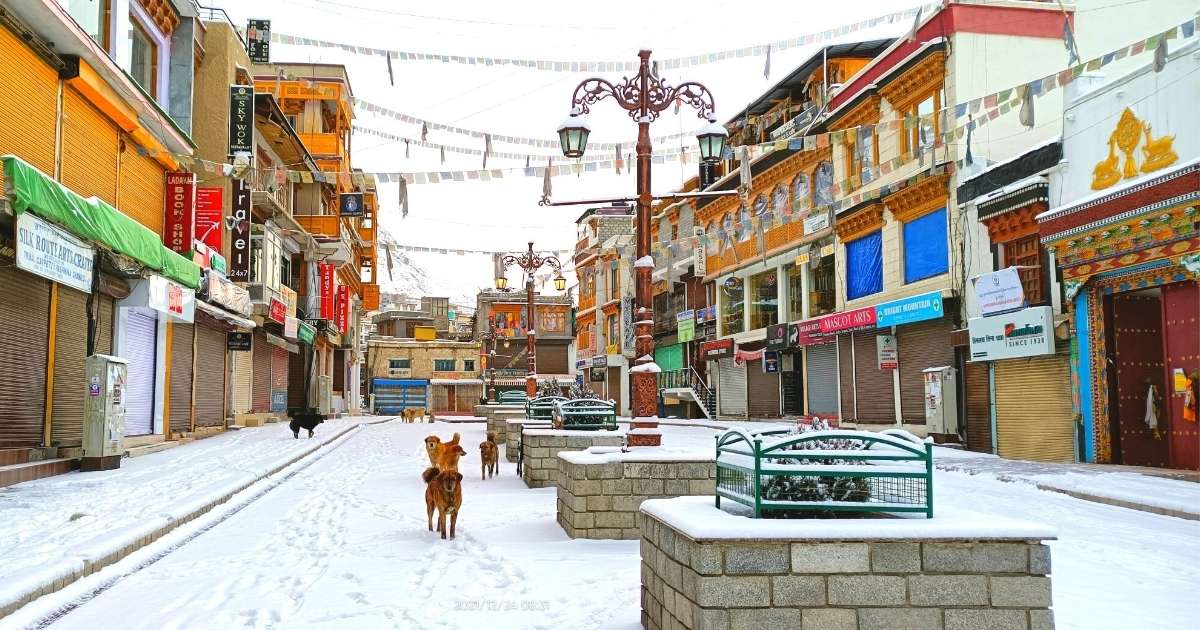
Losar in Leh begins without announcements. The lanes in the old town hold a thin layer of grit where yesterday’s snow has been kicked into powder. At the edges, ice stays in narrow bands, dull and compact. A broom moves in slow strokes near a doorway, pushing dust into a small ridge. Someone throws water from a metal bowl, a quick arc, and the splash becomes a dark patch that tightens and pales within minutes. Footsteps mark the cold stone, then fade as the sun climbs past the rooftops.
On the same street, shutters lift partway. A shopkeeper tests the hinge, sets a wooden wedge, and leaves the metal half-raised while he arranges boxes inside. The first sounds are small: a latch, a bucket dragged a short distance, a kettle lid tapping once, then still. Down the lane, a dog lies in a sun patch with its nose tucked under its tail. Prayer flags, stretched from roof to roof, pull hard in the wind; their movement is crisp, almost mechanical in the cold air. In Losar in Leh, the early hours are full of these ordinary tasks, repeated with a steadier pace than usual.
Near the bazaar side, tea stalls start to work. Cups stack in columns, rinsed quickly, wiped with cloths that hang from hooks. Steam rises in brief plumes, more visible here because the street is shaded. Hands warm around glass tumblers. A taxi creeps past with headlights on even in daylight, tires crunching softly at the roadside where snow remains. A few schoolchildren pass, scarves pulled to their cheeks, notebooks under their arms. Losar in Leh is not a performance at this hour; it is a town moving into the day with clean intentions and full bags waiting to be carried.
What the camera would catch in five seconds
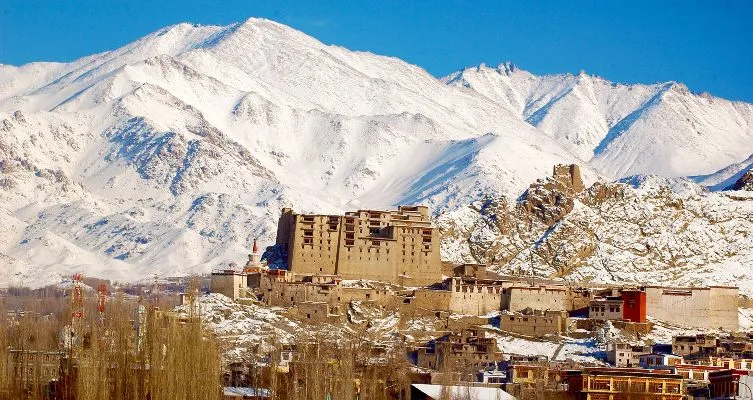
If you stop in Losar in Leh and hold your phone up for a moment, the frame fills easily: a sky so clear it looks rinsed, ridgelines sharp and pale, rooftops with tin sheets catching a hard white glare. In the foreground, a wall of sun-baked brick shows winter’s detail—chips, old paint, soot marks where a stove pipe has worked all season. A woman steps out with a basket, adjusts it once, and disappears into a doorway. A boy runs past with a plastic bag that snaps in the wind. These are the small scenes that repeat throughout Losar in Leh, different corners, the same bright cold.
At the market, the color is practical: orange peels, red packaging, green sacks, and the dull shine of metal trays. A vendor lifts a weighing scale by its hook and sets it down again. A coil of rope sits on a counter beside neatly stacked cartons. Flour sacks lie on their sides with their seams facing outward, ready for quick lifting. Someone counts notes with bare fingers, then presses them into a pocket. Nearby, a motorbike idles; the exhaust is a short cloud that dissolves quickly. This is the visible shape of Losar in Leh: preparation, movement, and a kind of careful order.
In the same five seconds, you also catch what the camera cannot hold for long: the smell of apricot wood smoke in a narrow alley; the dry bite of air when you inhale; the warmth that gathers in a doorway where the sun has reached the threshold. Losar in Leh is built from these quick impressions, and they return again and again across three days.
Day One: Buying, carrying, sorting
Leh market: late morning preparations
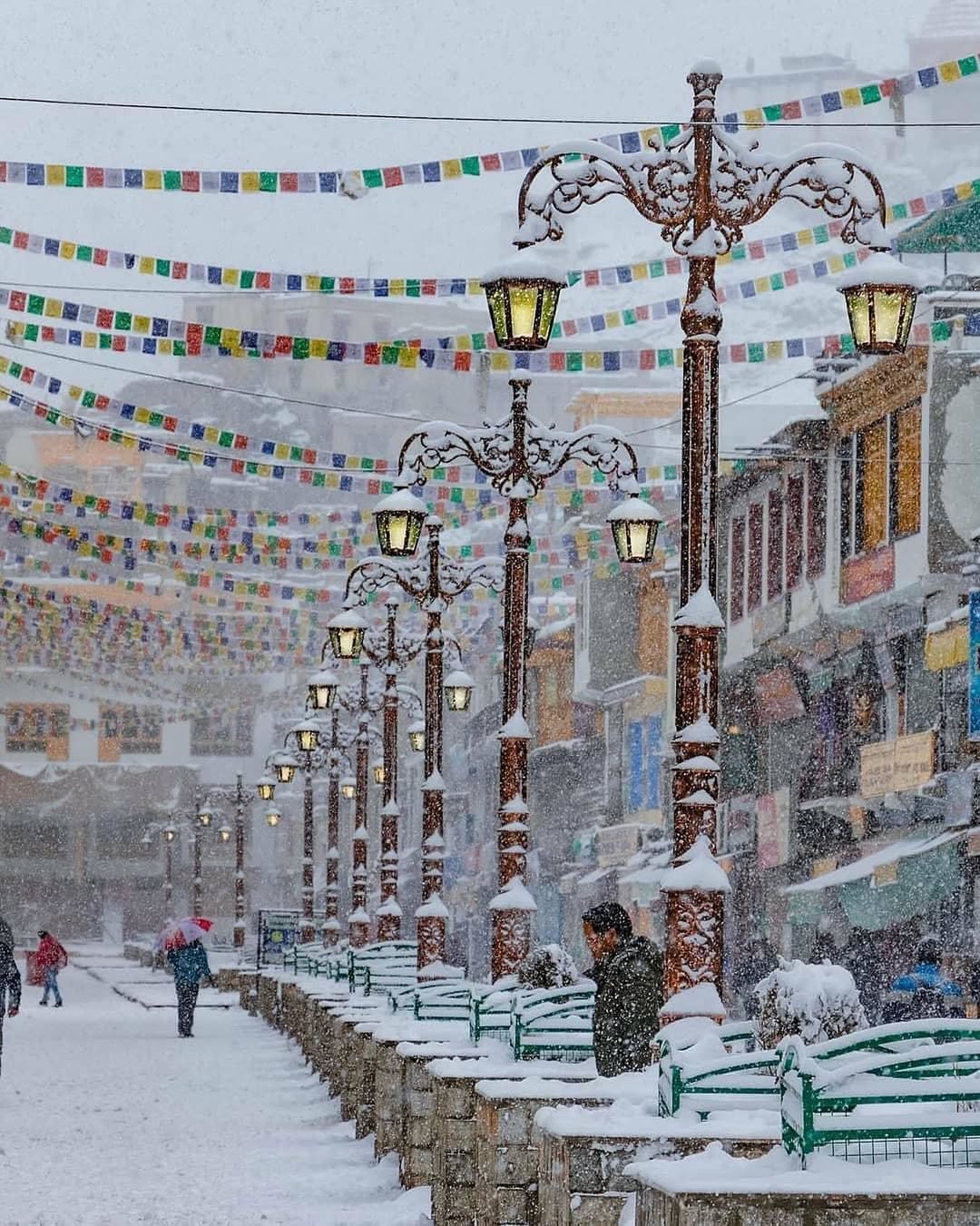
By late morning, Losar in Leh becomes visible in the market. People arrive with lists that do not need to be unfolded. The stalls carry winter’s stock: flour and rice in large sacks, cartons of oil, tea bricks, biscuits, nuts, dried fruit, and oranges arranged in pyramids. A shopkeeper taps the side of a metal tin to show it is full. Another folds paper into a cone for spices, tying it shut with string. Prices are spoken quickly, the numbers simple, the decision made in a nod. The pace is not hurried, but it is steady, as if there are many doorways to pass through before evening.
Bags fill fast. A plastic sack stretches around a box of sweets. A cloth bag takes flour, then is knotted twice. A man shifts a sack onto his shoulder, steps carefully to avoid the icy edge, and moves with the practiced tilt of someone who has carried weight in winter for years. In Losar in Leh, carrying is part of the day’s rhythm: from counter to bag, from bag to taxi, from taxi to threshold. The street shows it clearly—people walking in short loops, returning for one more item, then one more.
Near a vegetable seller, winter greens sit in small piles, tied with string. Someone checks them by lifting the bundle slightly and setting it back. A boy carries a tray of eggs carefully, elbows tight to his sides. Tea stalls do brisk business; cups are refilled without ceremony. There is a constant soft rustle: paper, plastic, rope, cloth. A short horn, a quick apology as two people pass in a narrow space, then the flow continues. Losar in Leh feels most like itself here—public, useful, bright.
Home threshold: shoes, bags, and a cleared floor
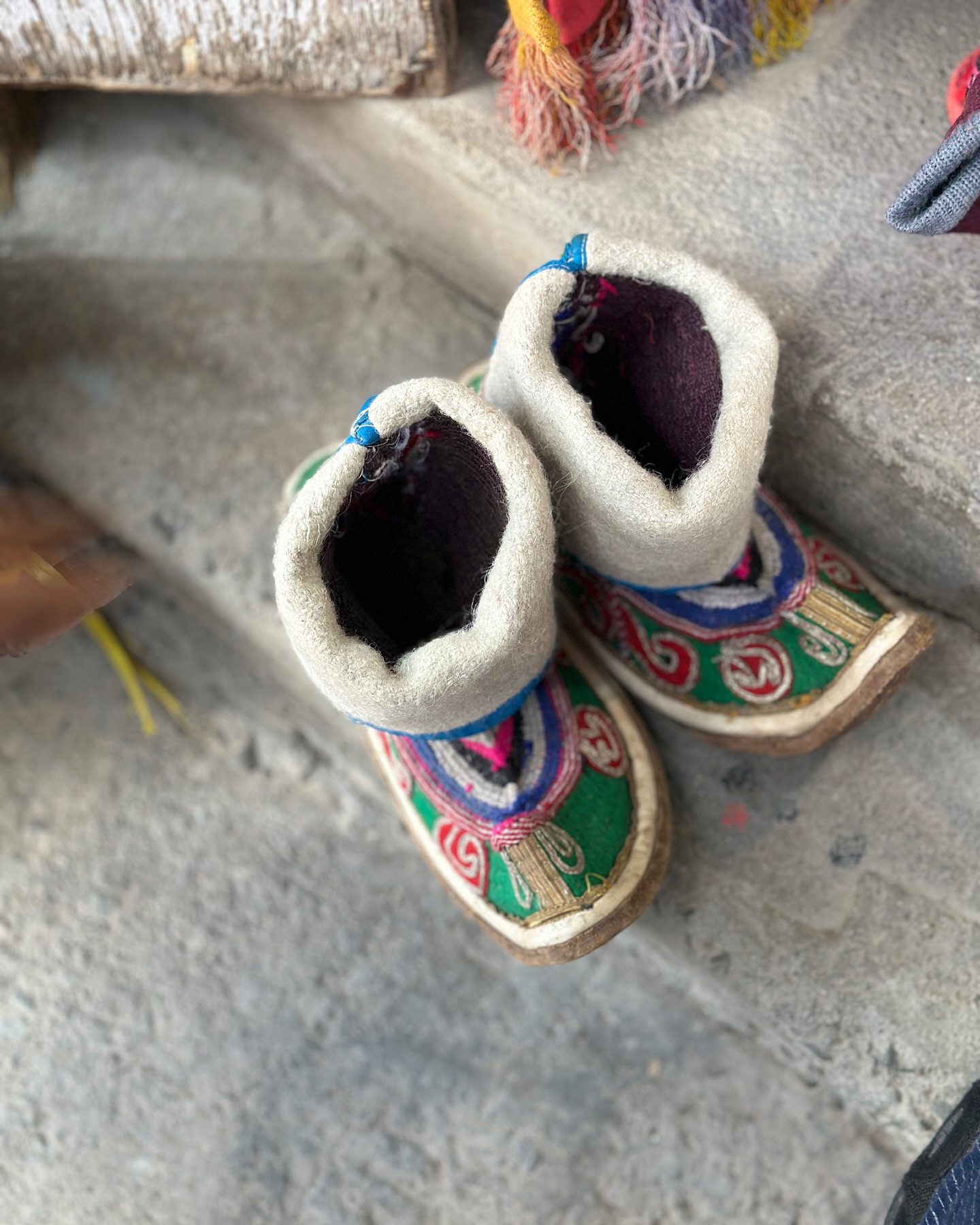
Back at the house, Losar in Leh moves indoors. Shoes line up near the door: boots with dried dust, slippers waiting behind them. Bags are set down in a neat cluster. Items are sorted by hand, without labels. Flour goes to one side, sweets to another, tea and spices grouped together. A jar is checked for its lid, turned once, tightened. A packet of nuts is tapped flat so it will stack well. Someone wipes the table with a cloth, then folds the cloth and sets it aside, ready for the next wipe. The floor is cleared in a way that looks simple but takes time: shifting a stool, moving a bucket, placing a broom in its corner.
A window is opened briefly to let smoke out, then closed again quickly. Cold air enters, sharp and clean. A kettle is put on, and while it heats, the room becomes a station: hands moving from bag to cupboard, cupboard to shelf, shelf to tray. The work is quiet. The sound is mostly packaging: the tear of plastic, the scrape of cardboard, the click of a tin lid. In Losar in Leh, the threshold is busy because it is the place where the town’s bustle turns into the household’s order.
Outside, in the lane, a neighbor passes and calls a greeting. The door opens, closes, opens again; each time, a slice of bright winter light falls across the floor. Someone shakes a cloth outside, sending a small cloud of dust into the sun. Another person pours water into a basin and rinses a cup. Losar in Leh is full of these repeated gestures, and they create the feeling of a house being reset for the year.
Day Two: Dough, oil, and winter sweetness
Khapse and the frying rhythm
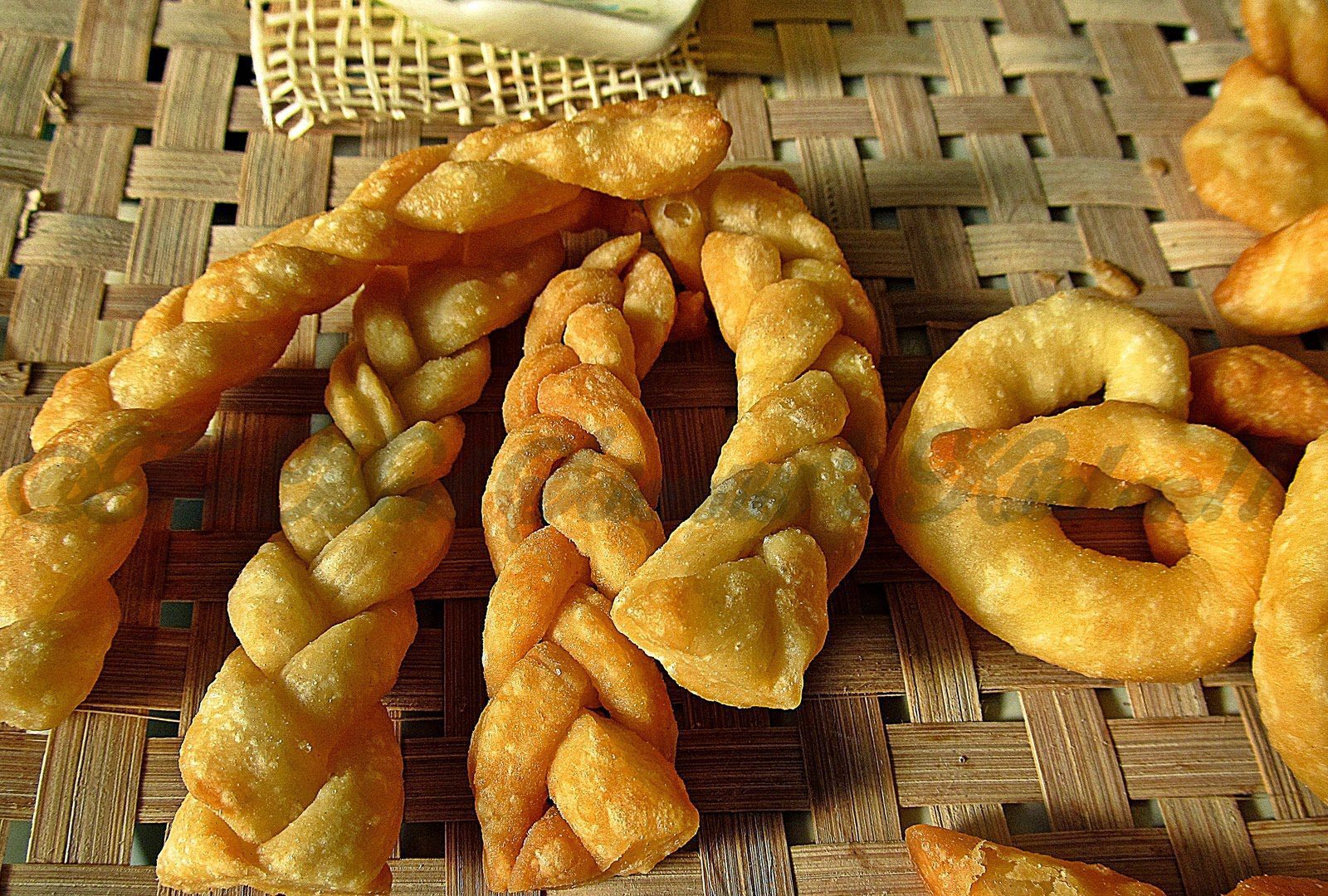
The second day of Losar in Leh is often shaped by food work that can be seen and heard. Flour sits in a wide bowl. Water is added slowly. Fingers press and fold, then press again, until the dough becomes smooth and elastic. It is rolled out on a board dusted with flour, then cut into strips. Each strip is twisted or pinched into a shape that will hold its crispness. Trays begin to fill. A cloth is placed over part of the tray to keep the dough from drying too fast in the heated air of the kitchen.
Oil heats in a deep pan. The first piece is dropped in to test the temperature; it sinks, then rises with bubbles. Another follows, and soon the surface is active. A pair of tongs turns each piece at the right moment. The color changes quickly: pale to honey, honey to gold. The fried pieces are lifted out and set on a metal plate to drain. The kitchen smells clean and warm, with flour and oil and a faint sweetness. In Losar in Leh, khapse is not a single dish; it is a process that fills the room for hours, and it leaves behind stacks of crisp shapes that look almost architectural when piled neatly.
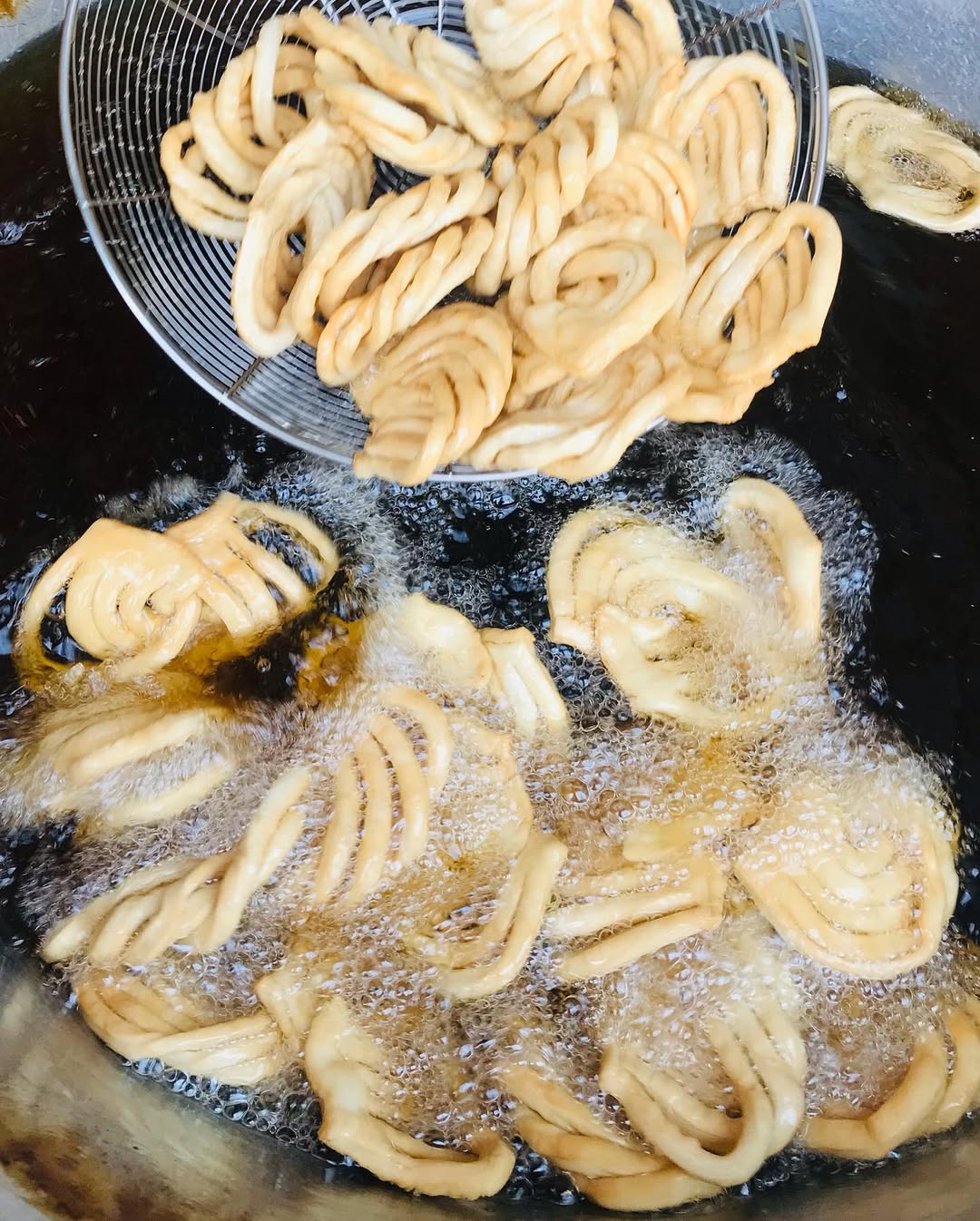
As the day goes on, the stacks grow. Some are dusted lightly with sugar. Others are left plain. Jars are filled and tapped once on the table so the pieces settle without breaking. Lids are tightened. A child steals a small piece, then another, and is told to wait, but the child smiles and keeps chewing. The work continues. The rhythm is simple: roll, cut, twist, fry, drain, stack. Losar in Leh often lives in this rhythm more than in any visible “event,” because it is the food that will travel from house to house when visitors begin.
Tea, trays, and the house ready for visits
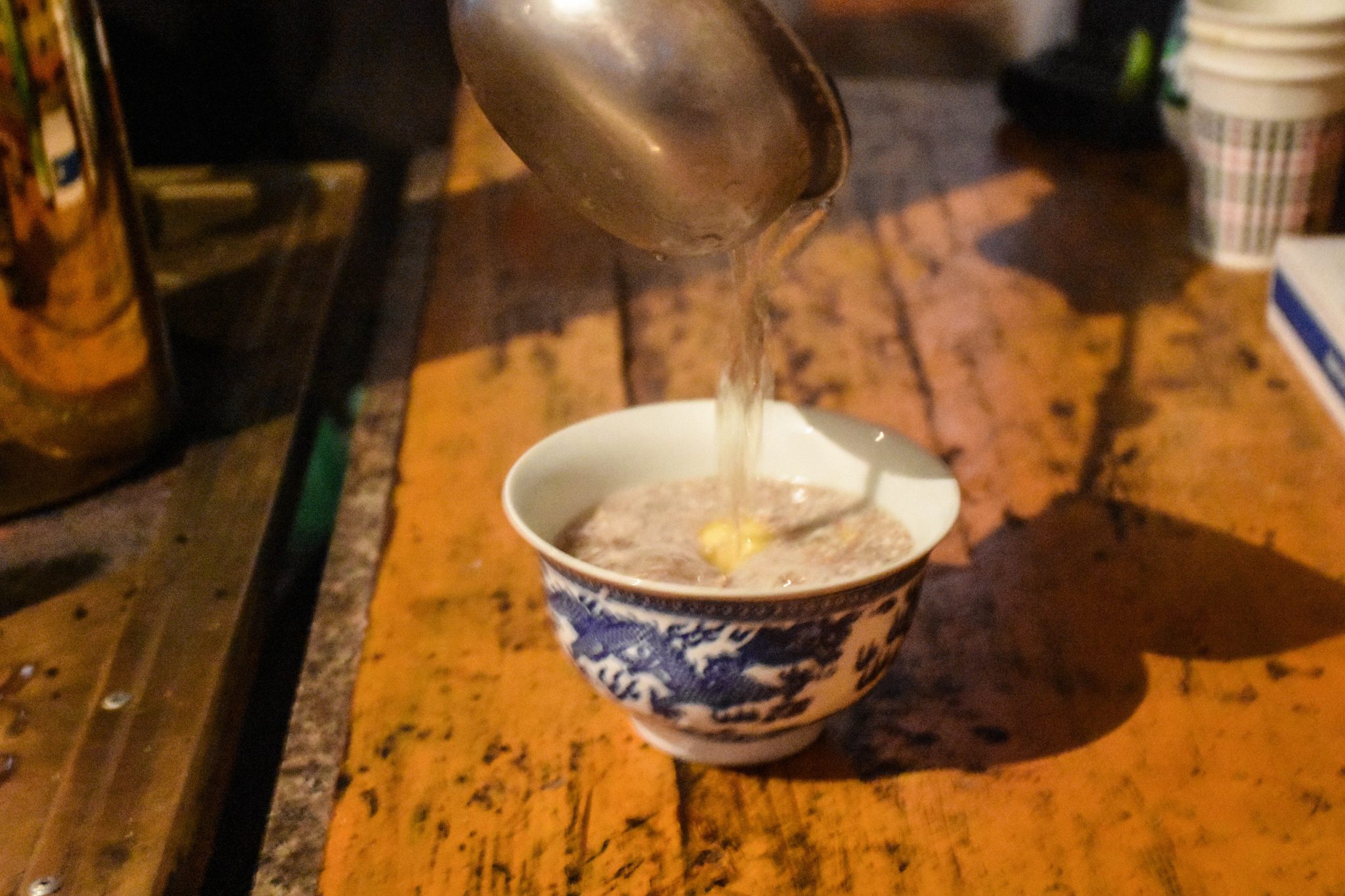
Alongside frying, Losar in Leh brings the steady work of tea. A pot simmers with tea leaves. Salt is measured. Butter is added, and the tea is churned in a tall cylinder, the handle moving up and down with a soft thump. Cups are warmed first, then filled. Foam settles quickly. The tray that carries the cups is wiped with a cloth, then wiped again. Another tray waits with khapse, nuts, and sweets. Everything is arranged in small, practical groups so that it can be lifted and offered without fuss.
A room is adjusted for sitting. Cushions are shaken and lined up. A small table is cleared, then set with a cloth. A corner is tidied: bowls placed neatly, a candle checked, a matchbox set beside it. Outside the kitchen, the broom returns to its corner, and the floor is swept once more. In Losar in Leh, the household looks freshly organized not because it is new, but because it has been worked on repeatedly, the same surfaces wiped and swept with patient attention.
“One more cup, just now.”
The phrase is ordinary, but it’s repeated often across Losar in Leh. Cups are refilled, not as a gesture, but as a practical hospitality that keeps hands warm in winter. A kettle is set back on the stove. A lid is placed carefully so steam stays in. A cloth is folded into a tight square and left within reach. By late afternoon, the trays are ready, the jars are closed, and the doorway begins to open more frequently. Someone knocks. Someone else steps out to answer. The second day finishes with the house set up to move smoothly into the third.
Day Three: Courtyards, doorways, and quick sittings
Morning visits: greetings, shoes, and refills
The third day of Losar in Leh often feels like a sequence of doorways. The morning is bright. The lane is busy in a gentle way, with people walking in short stretches, stopping at a gate, stepping inside, then reappearing a little later. Each visit begins with shoes removed. Boots are placed neatly to the side, toes pointing outward. Greetings are exchanged quickly. A scarf is adjusted. Hands are warmed around a cup almost immediately. The tray arrives with khapse, nuts, sweets, and biscuits, and it sits within easy reach so no one has to lean far in winter clothing.
Refills happen automatically. The teapot is lifted, poured, set down, lifted again. A child carries cups carefully, concentrating on not spilling. A metal kettle makes a short clink when it touches the tray. Someone wipes the rim of a cup with a thumb. These are the small, precise motions that define Losar in Leh. Conversations happen, but the shape of the visit is clear even without hearing a word: sit, warm hands, eat something crisp, drink tea, stand again, put on boots, step back into the sun.
Outside, taxis and scooters pass slowly. People carry small bags, gifts that are easy to hold—packets of sweets, a jar, fruit. The road shows patches of ice where shade remains. In Losar in Leh, people walk with a winter caution that looks graceful: a slight pause at corners, careful foot placement, shoulders relaxed, hands tucked in pockets between doorways.
Courtyard details and the evening table
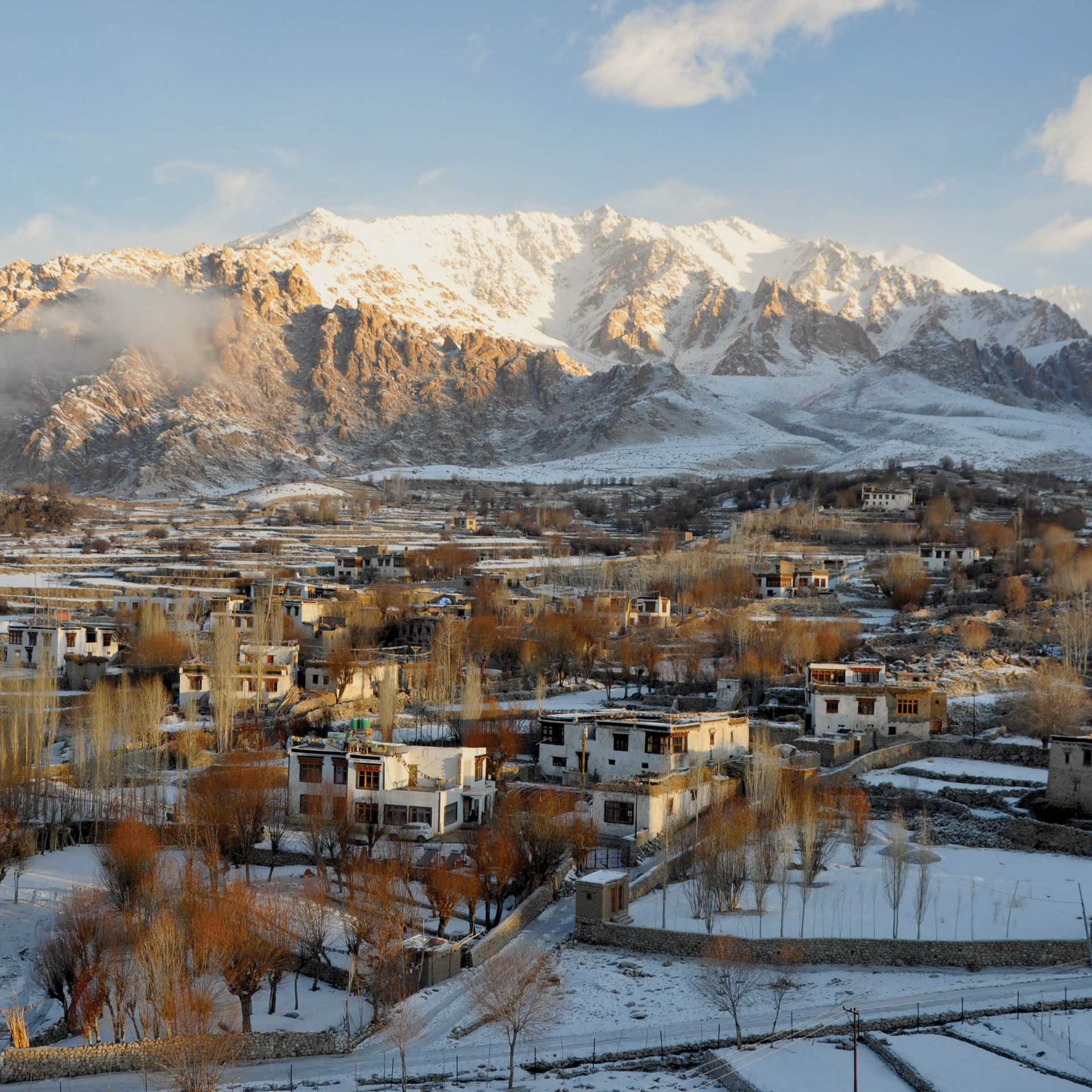
Inside courtyards, Losar in Leh has its own light. Sun hits one wall and turns it warm in color, even if the air stays cold. Shadows from prayer flags stripe the stone floor. A broom leaves visible lines where dust has been gathered and removed. A bucket sits near a tap. Cups are rinsed in cold water, then set upside down to drain. A stack of plates waits on a shelf. Apricot wood is piled neatly, logs aligned like bricks. A tin chimney stands upright, darkened near the top where smoke has passed all season.
Children move in and out of the courtyard, slipping quickly through doorways. Older hands sort and carry: jars moved to a cupboard, trays returned to the kitchen, cloths rinsed and wrung out. The work continues even during visits, but it is done without show. In Losar in Leh, the household runs like a well-practiced routine, and the courtyard is the space where you see how the routine holds together.
As evening comes, the table settles into a simple sequence. Food arrives in dishes that steam when the lids are lifted. Rice is served, then noodles or soup, then vegetables, each placed with care so it fits on the table without crowding. Spoons clink lightly. Bread is torn by hand. Cups reappear. A kettle returns to the stove and then to the table. Plates are cleared and stacked. The room remains warm from cooking, and the windows stay closed against the cold. Losar in Leh ends its third day with this steady, domestic order: food, warmth, cleanup, and quiet lanes outside.
Clothes, color, and the town’s public corners
Fabric, layering, and winter movement
Across Losar in Leh, clothing is part of the visible scene, especially in daylight. Thick layers give people a rounded winter silhouette. Wool caps sit low. Scarves cover cheeks and mouths. Gloves are worn, then removed briefly to count money or adjust a bag, then worn again quickly. Boots leave firm prints where the ground is soft. On ice, feet move with a measured caution. In narrow lanes, people turn sideways to pass, careful not to brush each other’s sleeves. Each motion looks slightly slower than in summer, but nothing feels heavy; the town has learned winter’s pace.
Traditional layers appear alongside modern winter jackets. A goncha is tied securely at the waist, the knot checked once and tightened. A padded sports jacket catches the sun in synthetic shine. Woolen socks peek above boot tops. Hands carry thermos flasks and small plastic bags, kept close to the body for warmth. In Losar in Leh, you notice how often people adjust something: a scarf, a cap, a strap on a bag. The adjustments are small, repeated, and they keep movement easy in cold air.
Inside houses, the same layers are loosened. Gloves are placed near the door. Caps come off and are set on a shelf. A scarf is folded quickly and placed on a chair. Shoes line up in rows. These quiet transitions—from outdoor cold to indoor warmth—repeat throughout Losar in Leh, and they give the day a soft rhythm that never feels rushed.
Main bazaar, quiet alleys, and the winter town as a stage
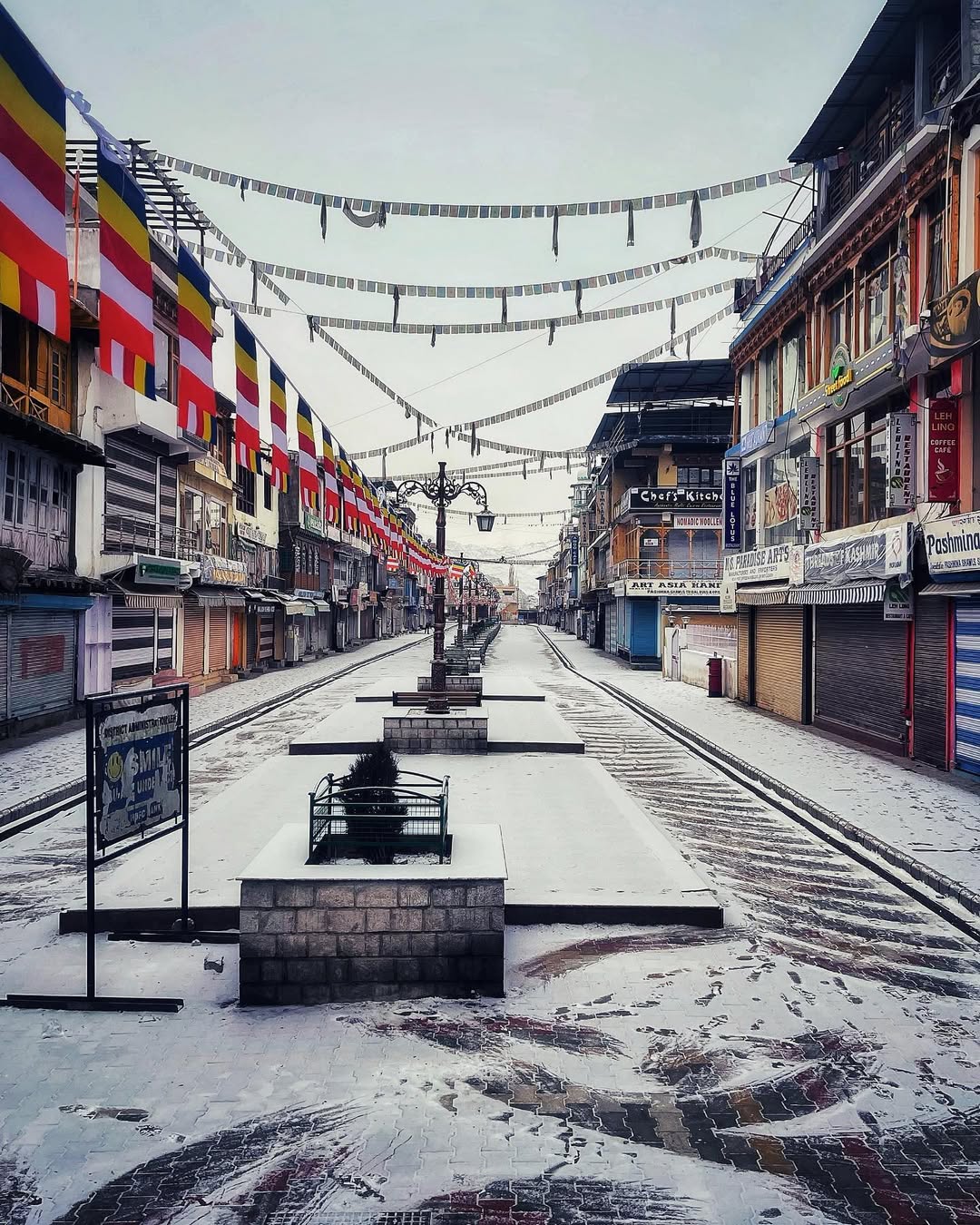
Losar in Leh also has its public scenes, and they are often found in the main bazaar. Shutters open in bursts with a metallic clatter. Cardboard boxes flatten under boots and are stacked against a wall. A porter shifts a sack on his shoulder with a short exhale. Taxi drivers sit with hands around tea glasses, then stand to greet someone. A shopkeeper sweeps the threshold outward, sending dust into a bright beam of sunlight. The street is lively, but the sound stays modest: short horns, brief greetings, a few laughs, and the constant soft shuffle of boots.
In side alleys, Losar in Leh looks quieter. Firewood stacks sit against walls. Tin chimneys cast thin shadows. Soot marks near vents show where stoves have worked hard. Dogs sleep in sun patches, and cats hover near warm vents. Sparrows hop on ledges, pecking at crumbs. A water pipe drips slowly, then stops, then drips again. In winter, the town has fewer tourists and fewer distractions; the details are easier to see, and Losar in Leh becomes an excuse to walk slowly and look carefully.
Even in these quiet corners, the signs of Losar in Leh remain practical: a tray carried across a lane; a bag of oranges swung lightly at someone’s side; a jar passed from one hand to another; a doorway opening and closing with steady frequency. The festival is not separated from the town’s ordinary life. It is threaded through it, visible in the way people move, carry, clean, and share.
Conclusion: What stays with you after Losar in Leh
Clear takeaways from three days
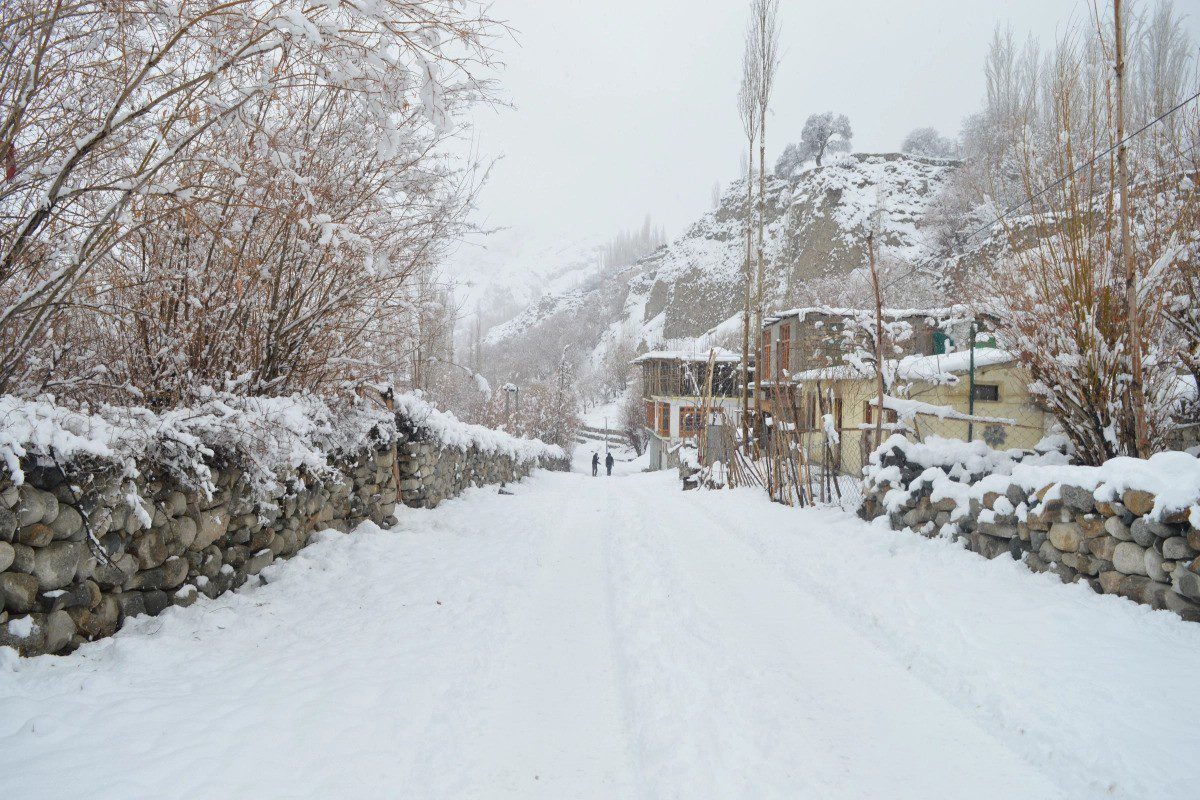
When Losar in Leh finishes, the town returns to its winter routine, but a few things remain easy to notice. First, the work is visible: the sweeping at thresholds, the sorting of food, the steady making of khapse, the constant pouring of tea. These are not side details; they are the center of the experience. If you are in Leh during the Ladakhi New Year period, you can understand a great deal just by watching how households prepare and how quickly visits flow from doorway to doorway.
Second, Losar in Leh is paced for winter. Movements are careful where ice remains. Visits are short enough to keep people warm, yet frequent enough to make the day feel social. Tea is served often, not as a formal gesture, but as a simple winter necessity. Food is arranged to travel easily: khapse stacks well, nuts and sweets keep well, and trays can be lifted and carried in one smooth motion. If you are arriving as a visitor, your best approach is practical: dress warmly, walk carefully, accept tea, eat a little, and follow the pace of the house.
Third, Losar in Leh is a town-wide reset that you can see in small places: the way a broom line looks clean on stone, the way jars are aligned on a shelf, the way shoes are lined at a doorway. These details give you the feeling of a new year without needing speeches or schedules. They are clear, quiet, and consistent across three days.
A final closing note
The morning after Losar in Leh, the lane looks familiar again. Shops open at their winter pace. Smoke rises steadily. Sun patches return to the same corners. But the house feels slightly reordered: cloths folded, jars filled, trays stacked neatly, and a calm readiness at the doorway. If you walk through Leh at this time, you can carry the memory in your senses: the crisp air, the clean thresholds, the steady tea, the bright market colors, and the soft crunch of boots on stone. It is enough to let the town show itself, one ordinary scene at a time, in winter light.
FAQ: Losar in Leh for first-time winter visitors
When is Losar in Leh, and how long do the celebrations last?
Losar in Leh is the Ladakhi New Year period that usually falls in late December, though the exact dates can vary by year and local calendar. The most noticeable rhythm often spans about three days, with preparation before and visits during the main days. In practice, you may see Losar in Leh signs for a longer stretch: shopping, baking and frying, and households receiving guests before and after the core days.
If you are planning travel, it helps to keep your schedule flexible and to check locally once you arrive, because different neighborhoods and families may emphasize different days. Even when dates shift, the visible patterns remain similar: market preparation, khapse and tea work, and short visits between homes. Dress for bright cold mornings and warmer indoor rooms, because you will move between both often.
What do people typically eat and drink during Losar in Leh?
During Losar in Leh, you will often see trays with khapse (fried, crisp dough shapes), sweets, nuts, biscuits, and seasonal fruit such as oranges. The food is chosen for winter practicality: it keeps well, travels easily, and can be offered quickly to guests. You may also encounter simple household meals served in the evening, including rice, noodles, soups, and vegetables, depending on each family’s habits and the day’s schedule.
Tea is central. In many homes, butter tea (gur-gur chai) appears frequently, served in warmed cups and refilled without much discussion. You may also be offered sweet tea. Accepting a small portion, even if you are not hungry, is a gentle way to match the pace of Losar in Leh visits. The experience is less about tasting rare dishes and more about watching how trays, cups, and refills keep the day moving smoothly through winter.
How should a traveler behave if invited into a home during Losar in Leh?
If you are invited into a home during Losar in Leh, follow the simplest signals. Remove your shoes at the doorway and place them neatly where others have placed theirs. Accept tea when it is offered, and take a small piece of khapse or something from the tray if it is presented close to you. Keep your visit light and unhurried; many households welcome guests in quick sequences, so staying a moderate time often fits the day’s rhythm better than lingering.
Wear warm layers that are easy to remove indoors, because rooms can be warm from cooking, while the lane outside remains cold. Avoid taking photos immediately; first observe where people sit and where trays are placed, then ask quietly if you wish to photograph. Losar in Leh hospitality is practical and steady, and matching that practical tone—warm clothing, careful steps, respectful gestures—helps you blend in without effort.
About the author
Sidonie Morel is the narrative voice behind Life on the Planet Ladakh,
a storytelling collective exploring the silence, culture, and resilience of Himalayan life.