
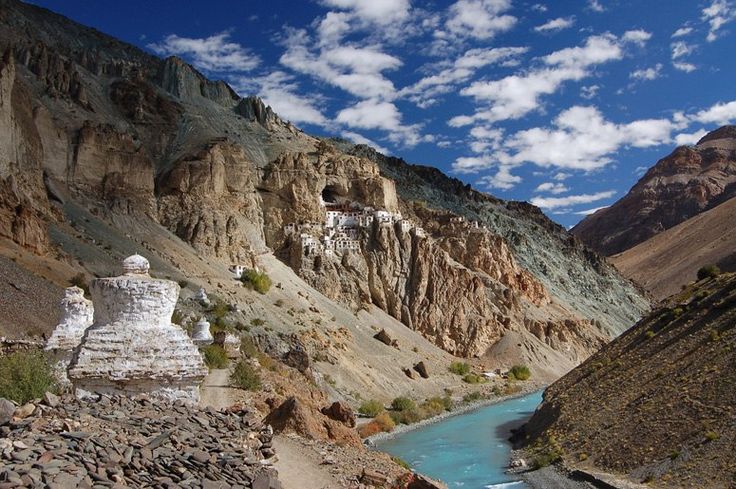
Where Silence Becomes a Geography
By Declan P. O’Connor
Introduction — A Corridor That Refuses to Hurry
There are routes in the Himalaya designed to move you efficiently, and there are corridors that insist you slow down, recalibrate, and listen. The Phuktal–Darcha Monastic & High Pass Corridor belongs decisively to the latter. It is not a line drawn for speed, nor a passage meant to impress through altitude statistics or conquest narratives. Instead, it unfolds as a sequence of inhabited pauses—monasteries, villages, and thresholds—each quietly reshaping how movement itself is understood.
For European readers accustomed to borders defined by timetables and signage, this corridor can feel disarming. Geography here is not merely physical. It is social, moral, and inward-facing. The journey begins with Bardan Monastery, anchoring the western edge of Zanskar’s spiritual memory, and concludes at Darcha, where the land opens toward Lahaul and the wider Himalayan road network. Between these points lies a lived continuum shaped less by ambition than by coexistence.
The word “corridor” matters. Corridors connect spaces without demanding attention for themselves. They shape experience precisely by remaining understated. The Phuktal–Darcha Monastic & High Pass Corridor operates in this way, linking spiritual interiors to exposed alpine crossings without ever announcing a climax. What it offers instead is coherence—a way of understanding how belief, labour, altitude, and silence share the same terrain.
I. Bardan Monastery — The First Measure of Stillness
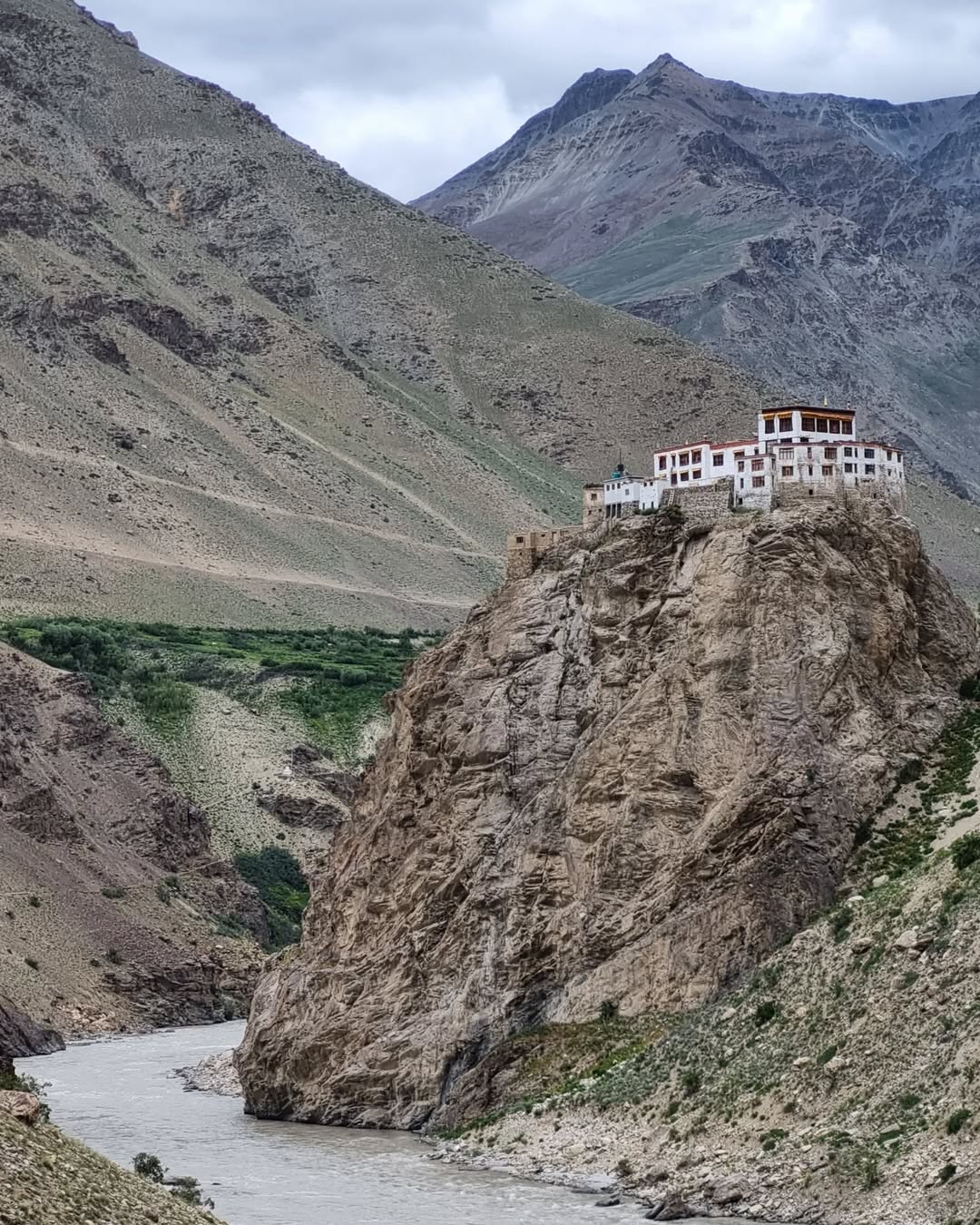
Bardan Monastery does not announce itself. Approached from the western margins of Zanskar, it appears settled rather than striking, confident without needing to persuade. This restraint makes it an ideal beginning for the Phuktal–Darcha Monastic & High Pass Corridor. Bardan does not instruct; it calibrates. It sets the emotional and intellectual tempo for everything that follows.
The monastery occupies a subtle hinge between histories. To the west lie trade routes, political memories, and recent disruptions. To the east begins the interior rhythm of Zanskar, where continuity is preserved through habit rather than proclamation. Bardan’s architecture reflects this balance. Stone walls, weathered courtyards, and unadorned prayer spaces communicate endurance without spectacle.
Within the corridor, Bardan performs an essential function. It begins the work of subtraction. Noise, urgency, and the impulse to accumulate experiences start to loosen their hold. By the time one leaves Bardan, the corridor has already shifted expectations. The journey is no longer about covering distance, but about aligning attention.
II. Icher — The Corridor Learns a Human Scale
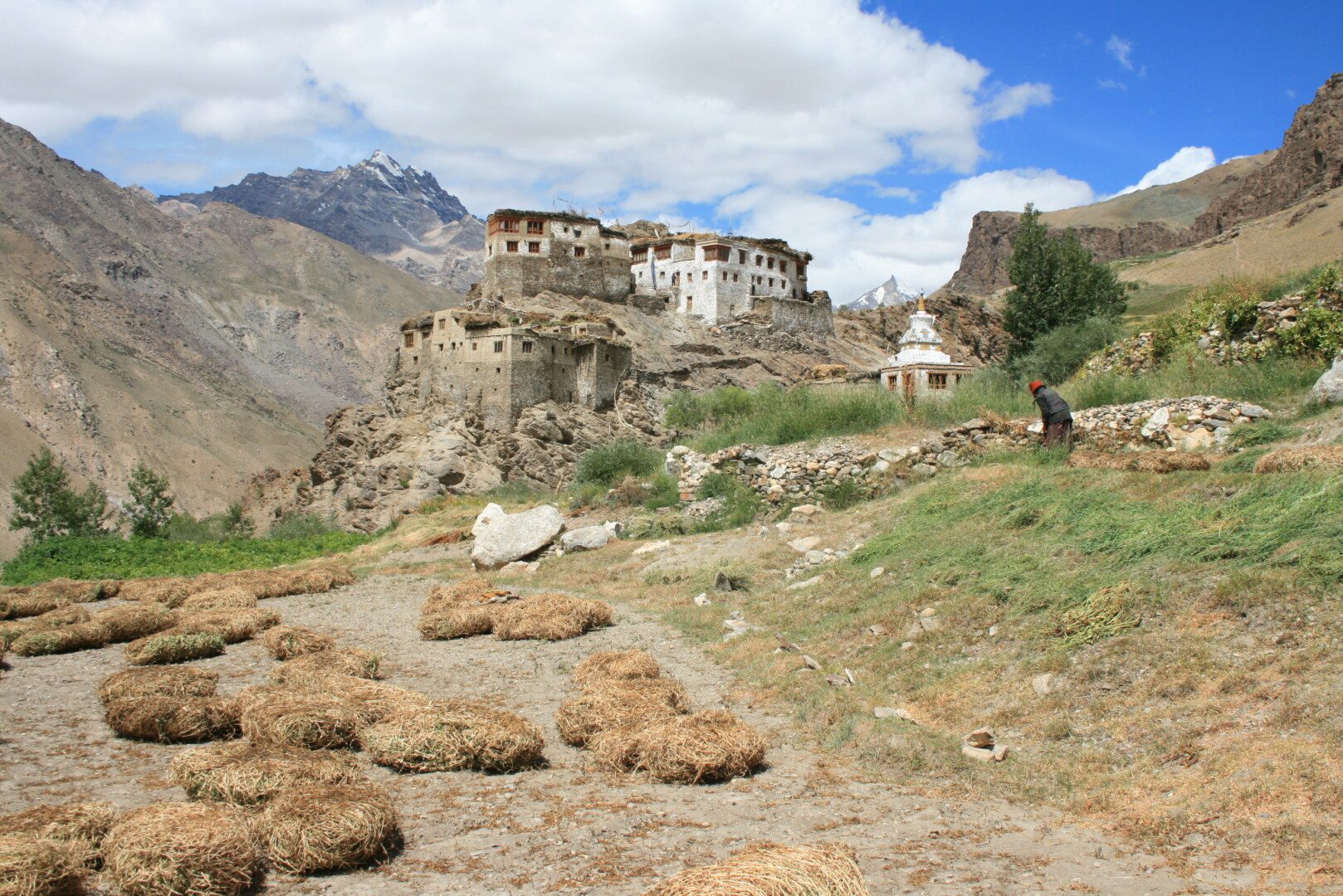
The movement from Bardan toward Icher introduces a gentler register. Fields appear, walls trace patient geometries, and the corridor reveals one of its defining truths: it is sustained not by monuments, but by villages. Icher is not a highlight. It is a lived landscape where agriculture, belief, and seasonal pragmatism coexist without ceremony.
Here, the Phuktal–Darcha Monastic & High Pass Corridor becomes legible as a social system. Footpaths follow necessity rather than design. Homes and religious spaces share the same visual language. For European travellers used to curated heritage, Icher can feel almost disarmingly ordinary. That ordinariness is precisely its value.
Icher reminds us that spiritual landscapes do not float above daily life. They are sustained by it. Fields must be worked, water managed, and winters endured. The corridor survives because villages like Icher make continuity possible. Leaving the village, one carries forward a recalibrated sense of scale—one that privileges relationship over spectacle.
III. Purne — Where Paths Converge and Time Thickens
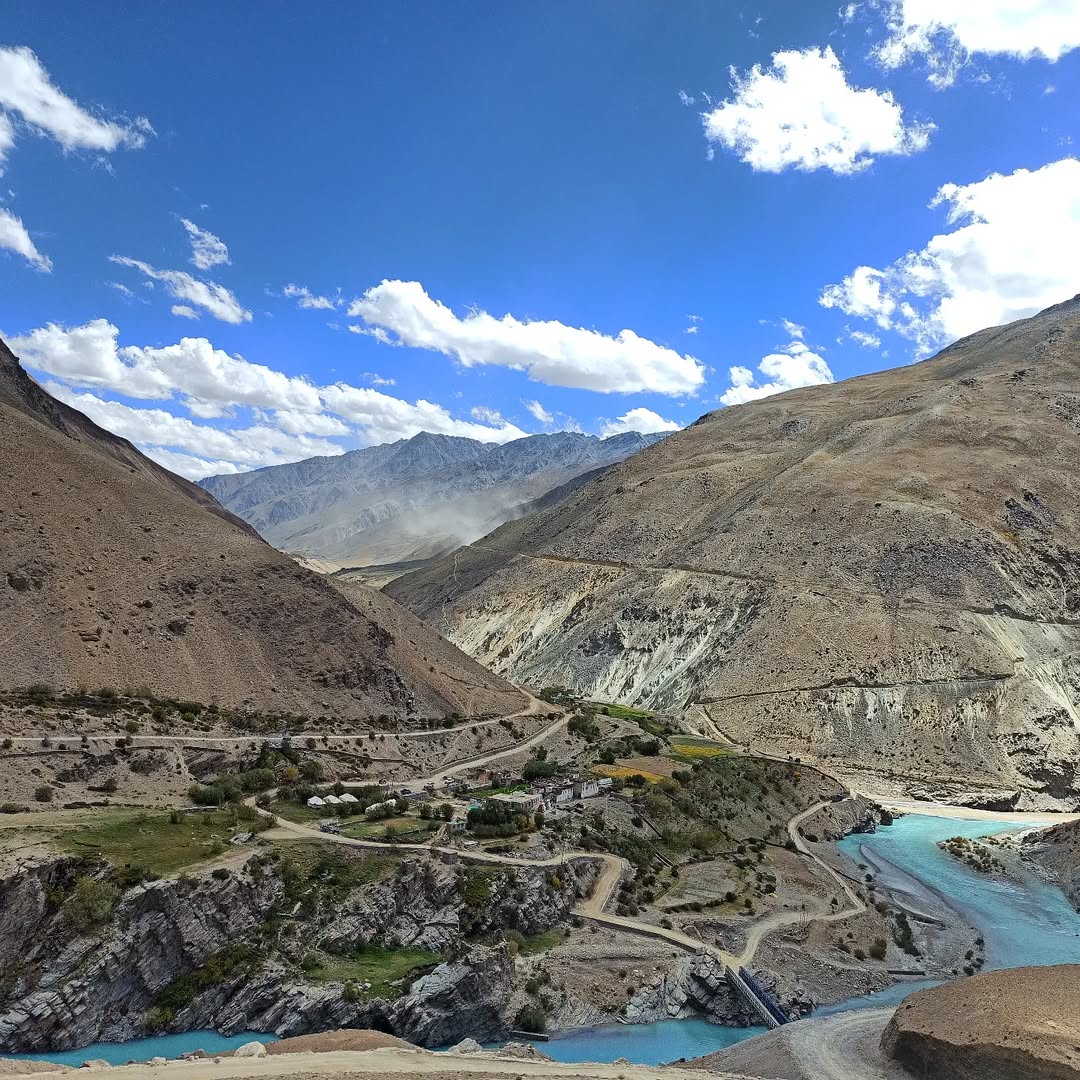
Purne occupies a quiet but decisive position within the Phuktal–Darcha Monastic & High Pass Corridor. Routes converge here with understated logic. Pilgrims, herders, and walkers all pass through, lending the village a social density rare in such terrain. It is not large, but it is connective.
What distinguishes Purne is its ability to slow time. Journeys pause not because they must, but because they should. Conversations unfold without urgency. Stories accumulate without hierarchy. Infrastructure here is modest, yet effective, encouraging interaction without spectacle.
In narrative terms, Purne deepens the corridor. It reveals how passage has historically functioned—not as a single route, but as a braided network of intentions. By the time one leaves, the iconic presence of Phuktal Gompa ahead is already grounded in human context rather than anticipation alone.
IV. Phuktal Gompa — The Architecture of Withdrawal
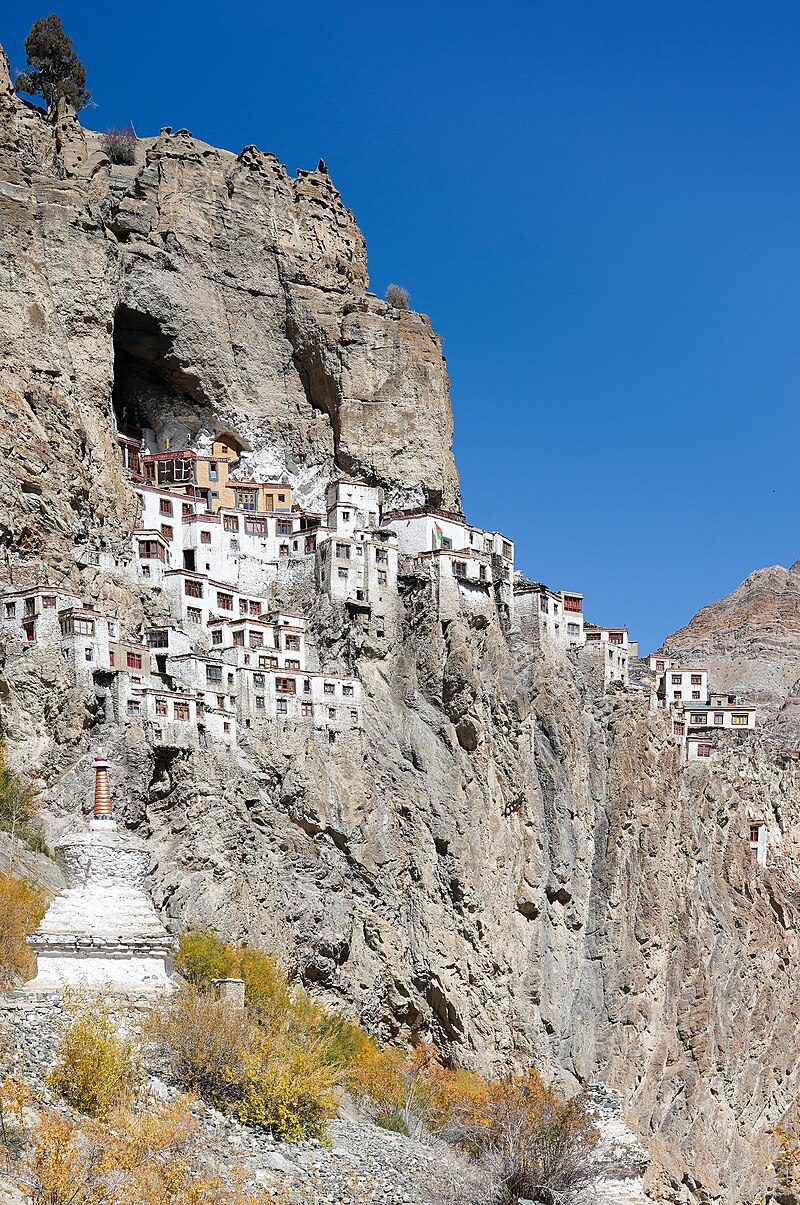
Phuktal Gompa is often described as the heart of the corridor, though this language can mislead. Suspended above the valley and emerging from a cave, the monastery embodies withdrawal rather than centrality. Within the Phuktal–Darcha Monastic & High Pass Corridor, it serves as a point of inward intensification, not culmination.
Its architecture negotiates gravity rather than defies it. The monastery clings to the rock with deliberation, mirroring its philosophical stance: engagement through distance. Ritual life here is disciplined but not performative. Understanding arises slowly, through observation rather than explanation.
Phuktal reframes significance. It is not a reward for effort, nor a summit of experience. Instead, it asks the traveller to reconsider the value of retreat in a world often defined by movement. Leaving Phuktal, one senses not completion, but a shift in register.
V. Kurgiakh and Shinkhu La — Negotiating the Threshold
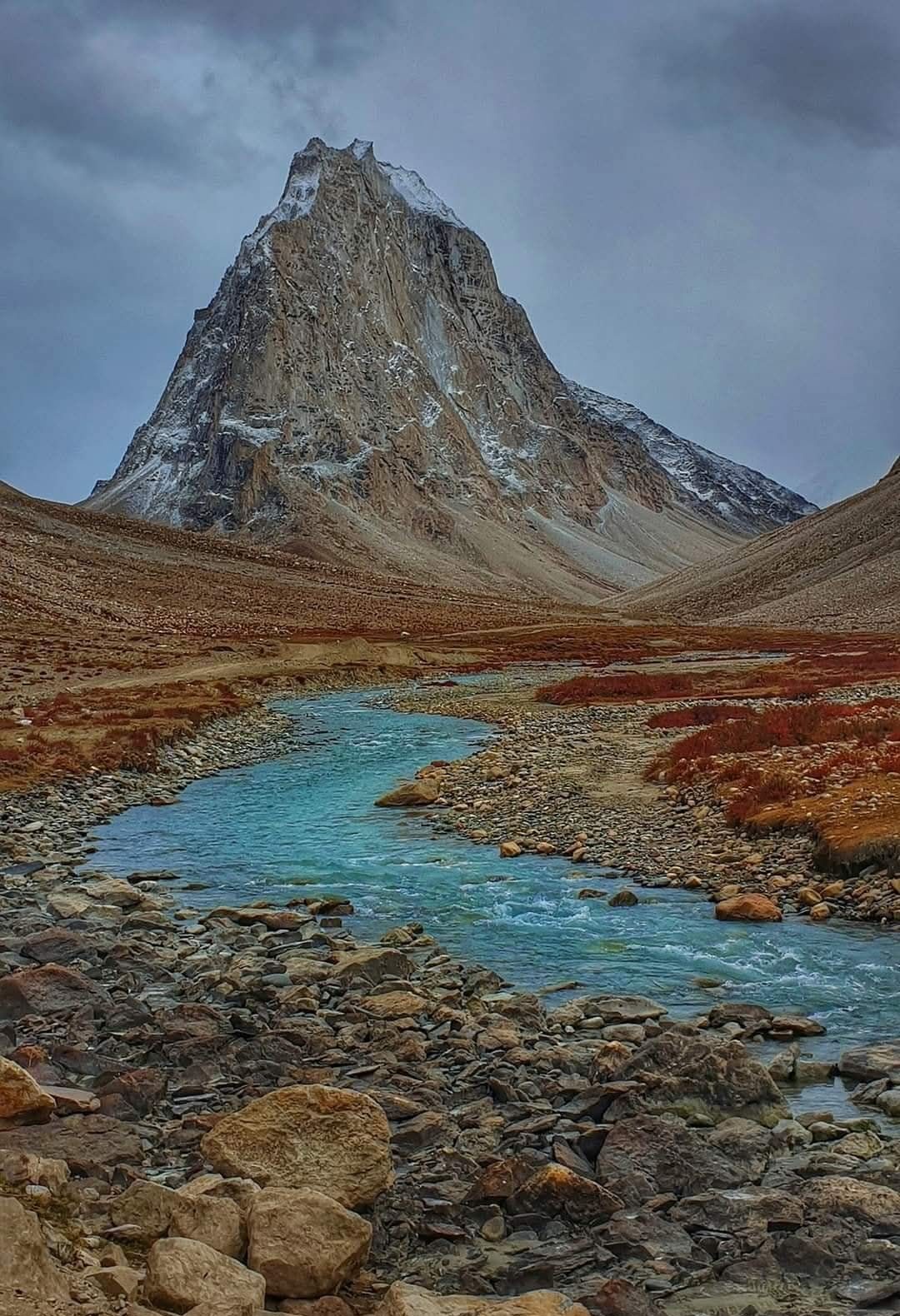
Beyond Phuktal, the corridor thins. Kurgiakh marks the last sustained settlement before the ascent toward Shinkhu La. Life here is seasonal and provisional, shaped by altitude’s constraints rather than its drama. The Phuktal–Darcha Monastic & High Pass Corridor enters a more austere phase.
Kurgiakh demonstrates that corridors persist only where they are respected. Timing, weather, and communal knowledge matter. The ascent toward Shinkhu La demands attentiveness rather than ambition. Conditions change quickly, and exposure replaces enclosure.
Shinkhu La itself resists triumphalist interpretation. It is a threshold, not a conquest. The crossing is brief, but psychologically clarifying. What matters is not the altitude gained, but the humility carried through the passage.
VI. Darcha — Leaving Without Resolution
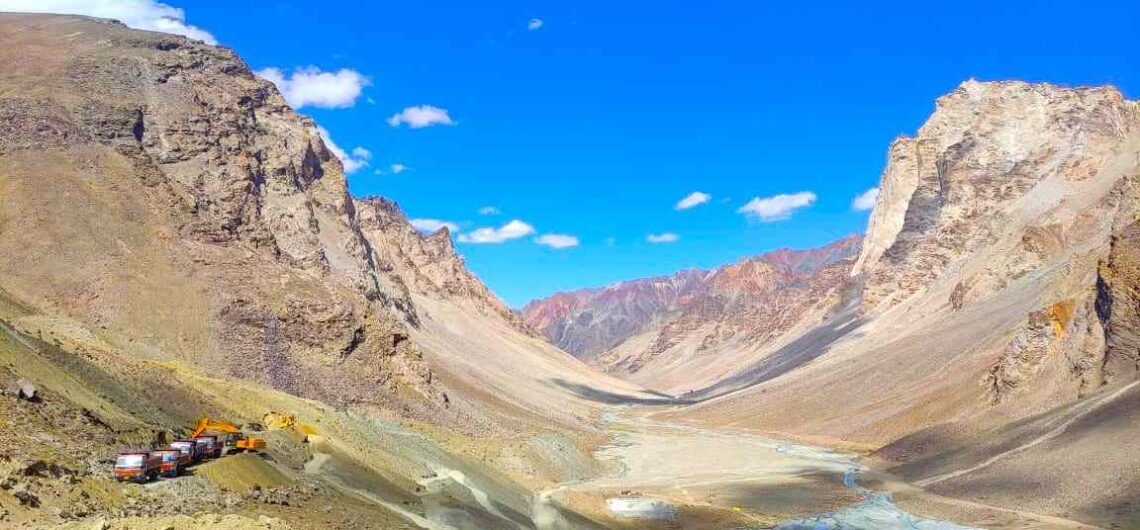
Darcha appears as a widening after prolonged containment. Roads reassert themselves, schedules return, and the landscape loosens its grip. Within the Phuktal–Darcha Monastic & High Pass Corridor, Darcha functions as an exit rather than a destination.
There is a temptation to frame Darcha as an endpoint, to summarise what has been achieved. The corridor quietly resists this impulse. Its lessons diffuse rather than conclude, shaping how movement itself is understood beyond geography.
Leaving Darcha feels intentionally unfinished. The corridor’s purpose is not closure, but transformation—subtle, cumulative, and resistant to summary.
Conclusion — What This Corridor Teaches Without Explaining
The Phuktal–Darcha Monastic & High Pass Corridor does not instruct. It arranges. Through monasteries, villages, and thresholds, it demonstrates how landscapes can cultivate patience, judgement, and humility. For European readers accustomed to efficiency-driven itineraries, it offers an alternative logic grounded in continuity rather than culmination.
What endures is not a checklist of places, but a recalibrated relationship to movement itself. The corridor suggests that travel, at its most meaningful, reshapes how we pay attention.
FAQ
Is the Phuktal–Darcha Monastic & High Pass Corridor suitable for first-time Himalayan travellers?
The corridor is accessible with preparation, but it rewards travellers who value cultural immersion and patience over speed. Its primary demands are interpretive rather than technical.
When is the best season to experience this corridor?
Late summer generally offers the most stable conditions, particularly for crossing Shinkhu La. Seasonal shifts significantly alter both access and village life.
Does this route require religious interest?
No prior religious background is necessary. The monasteries function as cultural anchors, offering insight into lived belief rather than requiring doctrinal engagement.
Declan P. O’Connor is the narrative voice behind Life on the Planet Ladakh,
a storytelling collective exploring the silence, culture, and resilience of Himalayan life.