
The Day the River Took Our Names
By Sidonie Morel
Leh, before the water
Dry air, slow breaths, and the first quiet rule: acclimatize or pay
Leh teaches you its terms without raising its voice. The first morning, the light arrives clean and hard, as if it has been filtered through stone. The air feels thin not in a dramatic way, but in a practical one: you stand up to pull on a sweater and you notice the small pause your lungs ask for. In the streets near the market, scooters thread through dust; shopkeepers lift shutters; a kettle begins its day somewhere behind a low wall. Everything works, but everything works a fraction slower.
Before any rafting on the Zanskar can be anything but a gamble, you wait. You drink water until it becomes an activity. You keep meals plain. You walk, but you do not hurry. Your body has to learn that this is not a place for sudden effort, and the river, later, will not negotiate with a headache that could have been avoided.
People arrive in Leh with an idea of adventure, but acclimatization is the unglamorous part that decides whether you will enjoy the days ahead or merely endure them. In a hotel courtyard, someone tests a new camera lens against the mountains; another person sits quietly with a cup of tea, looking at nothing in particular. A guide phones in from somewhere farther down the valley, asking if everyone is drinking enough, if anyone has slept badly, if there is nausea, if there is the dull pressure behind the eyes that makes small tasks feel heavy. It is not a performance of care; it is logistics.
By late afternoon, the town’s edges soften. You can feel heat in the sun on your face, yet your fingers cool quickly in the shade. The dryness has a texture, like flour. Dust settles on the tongue. At night, you hear dogs and distant laughter, and then the quiet returns. The river is still a name at this point—Zanskar, Indus—but the body is already being prepared for the work of cold water at altitude.
Kit laid out like a small ceremony: neoprene, straps, river shoes, and doubt
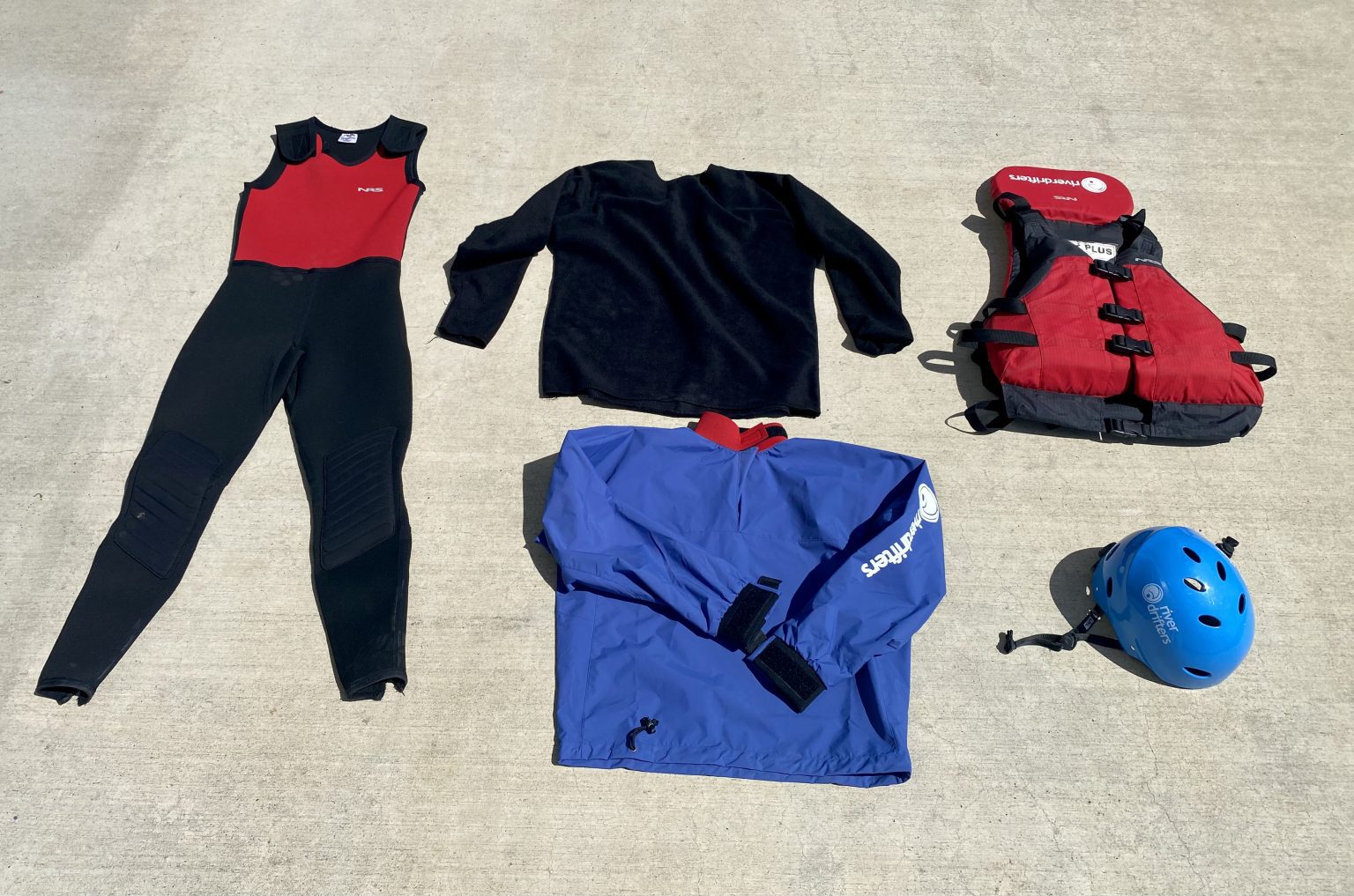
In most travel stories, equipment is either fetishized or skipped. On this trip, it sits in the middle, unavoidable. Neoprene smells faintly of rubber and storage. When you pull on a wetsuit, it grips the skin with an honest insistence; it is not comfortable, but it is correct. Helmets clack against one another in a pile. PFDs—life jackets, in the language of river people—are checked for buckles that lock cleanly and straps that tighten without slipping.
There are small things that become important later. River shoes that drain rather than fill. A dry bag that seals properly, not almost. A pair of gloves that still lets you feel the paddle shaft without turning your grip into a bruise. Sunscreen that does not melt off the moment you begin to sweat. Lip balm. A lightweight layer for camp that can be pulled on over damp skin without sticking.
The river’s cold is not a poetic cold; it is a measurable cold. It comes from ice and snowmelt, from shaded gorge walls that keep sections of water refrigerated even under sun. People talk about “glacial water” as if it were a metaphor for purity. Here it is an instruction. You dress for it because you do not want your hands to stop working when you need them most.
Doubt arrives in ordinary shapes: Are these straps too loose? Will my knees fit under the raft’s floor tubes without cramping? Can I swim in this altitude if something goes wrong? The questions are not dramatic, and nobody answers them with bravado. Someone shows you how to cinch the shoulder straps so the life jacket does not ride up. Someone else demonstrates how to tuck a water bottle where it cannot escape. This is the tone that carries you to the river: quiet competence, less about courage than about preparation.
The road that makes the river feel earned
Leaving Leh and trading comfort for distance—passes, dust, the long unspooling
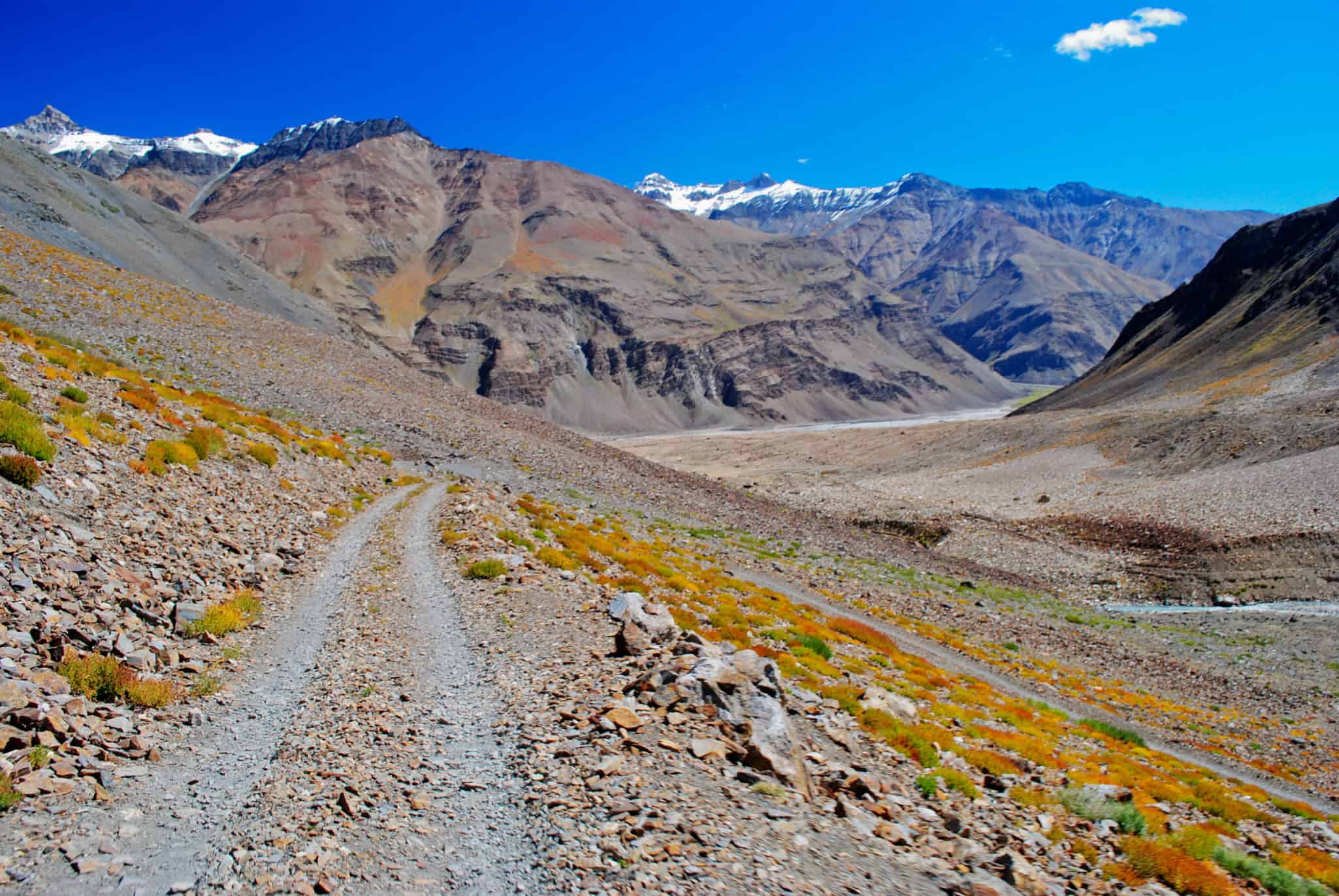
The drive away from Leh is part of the rafting, whether you want it to be or not. It is the slow transition from town life to river life: the last bakery, the last reliable mobile signal, the last evening when you can take a shower without thinking about how to conserve water. The road pulls you through landscapes that look empty until you watch them closely and begin to see the ways people have negotiated with altitude—fields in improbable rectangles, stone walls that hold back wind, small clusters of houses that turn their backs to winter.
You climb, then descend, then climb again. On high passes, the air is sharper and the sun seems nearer. Trucks idle. Prayer flags snap and fade. There are stretches where the road narrows into a thread of gravel; the driver negotiates oncoming traffic with a patient choreography of horns and hand signals. At roadside tea stalls, someone pours sweet chai from a metal pot into glass cups that burn your fingers. The warmth is immediate and temporary, like a favor.
In the back seat, bodies begin to learn how to sit still for long hours. Knees press against bags. Water bottles roll. There is a particular fatigue that comes from travel without distraction—no music you can keep steady, no scenery you can photograph fast enough to keep up with it. You begin to understand why river expeditions in this region are spoken of as journeys rather than “activities.” The river is not adjacent to the airport. It is a day, sometimes two, of movement into remoteness, and that distance changes the way you take the next instructions at the put-in. You listen more closely because leaving is not as easy as arriving.
When the valley narrows and the map starts to feel like a rumor
At some point the road becomes less an engineered promise and more a suggestion held together by gravel and habit. The valley tightens. Rock faces lean in. You see water below, sometimes only as a flash, sometimes as a braided stream over pale stones. The Zanskar region has a way of shifting scale: a village can appear as a handful of green against a world of brown and grey, and it is easy to forget, until you stop, how much work it takes to live here.
Roadside life is stripped to essentials. A small shop sells biscuits, instant noodles, batteries. Someone has placed apricots on a cloth to dry in the sun, each fruit split neatly, each pit removed with practiced speed. A donkey carries a load that looks heavier than it should be. A child watches your vehicle pass with the calm curiosity of someone who has been watching strangers all their life and has learned not to expect anything from them.
On paper, a rafting itinerary is a line from put-in to take-out, a neat sentence. On the road, the line becomes physical: you feel the altitude in your temples, the dust on your eyelashes, the heat inside the car when the sun turns the windshield into a lamp. It is here that the canyon begins to exist before you see it. It exists as an approach, as the steady removal of conveniences, as the acceptance that whatever happens on the river will happen far from quick solutions.
At the put-in: a river has its own language
Safety talk, signals, and the odd intimacy of listening to strangers with your life
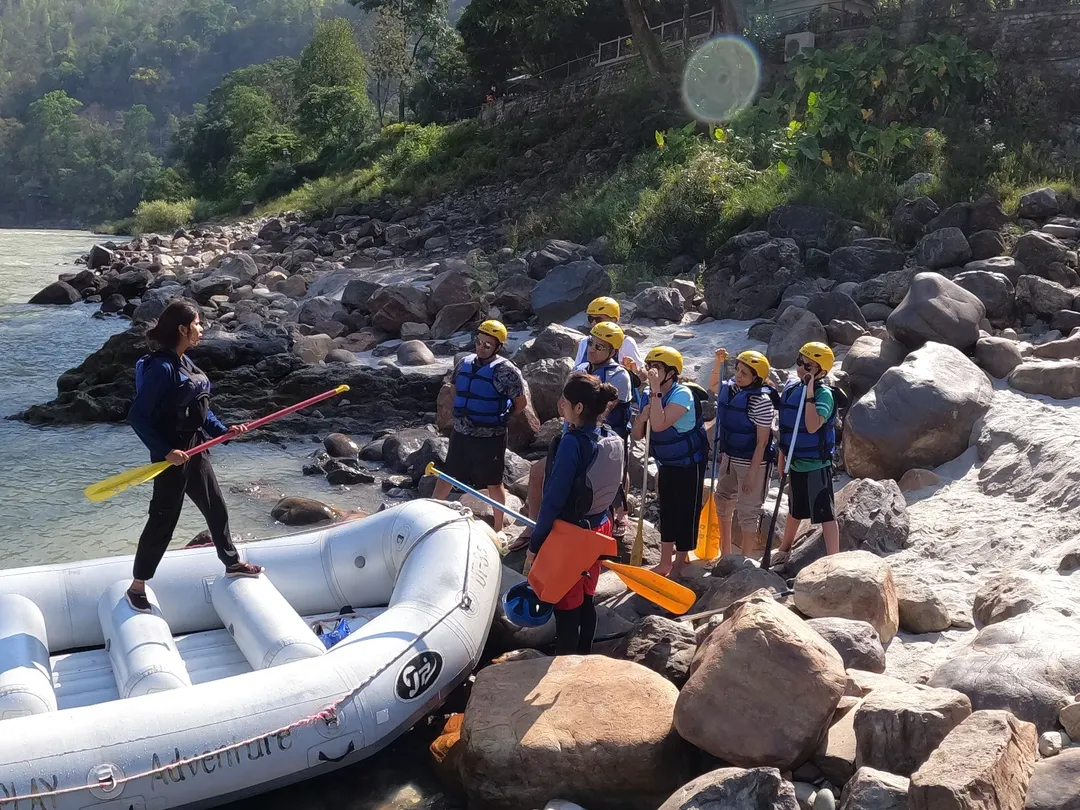
The put-in is rarely cinematic. It is work: rafts are dragged, inflated, checked; paddles are counted; dry bags are arranged so weight is balanced. People change clothes in a polite hurry, turning their backs, stepping into neoprene with the ungainly grace of adults trying not to fall. The river runs beside all of this, moving as if it has not noticed you have arrived.
Then comes the talk. It is not long, but it is dense. You learn how to sit: where to place your feet, how to wedge yourself so you do not become an unplanned projectile. You learn how to hold the paddle so your wrist does not twist under pressure. You learn the commands—forward, back, stop—and the way they may be shouted over sound. You learn what to do if you fall in, and the instructions are delivered without drama because drama wastes time.
“If you swim, keep your feet up, look for the raft, and listen. Don’t fight the current. Work with it.”
It is strange, how quickly this creates a small society. Ten minutes ago you were strangers making small talk about flights and weather. Now you are learning the same signals and agreeing to the same rules. The intimacy does not come from emotion; it comes from shared risk and shared attention.
Someone checks each helmet strap, pulling it snug under the chin. Someone else presses down on PFD shoulder straps to be sure the jacket will not float up around your ears. A guide asks if anyone has a sore shoulder, a stiff knee, anything that will matter after three hours of paddling. These are small questions, but they carry the message that your body, like the raft, has to be set up correctly before the river begins to test it.
First contact: glacial shock, laughter that sounds like coughing, hands learning the paddle
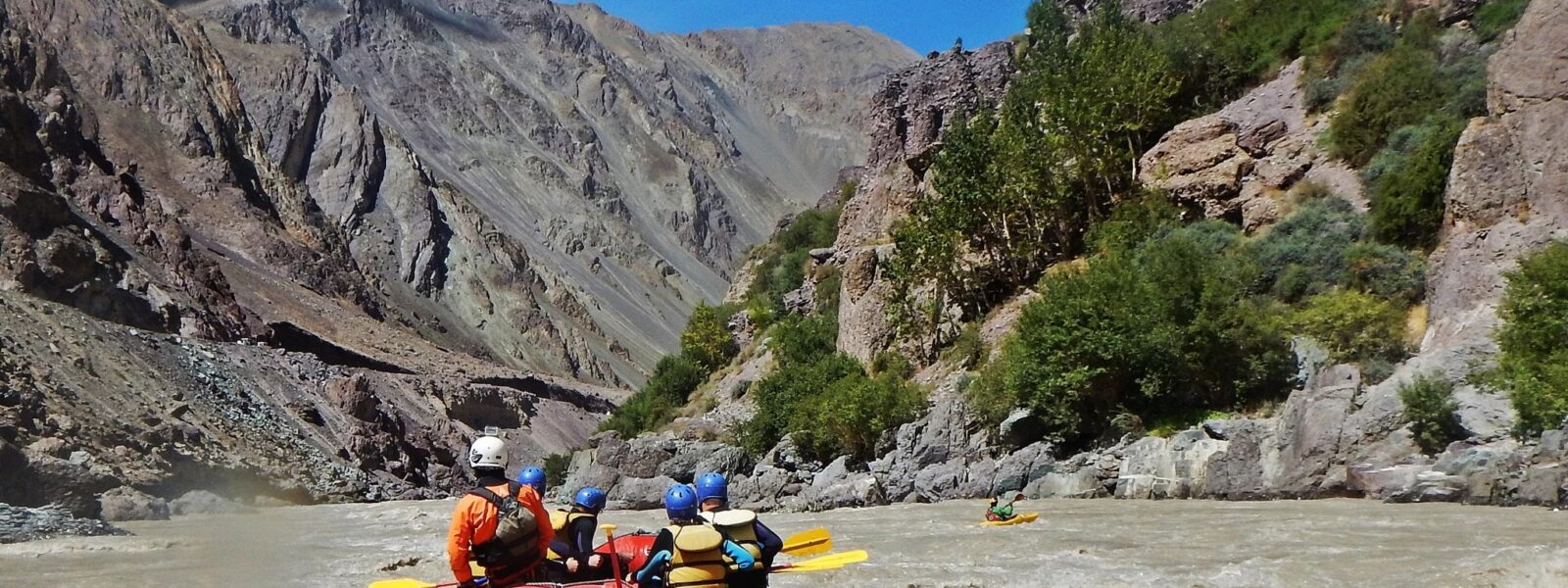
When the raft slides into the Zanskar, the cold arrives through the suit, not as pain but as a sudden, undeniable fact. Water seeps at the wrists, sometimes at the neck, and the body responds with a sharp inhalation. You do not “feel alive” in a neat literary way; you feel the immediate need to control your breathing. Your fingers tighten around the paddle shaft. Someone laughs, and it comes out in short bursts, the kind of laughter that is half reaction, half attempt at steadiness.
The first strokes are clumsy. The raft turns more slowly than you expect, and then faster. Water hits the tubes with a sound like wet cloth slapped against stone. The guide sits where they can see everything and calls commands with a voice that stays level. Forward. Hold. Back. The raft responds in degrees, not absolutes, and you begin to understand that rafting here is not about domination; it is about reading and adjustment.
The landscape does not present itself as a postcard. It is close. The river is close. Rocks are close. In certain stretches you can see the riverbed through clear water, pale stones slipping under you. Then the current thickens, darkens, and the raft rises slightly, carried by speed. The paddle begins to have weight in your hands, not only as an object but as a tool that must land in the right place at the right moment.
After half an hour, the initial shock fades into a working temperature. You can feel where the suit is doing its job and where water has found its way in. You notice the way the sun warms the top of your helmet. You begin to recognize the river’s cues: the smooth V that indicates a tongue of water, the boiling surface that suggests a hole, the line of white that marks a rock you do not want to meet. It is not romantic. It is absorbing.
Learning the Zanskar’s moods
Rapids as punctuation—clean lines, sudden commas, and the sentence that won’t end
The Zanskar shifts between stretches that allow conversation and stretches that silence everyone. On calmer water, you hear small things: the drip of paddles, the creak of raft material, the faint clatter of a carabiner. Someone points to a bird cutting across the cliff face. Someone adjusts a strap. You take a sip of water and taste the plastic of the bottle and the mineral dryness in your mouth.
Then a rapid arrives and the raft is asked to behave differently. The guide reads the approach with their eyes and their posture. The commands come faster. Your paddle bites. Water breaks over the front tube in sheets that slap your shins and splash into your lap. The raft lurches, not dangerously, but enough that you understand why foot placement matters. It is here that teamwork becomes visible. If one person is late on a stroke, you feel it in the raft’s angle. If someone digs in too hard on one side, you turn more than intended. Coordination is less about chemistry and more about paying attention at the same moment.
The river’s “moods” are not a mystical idea. They are the result of gradient, volume, rocks, and narrowing channels. In this altitude, fatigue is also part of the equation. You notice shoulders tightening. You notice forearms starting to burn. On the raft, people drink more often than they would at sea level, because dehydration can arrive quietly in cold air. A guide reminds you to eat something even when you do not feel hungry. It is simple advice, and it matters. A low blood sugar moment in a canyon is not charming.
As the day progresses, you stop thinking about the paddle as an object and start thinking about it as timing. You begin to anticipate commands. You learn the small discipline of not staring at the problem—a wave, a rock—but looking where you are meant to go. That is the kind of learning that stays with you after the raft comes out of the water.
Walls rising: entering the canyon
Rock faces like stacked colors—rust, violet, ash—changing with every hour of sun
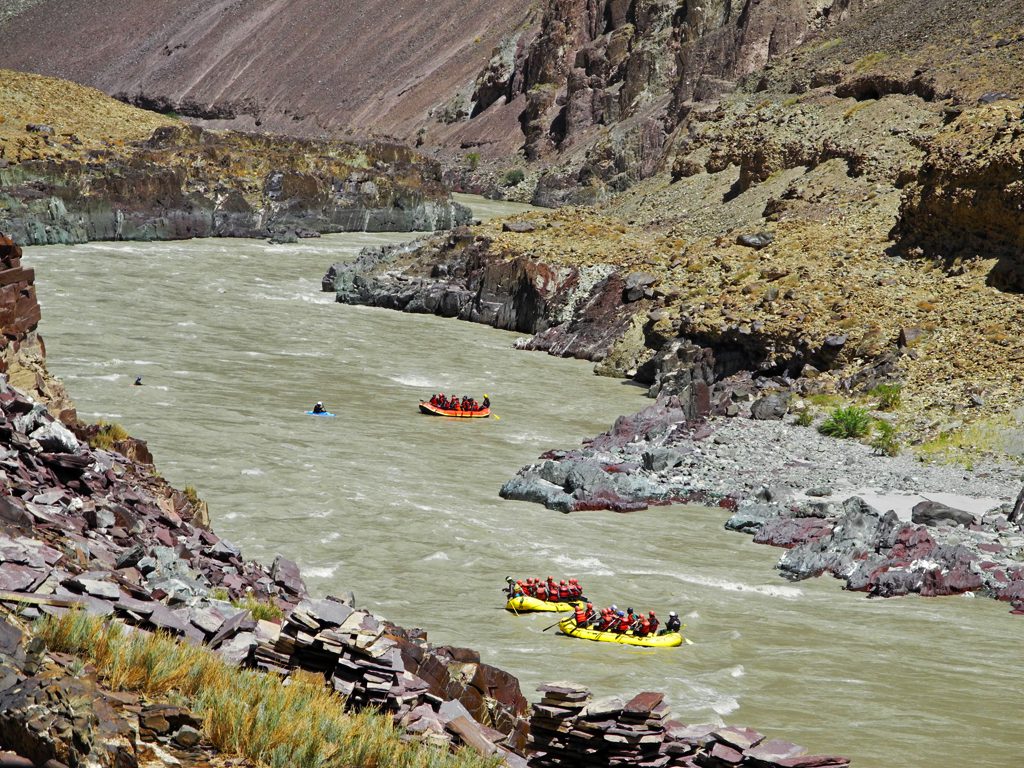
There is a moment when the canyon begins in earnest and you feel it in your ribs. The walls move closer. The sky becomes a narrower strip above. The river, which has been an open ribbon, turns into a corridor. The rock is not one color. It is layered, and the layers read like time: rust bands, grey slabs, violet undertones that appear when the light hits at a certain angle. In shadow, the colors flatten; in sun, they separate again.
The scale is difficult to explain without exaggeration, so it is better to describe the practical effect: you stop looking far ahead and start looking up. You notice where rock has fallen, leaving fresh scars in pale dust. You see smooth sections where water has polished stone. You pass small ledges that might hold a goat’s track, though you do not always see the animal.
Sound behaves differently here. In open valleys, the river’s noise spreads. In the gorge, it rebounds. A rapid a hundred meters ahead is heard as a continuous roar, not as a series of waves. Voices shrink. A guide’s commands remain clear, but casual conversation becomes less useful; you would have to raise your voice, and there is no need. People watch instead. They watch the water. They watch the guide’s gaze. They watch the line the raft is taking relative to the walls.
In the canyon, temperature becomes local. Sunlit patches feel warm on the face; shaded sections pull heat away. The wet suit holds your core temperature steady, but your hands remain exposed to air and spray, and you learn to move your fingers between rapids to keep them responsive. The canyon teaches you attention in small increments: a wet strap that starts rubbing, a pebble in a shoe, the way your mouth dries even when you are surrounded by water.
The day of constriction
Scouting from shore: helmets off, faces serious, the river deciding the route
Some rapids are run without ceremony; others ask for a pause. The most demanding section on many Zanskar itineraries is approached on foot first. The raft is pulled into an eddy. People climb out onto rocks, careful not to slip, and the canyon’s silence, away from the raft’s movement, becomes noticeable. You can smell wet stone. You can see the river pressing into a narrower channel, accelerating, piling up against itself.
The guides walk downstream along the bank, scanning for the cleanest line. They point. They talk in short phrases. From where you stand, you can see the features more clearly than you can from the raft: the pour-over that would flip you if you hit it wrong, the tongue of water that might thread you through, the recovery pool that would let you regroup if needed. There is no theatrical bravado. There is assessment.
Passengers are given instructions that feel unusually specific: how to lean, when to keep paddling, when to stop paddling and hold on, what to do if someone is ejected. You notice your own body again. You notice how the helmet strap presses under your jaw. You notice how your knees will brace against the raft. The river, in this narrow place, will not allow sloppy posture. It will amplify every small mistake.
In many travel narratives, danger is used as decoration. Here it is treated as part of a system. The goal is not to be frightened; it is to be prepared. When you step back into the raft, the mood is not tense so much as focused. The river has not changed, but your attention has narrowed to match the canyon.
Camp life, stitched by wet socks
Neoprene peeled away, skin returning, tea tasting like mercy
Camp is set with the same quiet efficiency as the put-in. A patch of level ground is chosen above the river’s reach. Tents appear. A kitchen tarp is tied. Someone fills a pot. Someone else lays out snacks that are meant to be eaten before hunger becomes a problem: biscuits, fruit, something salty. The raft gear is stacked so it will dry as much as it can, though “dry” is relative in a gorge.
Removing a wetsuit after hours in cold water is a small struggle. The fabric clings. Your fingers, clumsy with cold, find seams and pull. When it comes off, air hits skin and you notice where the suit has left pressure marks. Socks are damp. Hands smell faintly of river and neoprene. You change into something soft and the body’s mood shifts: from performing to recovering.
Tea at camp is not an aesthetic detail. It is a practical one. A hot cup held between both hands gives you back feeling. The steam carries a simple smell—black tea, sometimes ginger, sometimes just boiled water and leaves—and you drink without talking. Nearby, someone wrings out a pair of socks and hangs them on a line that will not do much by morning. Another person checks their blisters. Someone else spreads out a sleeping bag in late sun to chase off dampness.
Food is plain and welcome. A pot of dal. Rice. Something with vegetables if the supply chain has held. You eat because tomorrow will ask for arms again, and because altitude makes appetite unreliable. In the canyon, you learn to feed the body even when the body is not asking politely.
Night: the canyon keeps the cold; the sky gives back stars
When the sun drops behind canyon walls, the temperature falls quickly. The river continues its work below, sounding louder in the dark. You brush your teeth with water that feels painfully cold on gums. You zip your jacket. You watch your breath appear for a moment and disappear again.
Without city lights, the sky becomes a field of points rather than a vague glow. Stars are not inspirational here; they are simply numerous. You can see the Milky Way as a pale band when your eyes adjust. Someone points out a constellation, gets it wrong, corrects themselves. A headlamp swings. In the kitchen area, a metal pot is set down and makes a small ringing sound that seems too bright for the dark.
You notice other noises: the snap of a zipper, the rustle of a sleeping bag, the faint crackle of something being opened—nuts, maybe, or a packet of biscuits saved for later. The river’s roar remains constant, and it becomes a kind of background that makes everything else feel close and domestic.
In the tent, the fabric smells of dust warmed by sun. The ground beneath is hard even through a mat, and you find a position that will let your hips and shoulders settle. The canyon holds the cold, and you understand why river people treat sleep as another form of preparation. Tomorrow’s rapids will not care if you stayed up talking.
People you meet only because the river forces you to
The raft crew’s quiet choreography—who checks straps, who watches weather, who jokes last
A rafting expedition is a moving group, and its social structure is visible in actions rather than declarations. One guide always checks buckles twice. Another watches the river surface and the wind, as if reading a small set of clues. A cook appears with tea at the exact moment people begin to feel cold. Someone keeps track of who has eaten, who has drunk, who has gone quiet in a way that might mean headache rather than shyness.
In the raft, the rhythm of paddling creates its own familiarity. You learn who pulls strongly, who needs an extra beat to coordinate, who listens carefully to commands. You learn to trust certain habits: the guide who scans downstream before speaking, the person who tightens their helmet strap with the same gesture each time. Trust here is not sentimental. It is earned by repetition.
Occasionally, the river brings you close to other lives. You see a figure high on a trail, moving slowly with an animal. You pass a small patch of green where someone has coaxed crops from stony ground. Sometimes there is no one at all, and that absence is its own form of presence: the canyon as a place that does not exist for your entertainment.
What stays with you are not speeches, but small exchanges. A guide handing you a spare glove without comment. Someone sharing a chocolate bar cut into careful squares. A moment of laughter after a wet wave catches everyone at once and the raft momentarily becomes a group of dripping strangers, blinking and coughing, then immediately paddling again. The river does not allow long introductions. It makes you useful to one another before it makes you friendly.
River time: waiting, moving, repeating
Hours that feel suspended—paddle strokes counted by muscle, not by clock
On the river, time changes shape. You are moving, often quickly, yet the canyon’s walls and the repetition of paddling create a sense of suspended hours. The day’s structure is not measured in landmarks you can name, but in sequences: calm stretch, rapid, calm stretch, rapid, eddy stop, snack, resume.
Waiting on a river is not passive. You might be parked in an eddy while guides scout ahead, and you keep your body braced because the current still tugs at the raft. You might drift slowly while someone adjusts a dry bag. You might pause to let another raft run a section first, listening for their whoops and the river’s response. The waiting becomes part of the work: staying warm, staying attentive, staying ready to paddle again without delay.
In cold air, thirst is deceptive. People forget to drink because sweat is not obvious. A guide’s reminder becomes routine: sip water, eat something. The body’s ledger becomes visible in small signs: lips cracking, hands chafing, shoulders tightening, a bruise blooming on a shin where the raft tube met bone during a sudden drop. None of this is dramatic. It is the cost of being in motion for hours at altitude.
What you remember, later, is the physical repetition: the feel of the paddle shaft under wet gloves, the splash pattern that always seems to find the same place on your face, the sound of water hitting the raft in a particular rapid, the way your muscles learn to respond before you think. River time is not philosophical. It is a schedule written into the body.
When the Zanskar meets the Indus
The confluence as a hinge—two colors of water, two speeds, one sudden widening of the world

There is a moment on many Zanskar journeys that feels like a change of chapter: the approach to the confluence with the Indus. The canyon begins to loosen. The sky widens. The water’s behavior changes, subtly at first—different swirls, different texture on the surface—then more clearly when you see two rivers moving together without immediately becoming one.
At the meeting point, the colors can differ depending on season and recent weather: one stream clearer, one more silted, both carrying their own histories downstream. The raft floats through a place that has been named and photographed often, yet in person the meaning is practical. It is a navigational point, a psychological landmark, a reminder that your path has been real and has had direction.
People want to take photographs, and they do, but there is also a quieter behavior: watching. Watching how the currents braid. Watching how the river broadens and feels less compressed by walls. Watching the way the sound changes—still loud, but less enclosed, less amplified by stone. You can feel the raft move differently under you, as if the water has different weight.
For many, this is where the phrase “rafting the Zanskar to the Indus” becomes more than a line in a plan. It becomes an observable fact: you have followed one river into another, and the landscape has marked the transition clearly enough that you do not need words to name it.
After the take-out: what remains on the skin
Salt lines, dust over damp hair, the smell of river that clings to everything
The take-out is another non-cinematic place. Rafts are pulled onto shore. Paddles are stacked. People step out carefully, legs slightly uncertain after hours braced in one position. The river continues without acknowledging your departure. That, too, is useful: it reminds you that your experience was temporary, but the river’s work is not.
When you remove your helmet, hair is flattened and damp. The air dries it quickly, leaving it stiff with a combination of river water and dust. You notice salt lines on sleeves where spray dried. Your hands smell of wet rope and neoprene. Small scratches appear on knuckles and forearms, the kind you did not notice during the day because attention was elsewhere.
People begin to talk more, not because the river has made them sentimental, but because the immediate need for short commands has passed. Someone recounts a rapid with gestures, showing the angle of the raft, the wave that hit, the moment they missed a stroke. The story is less about heroism than about sequence: this happened, then this, then this. It is how human beings process risk once it has remained contained.
Practicality returns quickly. Wet gear has to be packed. Dry bags have to be checked for leakage. Someone counts helmets. Another person looks for a missing glove. A vehicle waits. There is dust again, and road again, and the body begins to switch back from river posture to travel posture. Yet the river remains in small traces: grit under fingernails, a faint ache across the shoulders, the sound of water still present in the ears even when you are no longer beside it.
Returning to Leh, carrying a river inside the ribs
Hot shower shock, quiet beds, and the missing roar when you close your eyes
Back in Leh, the ordinary feels strangely specific. A hot shower is not just comfort; it is contrast. Heat hits skin and you feel where the cold has been living—inside wrists, between fingers, under the collarbones. The first clean clothes feel too soft. The first bed feels too still. You sleep, then wake, then sleep again, as if the body is catching up on a debt.
In town, life continues with the same calm rhythm as before. A shopkeeper arranges dried fruit. A café serves coffee to someone scrolling on a phone. Dogs lie in the sun. It would be easy to believe the river was a separate world that never touched this one, yet your body carries evidence that it did. A bruise blooms on a knee. A blister hardens on a palm. Your shoulders ask for a slower movement when you lift a bag.
The river also changes the way you notice the landscape around Leh. You find yourself looking at water more carefully—at streams crossing the road, at irrigation channels in small fields, at the way a hillside holds or releases meltwater. You notice how people here treat water as something managed rather than assumed. A plastic pipe runs from a slope to a cluster of homes. A bucket sits by a door, ready. There is no abstraction in this; it is daily life.
On the last evening, you climb to a rooftop or a small rise above the town. The air is still dry. The light fades again. Somewhere beyond the ridgelines, the Zanskar continues into the Indus and onward. You cannot hear it from here, and that absence is its own reminder. The roar in the canyon was not a soundtrack; it was a physical environment. Now the silence returns, and it does not feel like peace or loss. It feels like a place returning to its normal scale.
Sidonie Morel is the narrative voice behind Life on the Planet Ladakh,
a storytelling collective exploring the silence, culture, and resilience of Himalayan life.