
The Plateau That Teaches You to Listen
By Sidonie Morel
Leh, where the body rehearses for thin air
A slow arrival into altitude
In Leh, the simplest errands can feel like a small negotiation. You cross a courtyard, climb a short flight of stairs, and notice you have chosen breath over speed without meaning to. People arrive here with tidy plans and strong opinions about routes; the first days have a way of sanding those edges down. The air is dry enough to leave a fine crust on the inside of the nose by evening. In the morning, the water in a glass tastes faintly of minerals, as if it has been stored with stones. Even a fresh apple seems more fragrant than it should be, simply because the surrounding air carries so little else.
Acclimatisation in Ladakh is often described as a rule, but in practice it is a set of ordinary acts: walking slowly past bakeries, resting on a low wall, drinking more than you want to, eating when appetite finally returns. A short stroll to Shanti Stupa or a quiet lane behind the bazaar is enough to teach humility. At night, the room cools quickly. Wool feels right against the skin; cotton can feel thin and irresponsible. The first real sleep, when it arrives, comes in shallow segments—wake, sip water, listen to a distant dog, sleep again.
Rumtse to Tso Moriri is a trek that rewards this unglamorous preparation. It is not a route that catches you with one sudden drama; it accumulates weight by altitude and distance. The plateau does not offer constant spectacle. It offers repeated work: packing in cold fingers, walking into wind, finding a place to pitch a tent where the ground is flat enough and the water near enough, and then doing it again the next day.
Leaving “easy comfort” behind
Before leaving Leh, the practical world still feels close. You can buy batteries, biscuits, a bar of soap that smells of lemon. You can replace a missing glove, or add an extra roll of tape “just in case.” These small purchases are not souvenirs; they are an attempt to make future discomfort less personal. The last hot shower matters more than anyone admits. You step out and feel the air pull the heat from your skin at once, and you realise how quickly the plateau will do the same, without malice and without exception.
The drive to Rumtse is not long, but it marks a shift. The road threads past poplar-lined villages and then, gradually, loosens its grip on the landscape. The view opens. The colours reduce: brown rock, pale grass, a thin strip of water in a valley. At the start, there is no grand gate. There is a place where vehicles stop, bags are shifted, and the human body becomes the only engine again.
Rumtse, where the road lets go
The first steps beyond engines
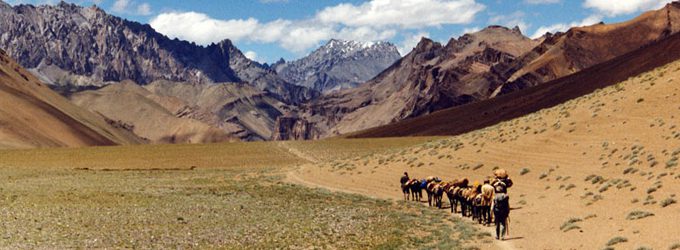
Rumtse sits at the edge of what feels inhabited in a familiar way. There are walls, courtyards, a few trees that still look like deliberate planting rather than chance. Then the path climbs and the built world recedes quickly, as if someone has turned a page. The ground underfoot is dry and granular. Dust rises in small puffs with each step and settles on trouser hems and boot tongues. The light has a hard clarity; shadows look cut out rather than gently shaded.
Early on, walking still feels like an ordinary act. The group’s voices are present. Someone adjusts a strap, someone jokes, someone asks about the next ridge. Then the silence begins to take its place. It is not absolute silence—there is wind, the scrape of soles, a faint clink of metal from a bottle—but it has room to expand. You begin to hear your own breathing clearly, not as an emotion but as a fact. Conversation thins out without anyone deciding it should. Spacing happens naturally: a few metres between walkers, then more, then the steady pattern of each person travelling inside their own rhythm.
Rumtse to Tso Moriri is often described by the names of its camps and passes—Kyamar, Tisaling, Ponganagu, Nuruchen, Rachungkaru, Gyamar, Yalung Nyau La—because on the plateau names are the closest thing to landmarks. Yet the first day is less about names than about the body learning a new scale. A slope that would feel moderate at sea level can feel precise and deliberate here. You can point to a ridge and tell yourself you will reach it in an hour; then you learn that on this terrain the horizon negotiates.
First camp, first cold
By the first camp, the day has already taught its lessons: water matters, shade is scarce, and wind can arrive from nowhere. The tent goes up on ground that looks flat until you lie down, and then you discover the smallest tilt in the earth. Pebbles seem to find their way under hips and shoulders. You pull out a sleeping bag and it smells faintly of nylon and last winter, as if cold can be stored in fabric.
There is a distinct sound to evening on this route: the hiss of a stove, the dull thud of a pot placed on stone, the rustle of down jackets. When someone pours tea, the liquid looks almost black in the thin light, and steam rises straight up if the wind has paused. In the distance, a stream may run with a sound that seems louder than its size. You wash your face and the water stings the skin as if it carries a little ice, even in summer. Small acts—washing, brushing teeth, arranging socks to dry—take on the seriousness of procedure. Nothing is difficult, but everything is slower.
Night arrives quickly. The sky turns from blue to a deep, matte tone, and stars appear in layers. There is a particular kind of fatigue that comes after the first high day: not the heavy exhaustion of overwork, but a dry, hollow tiredness that sits behind the eyes. When you wake in the night, you can hear the fabric of the tent shift in the wind. Somewhere, a stone rolls down a slope with a short clatter. The plateau feels awake even when you are not.
Early passes, early lessons
Breath becoming a measure of time
As the trek progresses, the days begin to resemble each other in structure—pack, walk, pause, walk again—yet the terrain keeps changing the details. One morning the ground is coarse gravel; another it is pale sand that gives slightly underfoot. Sometimes the path is obvious, a faint line pressed into the slope by many boots. Sometimes it disappears into a fan of stones, and you follow cairns or a leader’s instinct, or the simple logic of the valley.
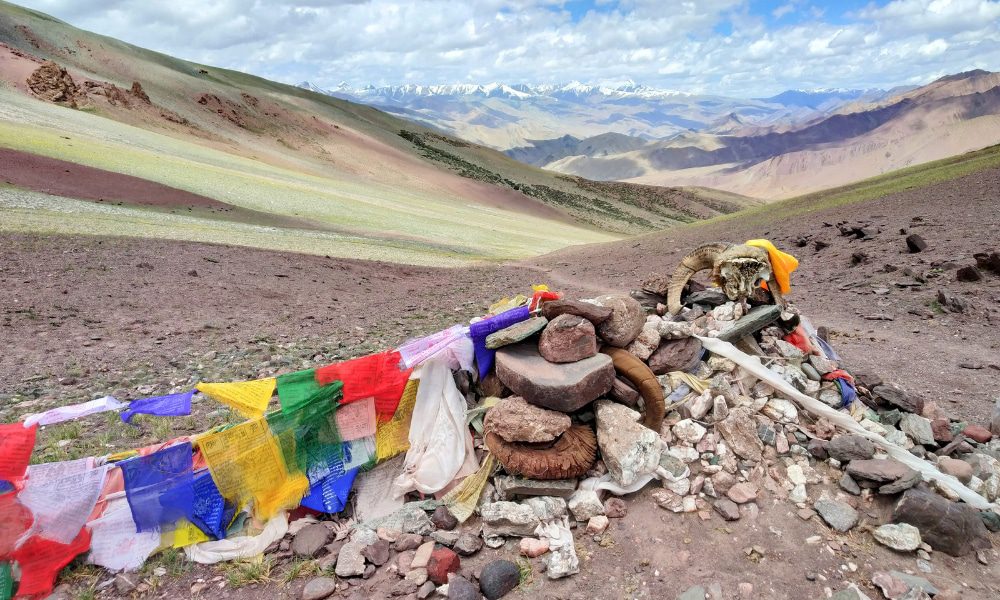
The passes arrive not as climactic moments but as exposures. You climb for hours with the ridge slowly unspooling, and then you crest and feel the wind strike the face directly. Prayer flags appear, snapped stiff by weather. The air at a high pass has a particular taste: dry, metallic, and thin enough that you can feel it in the throat. People do not linger long. Photographs happen quickly. Gloves come on. Someone checks another person’s face for signs of fatigue. Then the descent begins, and the pass becomes something behind you, no longer a goal but a line crossed.
On routes like this, altitude is not a single crisis but a set of small adjustments. A mild headache in the morning that vanishes after water. A loss of appetite at lunch, then an unexpected hunger at dusk. A moment of lightheadedness when standing too quickly after a break. These are not heroic problems; they are reminders that the plateau requires patience. Good walking here has a quiet discipline: short steps on steep slopes, a steady pace on flats, frequent sips rather than long gulps, and the willingness to stop before fatigue becomes stubborn.
Camp names as a kind of map
Kyamar, Tisaling, Ponganagu—each camp tends to have a simple reason for existing. There is water nearby, a stretch of ground that can take tents, perhaps a slight shelter from wind. Often there is little else. The camps are not scenic overlooks arranged for pleasure; they are practical pauses in a large, spare landscape.
In Kyamar, you might notice the redness of the earth more strongly, the way it stains palms when you fall or when you pick up a stone. In Tisaling, the valley can feel broader, the air moving with a steady insistence that makes even a light jacket feel necessary. Ponganagu may bring you closer to a small stream, and you learn the routine of water: filtering, waiting, refilling, and carrying enough for the hours ahead. The weight of a full bottle is not significant in a city. Here it is a small certainty in the hand.
Evenings begin to develop their own rhythm. Socks are spread on rocks, then collected again before wind steals them. Boots are loosened, and feet look pale where the socks have pressed. Someone produces a small tin of biscuits. Another person discovers that their hands are cracked at the knuckles from dryness. These details are not ornamental; they are the actual texture of the trek. The plateau is made not only of passes and lakes but of lips chapped by wind, of the smell of fuel on fingers, of the grit that gathers in the folds of clothing.
Tso Kar: salt light and a harsh kind of beauty
The white rim of the lake
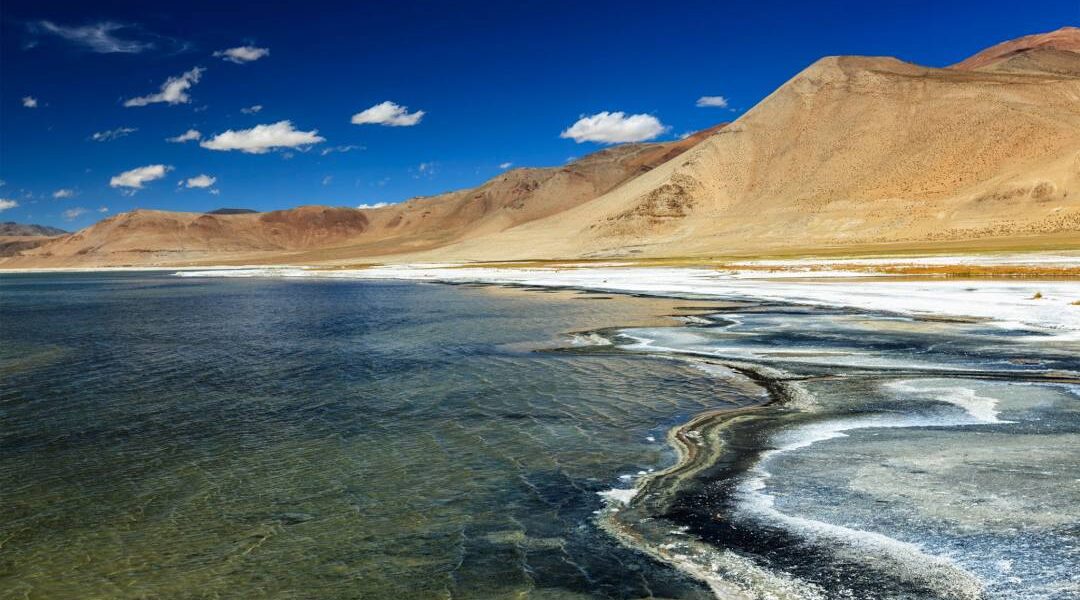
Tso Kar arrives with a change in the ground. The soil begins to look paler, and the light sharpens in a way that makes distances deceptive. As you approach, salt appears first as a faint crust, then as a clear rim—white against brown, like a line drawn around the lake with chalk. The air near salt water has a slight tang, subtle but present. Wind carries fine dust that clings to lips and collects at the corners of the mouth. It is the sort of dryness that makes you aware of your own skin as a surface.
At the lake’s edge, the flatness can feel almost unsettling after days of slopes and ridges. The horizon becomes a clean line. Small waves, driven by wind, break against a shore that looks brittle. Birdlife is often the most sudden movement here. A dark shape lifts from the pale ground; a call cuts through the air; then quiet returns. On the plateau, even a single bird can feel like punctuation.
There is a temptation to treat Tso Kar as a destination, to rest in the idea of having “arrived” somewhere recognisable. But on this trek, the lake is a middle. It gives you a new register of colour—white salt, pale water, a faint green patch of grass—and then it sends you onwards into higher, drier spaces. The kettle boils. Tea is poured. The wind continues to press at clothing and tents. You learn that comfort here is brief and that briefness does not make it less valuable.
Rupshu’s sparse human presence
Near Tso Kar, you may pass settlements that look minimal from a distance: a few low structures, a pen for animals, a line of prayer flags that makes the wind visible. Nuruchen and nearby areas can feel like outposts rather than villages, and yet they are part of a working world. Herding changes the meaning of “empty land.” A slope that seems unused from far away might be a pasture; a dry basin might be a route for moving animals; a small stream might be the centre of someone’s daily calculation.
People here often read weather with a directness that makes city forecasts feel theatrical. A cloud line over a ridge can change a day’s plan. Wind direction matters. The look of snow on a distant pass can decide whether a caravan moves. For a walker, this knowledge is humbling. You arrive with your own schedule and then realise that the plateau has already set terms.
Practical information slips into your mind not as a list but as repeated observation: you need more water than you think; you need to protect lips and hands; you need to keep layers close because sun and wind can change quickly; you need to eat even when appetite is poor. These are not travel tips in the abstract. They are what the day requires, and the day is precise about it.
Pastures with a pulse: Changpa country
Black tents, smoke, and butter tea
As you move deeper into the Changthang, the landscape begins to show a different kind of life. The first hint may be a line of animals in the distance—small dark dots that resolve into goats or yaks as you draw nearer. Then a tent appears, low and dark against the pale ground. Changpa tents, made of thick yak hair, have a distinct texture: coarse, matte, and heavy-looking, as if designed to hold its place against weather.
If you are invited closer, the first thing you notice is smoke. It clings to fabric and hair, a smell that is not unpleasant but persistent, the scent of warmth in a dry world. Inside or near the entrance, the air is warmer, and the warmth has a weight to it. Butter tea is offered in a cup that may be chipped or stained from long use. The tea carries salt and fat, and it coats the mouth. It is functional, not decorative; it answers the cold and the exertion in the simplest way.
Hospitality here can be quiet, expressed in gestures rather than elaborate conversation. A place to sit, a cup placed in the hand, a brief glance at the sky to judge what comes next. Animals remain the centre of attention. A herder’s eyes follow the movement of goats with the concentration of someone watching a fire: not tense, but alert. The working world is visible in small repairs—ropes, cloth, a pot soot-blackened at the bottom, a ladle with a smooth handle worn by years of hands.
Respectful distance
Walking through pastoral land changes the relationship between traveller and landscape. The plateau is not a blank stage. It is a place with routines and risks. Gates may need to be closed. Camps must be chosen carefully so as not to disturb grazing areas or water sources. The principle is simple: leave little behind, take little space. Yet it is easy to fail without meaning to. A loud voice carries far in thin air. A careless footprint can damage fragile ground that takes a long time to recover. Even the act of washing near a stream is charged with consequence when water is scarce.
The trek’s quiet practicality becomes a kind of courtesy. You begin to pack waste with the same seriousness as you pack food. You stop stepping on grass patches because they are rare and therefore precious to someone else. You learn to accept that some encounters will be brief: a nod, a word, a shared look at an animal, then movement continues. The trek is a corridor through another life, and corridors are not places to linger without invitation.
Over time, the Changthang’s scale becomes less abstract. You begin to recognise the difference between a valley that holds water and one that only appears to. You learn the look of ground that will cut your tent floor and the look of ground that will hold it safely. You learn that wind can change a night, and that a properly closed zipper matters as much as a romantic view.
Days that turn into a single rhythm
The long quiet between the two lakes
At a certain point, the trek stops feeling like a sequence of days and starts feeling like one long day with pauses. Morning begins with the same small sounds: fabric, zips, the clink of metal. Fingers are slower in cold. Breath appears briefly in the air. The first step out of the tent always carries a slight shock: the ground is colder than expected, the air thinner than remembered, the sky already bright.
Walking becomes repetitive in the best sense. Repetition removes drama. It leaves room for attention. You notice the grain of stone: some slopes are made of loose shale that slides underfoot; others are firm with small rounded pebbles that behave like marbles. You notice how the sun warms one side of a valley while the other remains in shade. You notice the scent of your own clothing changing as dust and smoke and sweat settle into fabric. You notice that thirst is not a single feeling but a steady condition that you manage rather than cure.
There are moments when the plateau seems to offer a small gift. A patch of flowers at an altitude where you would not expect softness. A calm pocket of air where wind has been constant for days. A stream so clear you can see the stones under water and the slight tremble of light. These moments are not presented with ceremony. They appear, and then they are gone as the path turns.
Practicality continues to thread through everything. You eat because you must, not because food is exciting. You check the sky because it matters, not because it is picturesque. You keep a layer accessible because wind can return suddenly. The body learns not to argue. It simply proceeds.
Small wonders that feel oversized
On an ordinary European trail, a lone yak would be an event, a photograph, a story told later. Here, animals are part of the day’s texture. Their bells can be heard in the distance, a dull, irregular sound that does not resemble the tidy ring of church bells at home. Hoofprints appear stamped into dust like a language. Sometimes you find a tuft of hair caught on a thorn or a stone, a small trace of movement that has already passed.
Light changes the look of everything. In the morning, the plateau can appear almost flat and gentle, softened by cool air. By midday, shadows sharpen and the ground looks more severe. In late afternoon, the colour warms slightly and stones take on a faint copper tone. A ridge that looked close at noon still looks close at five, and then you learn that closeness is not measured by sight but by step.
Even the simplest domestic objects take on prominence: a mug becomes precious; a scarf becomes a barrier against dust; a small tin of balm becomes the difference between comfort and cracked skin. These are the real trophies of the trek. They are not displayed, but they are used constantly.
The last high pass: Yalung Nyau La
Upward in thin increments
Yalung Nyau La is often named as the highest point on the Rumtse to Tso Moriri trek, and walkers carry that fact in their minds long before they reach it. Yet in the hours of climbing, the number matters less than the steady work. The slope may not look dramatic from far away. Up close, it asks for patience. The air is thin enough that you can hear breath as a sound separate from thought. Each pause feels necessary, not indulgent.
As you climb, the landscape becomes even more stripped. Grass disappears in places. The ground turns to scree and compacted dirt. Stones slide underfoot. Hands may briefly touch the slope for balance, and the stone feels cold even in sun, as if it holds night inside it. At breaks, people look down at their boots, not out at the view. The view can wait. The body is the immediate terrain.
Near the top, prayer flags appear again, and the wind grows louder. Faces look pale under sun and dust. Someone’s lips may be visibly cracked. A person who has been quiet all day may suddenly cough and then wave it away. These are small, ordinary signs, but on a high pass they become significant. At the crest, there is often a brief stillness. The world opens in all directions, and the scale is difficult to convert into language. Most people do not try. They stand, adjust gloves, take a quick photograph, and begin to descend.
The descent that asks for patience
If climbing is slow, descending can be slower. The ground may be loose and angled, and the path can feel narrow or indistinct. On some slopes, scree behaves like water: it moves under you and forces short, careful steps. On others, stones are stable but sharp, and you become aware of how much trust you have placed in your boot soles.
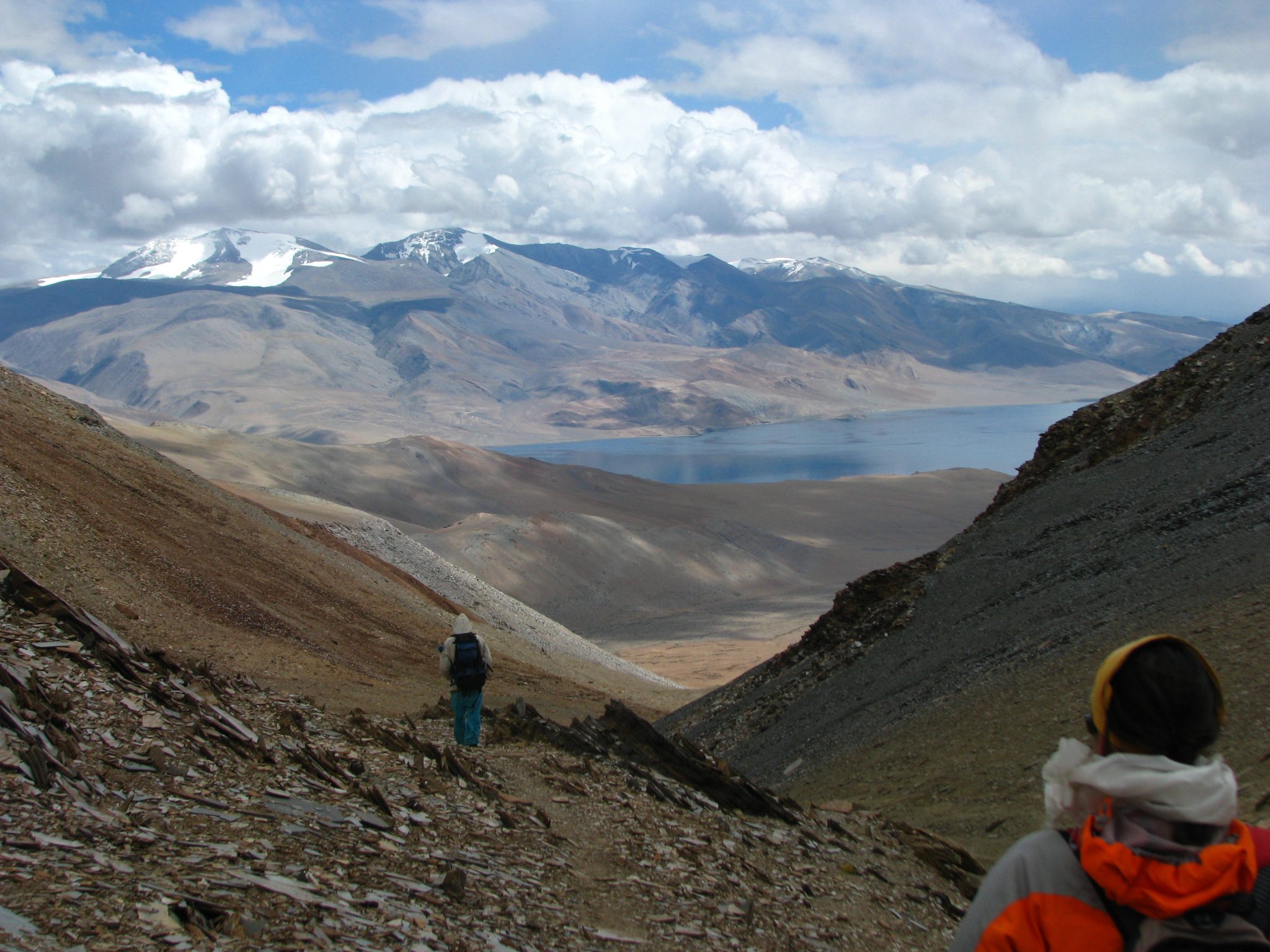
Distance plays a particular trick here. The lake you have been promised—Tso Moriri—may seem to appear in flashes between ridges, a strip of blue that looks close. Then the path turns, and the strip vanishes, and hours pass. Concentration narrows to the next safe step. Poles tap and sink into gravel. Knees begin to speak. The body’s complaints are not dramatic; they are factual. You learn to respond with small adjustments: tighten a strap, loosen a boot, take a mouthful of water, keep moving.
At lower altitude, fatigue often comes as a heavy blanket. Here it can come as dryness—dry mouth, dry throat, dry skin—and as the slow stiffening of muscles in cold wind. You arrive at camp with dust on eyelashes and grit in the seams of socks. The act of removing boots can feel like a small release. Feet are inspected in silence. A blister is not a tragedy, but it is a task. A cup of tea is not romantic, but it is immediate relief.
Tso Moriri appearing without ceremony
The first blue after days of austere tones
When Tso Moriri finally holds its place in view, it is not framed like a postcard. It appears as a real body of water at altitude, broad and still, the colour deepening with the angle of light. After days of stone, dust, and pale grass, the blue can feel almost intimate. The shore is not soft. The air remains dry. Wind still moves. Yet the presence of water changes the temperature of the mind. You stop thinking only in terms of passes and camps and begin to notice small domestic details again: how a strap sits on the shoulder, how heavy a pack feels now that you know it will soon come off for good.
The approach to the lake can be long and quiet. The ground becomes flatter in places. The path may pass near streams that feed the lake, where the water is cold enough to numb fingers quickly. If you wash your face, the skin tightens at once, and the dryness returns within minutes. You can smell damp earth briefly near the water—rare on this trek—and then it disappears again into the prevailing dust and stone.
The primary keyword, Rumtse to Tso Moriri trek, belongs here not as a label but as a fact. This is what the route does: it takes you from a roadhead near Leh into the Changthang’s open distances, past salt at Tso Kar, over high passes including Yalung Nyau La, and finally down to a lake that sits beside a village where life continues at altitude without theatricality.
Korzok, ordinary life at an extraordinary shore
Korzok does not present itself as a triumphant finish line. It is a village with the familiar signs of settlement: low buildings, smoke from kitchens, dogs sleeping in sun, children’s voices carried by wind. If you arrive in the afternoon, you may see laundry laid out to dry, fabric fluttering stiffly. The air is clear enough to make distances sharp, and yet the village feels close, contained, arranged around daily needs.
The monastery stands above, a reminder that prayer and work share the same weather. People move at a pace that suggests they have long accepted altitude as a condition rather than an achievement. Visitors come and go. Animals are still counted. Water is still valued. The lake is present beside all of it, and the village behaves as if this is ordinary, which in a way it is—ordinary life, simply placed at 4,500 metres.
After days of tents, Korzok’s small comforts can feel almost excessive: a sheltered corner out of wind, a cup that is filled without being asked, a floor that does not tilt under your sleeping bag. Yet the trek does not end with a grand statement. It ends with the practical acts that follow arrival: washing dust from hands, hanging socks where they will dry, sitting down without needing to stand again for a while. The plateau continues outside, unaltered by your passage.
Sidonie Morel is the narrative voice behind Life on the Planet Ladakh,
a storytelling collective exploring the silence, culture, and resilience of Himalayan life.